What Is RTCP? How Real-Time Control Protocol Helps Monitor Voice Quality
Learn what RTCP is, how it works alongside RTP, and how it helps monitor jitter, packet loss, latency, and call quality in real-time voice systems.
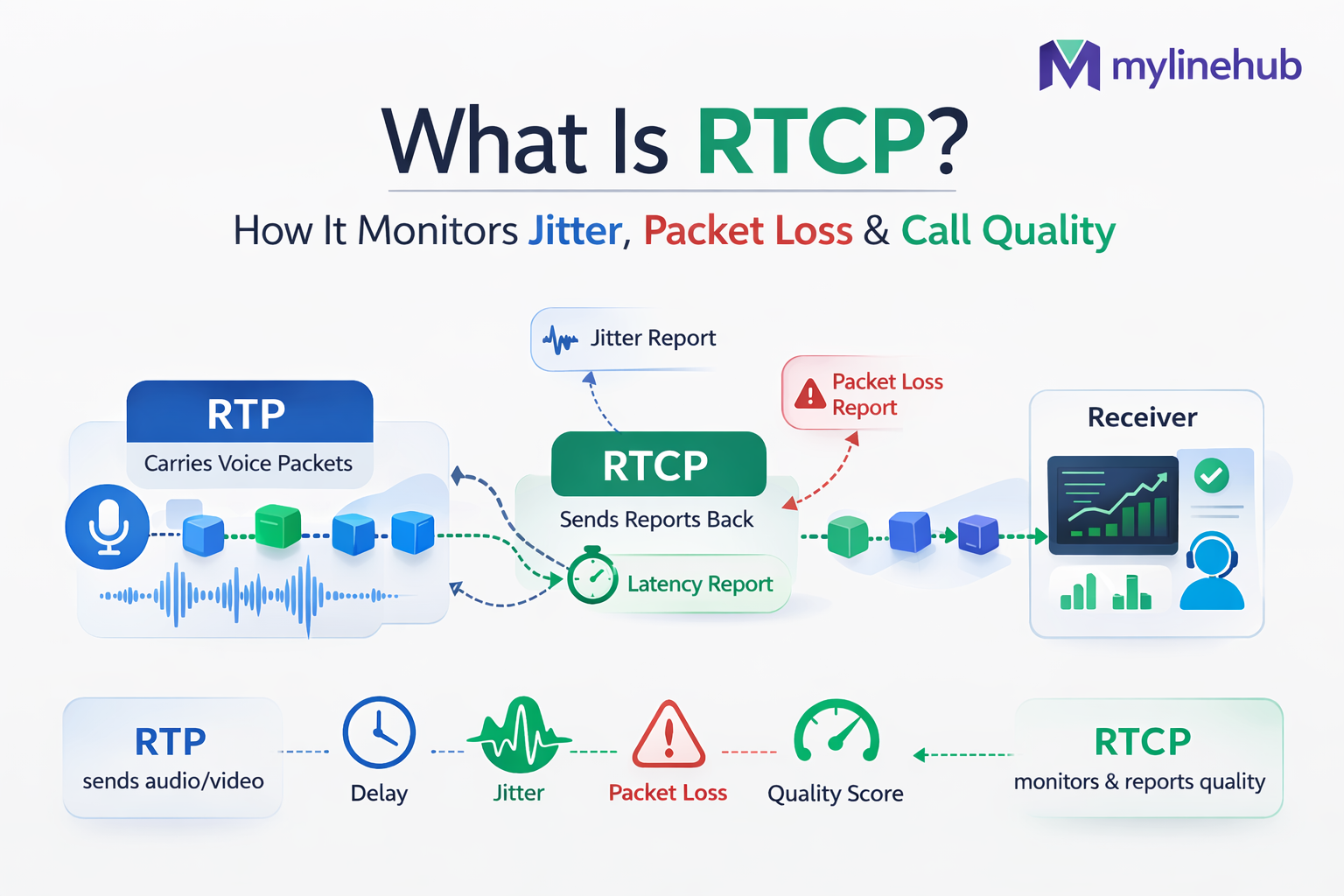
🌐 Start with a simple comparison
Imagine a transport company sending trucks full of goods from one city to another.
The trucks carrying the goods are like RTP packets.
The quality/control reports telling you “some trucks were late”, “some never arrived”, or “delivery timing is unstable” are like RTCP packets.
• RTP carries the live media
• RTCP reports how well that media is being delivered
That simple distinction is the foundation for understanding RTCP properly.
🧠 What RTCP is really doing
RTCP is often described as a “control protocol”, but that can sound vague. In real terms, RTCP helps a media system do four important jobs:
1) Quality reporting
It reports packet loss, jitter, sequence progress, and timing-related quality information.
2) Sender/receiver statistics
It allows endpoints to exchange counts, timing references, and receiver observations about the media stream.
3) Stream/source identity
It helps identify and describe participating sources with items like SSRC and CNAME.
4) Synchronization support
It helps correlate RTP timestamps to real clock time, which is especially important for audio/video synchronization.
🎙️ Why RTP alone is not enough
RTP is built for real-time delivery. It includes sequence numbers and timestamps, which help a receiver order packets and play them correctly. But RTP by itself does not tell the sender:
• how many packets were lost on the way
• whether packets are arriving with unstable timing
• whether playback quality is getting worse
• how the remote side sees the stream
• how to map stream timing to wall-clock timing for sync
Without RTCP, a sender can keep transmitting RTP continuously but have very limited visibility into what the receiver is actually experiencing.
So RTCP exists to provide feedback, monitoring, identification, and synchronization support.
🔗 How RTP and RTCP are associated
RTP and RTCP are a pair. They are part of the same real-time media system.
Traditionally:
• RTP uses one UDP port
• RTCP uses the next UDP port
Example:
• RTP on port 4000
• RTCP on port 4001
In many modern systems, especially WebRTC, RTP and RTCP can also be multiplexed on the same port using rtcp-mux.
That means the logical role stays separate, even if the transport path is shared.
🧾 What information RTCP usually carries
RTCP is not one single message. It is a family of related control/report packet types.
Common RTCP functions include:
• reporting packet loss
• reporting jitter
• reporting sender/receiver timing data
• identifying sources with SSRC / CNAME information
• supporting audio/video synchronization
• sending feedback for media control in advanced setups
RTCP is less about “starting the session” and more about session health, source identity, timing visibility, and media feedback intelligence.
📘 The main RTCP packet types
| RTCP type | What it means | Main purpose | Why it matters |
|---|---|---|---|
| SR (Sender Report) | Sent by active sender | Reports packet/octet counts and timing mapping | Useful for synchronization and sender-side visibility |
| RR (Receiver Report) | Sent by receiver | Reports loss, jitter, sequence tracking | Tells sender how stream quality looks remotely |
| SDES | Source description | Carries CNAME and source identity metadata | Helps identify/media-correlate participants and sources |
| BYE | Source leaving session | Signals end of participation | Useful in session cleanup/participant tracking |
| APP | Application-specific | Custom application data | Lets applications extend behavior |
In modern multimedia systems, additional feedback styles such as NACK, PLI, FIR, transport feedback, and bitrate-related feedback are often discussed as RTCP-based feedback extensions.
📊 What do packet loss, jitter, and delay mean here?
RTCP becomes powerful because it turns vague media complaints into structured quality information.
1) Packet loss
Some RTP packets never reached the receiver. This can cause clipped syllables, robotic sound, brief silence gaps, or broken speech continuity.
2) Jitter
Packets arrive with inconsistent timing. Even if most packets arrive, uneven arrival spacing can hurt smooth playback and stress the jitter buffer.
3) Delay / round-trip timing
RTCP timing fields help estimate reporting delay and round-trip style timing visibility, which is useful for troubleshooting and sync logic.
RTP gives the stream. RTCP tells you whether the stream is staying healthy enough for real-time conversation.
🧪 Why these metrics matter to users
| RTCP observation | What users may hear/see | Likely class of issue |
|---|---|---|
| Rising packet loss | Broken words, gaps, robotic voice | Network congestion, drops, unstable path |
| High jitter | Uneven speech, bursts, glitchy playback | Timing instability, queue variation, network burstiness |
| Growing delay indicators | Conversation feels laggy or awkward | Long path, buffering, route issues |
| Bad sync mapping | Lip sync drift in audio/video | Timing correlation/sync problem |
📦 A conceptual RTCP Sender Report example
An RTCP Sender Report gives both sender statistics and timing correlation information.
RTCP Sender Report (conceptual fields)

Version: 2
Packet Type: SR
SSRC: 0x13AF9021

Sender Info:
  NTP Timestamp: 3965221001.1234
  RTP Timestamp: 284712992
  Sender's Packet Count: 18234
  Sender's Octet Count: 2917440

Report Block:
  Fraction Lost: 2/256
  Cumulative Packets Lost: 37
  Extended Highest Sequence Number: 42871
  Interarrival Jitter: 14
  Last SR Timestamp: ...
  Delay Since Last SR: ...
This looks very different from RTP payload packets. RTCP is about status, counters, timing relationships, and receiver observations.
A sender report is especially useful because it gives both how much was sent and how that stream timeline maps to real time.
📥 A conceptual RTCP Receiver Report example
A Receiver Report is often what people care about most in troubleshooting, because it tells the sender what the receiver is actually seeing.
RTCP Receiver Report (conceptual fields)

Version: 2
Packet Type: RR
SSRC of Receiver: 0x66B12002

Report Block for Source 0x13AF9021:
  Fraction Lost: 6/256
  Cumulative Packets Lost: 148
  Extended Highest Sequence Number: 52244
  Interarrival Jitter: 31
  Last SR Timestamp: ...
  Delay Since Last SR: ...
That gives the sender concrete evidence that the stream is not arriving perfectly, instead of forcing the system to guess from user complaints alone.
⏱️ Why sender reports matter for synchronization
One advanced and very important use of RTCP is synchronization.
RTP timestamps are stream-local timing values. They are useful for media playback order and timing, but they are not directly the same as wall-clock time.
RTCP Sender Reports provide a mapping between:
• NTP time → real clock reference
• RTP timestamp → stream playback timeline
That mapping is especially useful when synchronizing audio and video from the same source.
🔁 RTCP feedback in modern systems
In more advanced real-time systems, RTCP is not limited to passive statistics. It can also support feedback-driven media behavior.
| Feedback item | What it means | Why systems use it |
|---|---|---|
| NACK | Negative acknowledgment for missing packets | Can help trigger retransmission logic in suitable systems |
| PLI | Picture Loss Indication | Requests a new clean reference frame in video |
| FIR | Full Intra Request | Used when a fresh keyframe is needed |
| Transport feedback | More detailed path/arrival feedback | Useful for congestion adaptation and bitrate logic |
This is one reason RTCP matters even more in video and browser-based communication stacks: it can influence how the media engine reacts to current network conditions.
🛠️ How RTCP helps in real troubleshooting
RTCP is extremely useful when media exists but quality is poor.
Example 1: Choppy audio
RTCP may show rising jitter or packet loss. That tells you the problem is likely in media transport quality, not call setup.
Example 2: One-way quality problems
One side may report much higher loss than the other. That often points to directional network trouble rather than a symmetric issue.
Example 3: Audio/video sync drift
RTCP sender timing helps correlate streams and diagnose synchronization behavior.
Example 4: Video quality recovery
RTCP feedback like PLI or FIR may explain why a video sender transmits a fresh keyframe after stream damage.
In short: SIP tells you whether the session was established, RTP tells you media is flowing, RTCP tells you how well that media is flowing.
🆚 RTCP vs RTP vs SIP vs SDP
| Protocol / format | Main job | Carries live voice? | Easy memory line |
|---|---|---|---|
| SIP | Session signaling | No | “Let’s set up the call.” |
| SDP | Media description | No | “Here is how media should work.” |
| RTP | Media transport | Yes | “Here is the actual voice/video.” |
| RTCP | Media control/reporting | No | “Here is how the media is performing.” |
⚠️ Common misunderstandings about RTCP
❌ “RTCP carries the actual voice”
No. RTP carries the voice. RTCP carries reports and control-related information about that RTP stream.
❌ “RTCP replaces RTP”
No. RTCP exists because RTP needs a feedback companion. It complements RTP rather than replacing it.
❌ “If RTCP exists, quality will automatically improve”
No. RTCP reports quality and can support adaptive behavior, but it is not magic repair traffic by itself.
❌ “RTCP is only for video calls”
No. It matters for audio-only VoIP too, especially for quality monitoring and stream visibility.
❌ “RTCP is part of SIP signaling”
No. RTCP belongs with RTP in the media/control side, not in SIP signaling.
🔐 RTCP in secure systems
In secure media environments such as SRTP and WebRTC-based systems, RTCP can also be protected.
• RTP becomes SRTP
• RTCP becomes SRTCP in secure handling contexts
The role remains the same. The difference is that the control traffic is now protected as part of the secure media environment.
🪜 Beginner → advanced understanding ladder
Beginner level
RTP carries the voice. RTCP reports how good or bad that RTP delivery looks.
Intermediate level
RTCP packets report loss, jitter, timing, source information, and sender/receiver statistics. They help systems understand media health and stream behavior.
Advanced level
RTCP is essential for stream monitoring, synchronization, source description, and feedback-driven behavior. It complements RTP by giving control-plane visibility over real-time media performance without replacing the media stream itself.
Expert mindset
When media quality issues appear, do not only ask whether RTP exists. Ask what RTCP says about that RTP path: loss pattern, jitter trend, timing quality, source behavior, and whether the stream can stay usable in real time.
❓ Quick FAQ
Does RTCP improve call quality by itself?
Not directly. RTCP provides visibility and, in some systems, feedback that can support adaptation. But it is not the media payload.
Is RTCP optional?
Different systems handle it differently, but conceptually it is the companion protocol that provides quality and control visibility for RTP sessions.
Why do engineers care about RTCP logs?
Because RTCP helps translate user complaints like “audio is breaking” into measurable transport-quality symptoms.
What is the cleanest memory line?
RTP says “here is the media.” RTCP says “here is how the media is performing.”
✅ Final takeaway
If you want the cleanest summary:
RTP says: “Here is the live media.”
RTCP says: “Here is how that live media is performing.”
Once you understand that difference, VoIP quality troubleshooting becomes much clearer. You stop treating all problems as “audio issues” and start separating them into: media flow, media quality, timing/sync, and feedback/control.
That is exactly where RTCP becomes valuable: it gives the media stream a way to describe its own health. 🎯
Want to see API-driven CRM + Telecom workflows in action? Try the WhatsApp bot or explore the demos.
Comments (0)
Be the first to comment.