How a Multi-Level IVR Works
A multi-level IVR uses one voice menu to lead into another. The first level handles a broad choice—such as sales, support, or locations—while a second level handles a narrower decision, such as new orders versus existing orders.
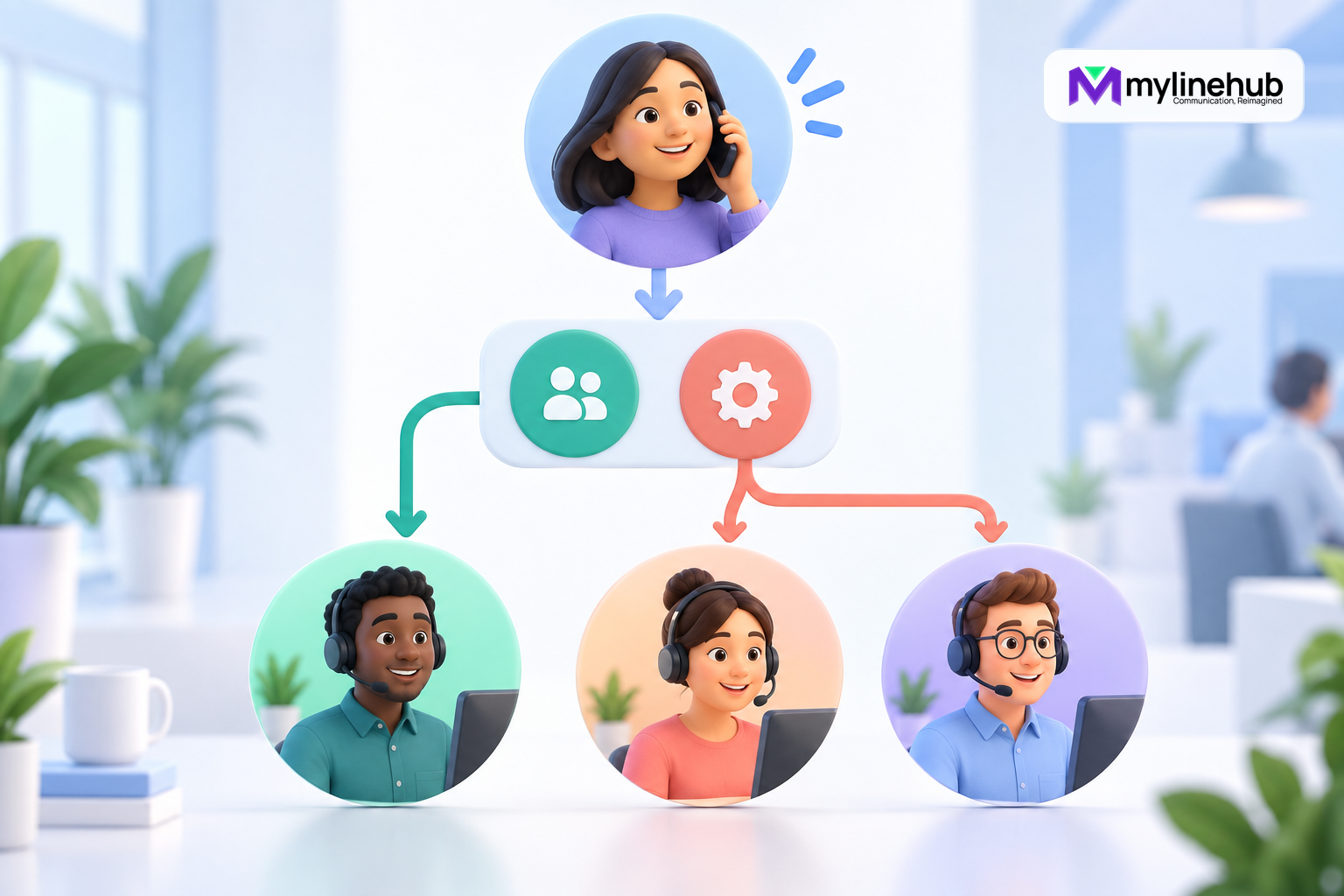
A multi-level IVR uses one voice menu to lead into another. The first level handles a broad choice—such as sales, support, or locations—while a second level handles a narrower decision, such as new orders versus existing orders. Each keypad selection moves through a predefined tree until the call reaches a real destination or a controlled fallback. This structure can make a complex organisation easier to navigate, but it can also create long prompts, loops, and outdated branches. A small business should use multiple levels only when one short menu cannot express stable customer choices. MYLO can support bounded IVR configuration and verification on the appliance; the business still owns prompt content, destinations, schedules, privacy, staffing, provider service, and the decision to introduce complexity.
The Basic Call Flow
- The provider delivers the public DID to the PBX.
- The inbound route checks the active schedule and selects the root IVR.
- The root prompt offers broad, customer-understandable choices.
- A valid digit sends the call to a destination or a child IVR.
- The child IVR offers a smaller set of choices within that category.
- The final selection reaches an extension, ring group, queue, voicemail, or approved external route.
- No input, invalid input, unavailable destinations, and closed conditions use explicit fallback rules.
The telephony engine evaluates these branches deterministically. An AI model should not decide the next path during every live call. MYLO’s role is to help an authorised person define and safely manage a supported configuration.
Root Menus and Child Menus
The root menu is the caller’s first decision. It should contain the broadest stable categories and as few options as practical. A child menu should exist only when the selected category still contains a meaningful choice. For example, the root may offer “sales” and “support”; the support child may offer “product help” and “account access.”
Every menu needs a unique purpose, prompt, allowed digits, timeout, invalid-input rule, retry limit, and fallback. It also needs a way back or forward that does not trap the caller. Reusing one child menu from several parents may be efficient, but its wording must still make sense in every context.
When Multiple Levels Are Justified
- One number serves several branches, and each branch has distinct departments.
- A genuine language choice must precede equivalent service choices.
- Support has stable product categories owned by different trained teams.
- A central number serves several brands with separate destinations.
- Regulated or contractual workflows require a clearly approved branch.
Multiple levels are not justified merely because the PBX can build them. If callers frequently choose the wrong option, if staff transfer calls anyway, or if branches change every month, direct numbers, a receptionist, or a simpler menu may work better.
Example: A Business With Two Locations
A service company has north and south offices under one public number. The root menu asks the caller to choose a location. Each location’s child menu offers new bookings, existing-job support, and reception. During open hours, bookings and support reach separate groups. Reception is the no-input fallback. During closed hours, the root menu is bypassed and the caller hears a central message with an owned voicemail option.
This tree has a business reason at every branch. The company avoids a third level. If a caller chooses the wrong location, staff can transfer the call. The company tests both locations, every digit, no input, invalid digits, all final destinations, holiday schedules, two-way audio, and failure fallbacks.
Design the Tree Before Recording Audio
Draw the call flow using plain labels. For each node, record its owner, prompt, digits, children, final destinations, hours, timeout, retry count, invalid route, no-input route, and failure route. Confirm that all referenced extensions, groups, queues, and recordings exist or will be created in the correct order.
Review the diagram with the people who answer calls. Walk through common and unusual journeys. Remove repeated information, duplicate branches, and internal terms. Only then write and record prompts. Recording too early makes teams reluctant to simplify because audio has already been produced.
Prevent Loops and Dead Ends
A caller should not bounce forever between parent and child menus. Set bounded retries. Decide whether a repeated failure reaches reception, voicemail, a clear final message, or hangup. A “go back” option can help, but it should return to a known parent rather than creating an ambiguous cycle.
Final destinations also fail. An extension can be offline, a queue can have no agents, or an external number can be unreachable. Each terminal branch needs a no-answer or unavailable outcome. Validation should detect references to missing destinations before deployment, but live availability still requires runtime handling.
Prompt and DTMF Quality
Each prompt should announce only the choices available at that level. Use consistent voice, volume, terminology, and digit order. Let callers enter a digit at the appropriate time, and avoid long introductions at every child menu. If legal or privacy notices are necessary, place them deliberately and keep approved wording current.
DTMF may behave differently across providers and endpoints. Test the complete external path using relevant mobile and fixed networks. Menu playback, digit recognition, and media are related parts of the experience but distinct diagnostic signals. A prompt that plays does not prove digits will be received correctly.
Schedules in a Menu Tree
A root schedule can switch the entire tree between open and closed behaviour. Some child destinations may also have different hours. Use nested schedules carefully: too many independent time rules make the caller journey difficult to predict. Document which schedule has authority at each point.
Include holidays and temporary closures, and establish safe defaults. If only one branch closes early, its prompt and fallback must remain truthful while the rest of the tree is open. Calendar maintenance needs a named owner and pre-holiday testing.
How MYLO Supports a Multi-Level IVR
MYLO can guide an administrator through gathering the tree, prompt references, destinations, schedules, and fallbacks. Supported changes can be validated as a whole so a missing child or invalid destination does not leave a partially deployed tree. Approval, backup, targeted reload, and deterministic verification protect consequential configuration work.
Asterisk remains responsible for live IVR execution and evidence. The provider supplies the DID, trunk, channels, signalling, and media service. The business supplies accurate content, authorised recordings, staffing, policies, devices, network readiness, and lawful data handling. A custom database lookup, CRM action, payment workflow, or specialised speech application may sit outside the standard MYLO appliance boundary and require separate engineering.
Testing the Complete Tree
Create a test matrix with one row for every path. Include each valid digit, no input, invalid input, retry exhaustion, back navigation, each final destination, destination busy, destination unavailable, open hours, closed hours, holidays, and provider or channel failure where practical. Test caller ID, two-way audio, recording behaviour if authorised, and hangup.
Use external calls, not only internal extension tests. Review live evidence when a path fails and classify whether the issue is provider delivery, DID match, menu logic, DTMF, destination state, or media. This prevents unrelated configuration changes and produces a more trustworthy release decision.
Documenting and Reviewing the Tree
Keep a human-readable map beside the deployed configuration. Give every menu and destination a stable name, describe its purpose, and record the business owner. Note prompt files, schedule dependencies, expected digits, retry rules, and the last successful test. This document is not the live telephony authority, but it helps reviewers understand intent and compare that intent with current evidence.
Review changes from both directions. A top-down review asks whether every root choice reaches a valid outcome. A bottom-up review asks whether every extension, group, queue, recording, and schedule referenced by the tree still exists and is owned. This catches orphaned branches and destinations that remain technically present after the business stopped using them.
Set a complexity threshold. If callers routinely traverse more than two menus, if the tree cannot fit on a readable page, or if testing requires knowledge held by one person, consider separate DIDs or a redesigned service structure. Complexity may reflect the organisation rather than customer need. Telephony should not expose every internal distinction.
Use call evidence to guide review while respecting privacy. Repeated invalid entries, early abandonment, and frequent transfers suggest unclear choices. Validate any interpretation with staff and customer context before changing the route. A measured improvement should reduce effort without removing a path that a smaller but important caller group depends on.
Multi-Level IVR Checklist
- Confirm that a second level solves a documented caller problem.
- Draw every root, child, terminal destination, and fallback.
- Use customer-facing labels and keep each menu short.
- Define digits, timeout, invalid input, no input, and retry limits at every node.
- Prevent loops and provide a controlled exit from every branch.
- Validate destination references and deployment order.
- Document schedule authority, holidays, and temporary closures.
- Approve prompt content, audio files, privacy, and recording policy.
- Test every path through the external provider.
- Assign an owner and review the tree when the organisation changes.
A multi-level IVR should make a complex organisation feel simpler to the caller. If the tree makes the caller learn the organisation, it needs redesign. Start with the principles in the small-business IVR decision guide, then add only the levels that have a stable and testable purpose.
Continue planning
Continue with How Can a Small Business Set Up an Inbound Support Number?; IVR vs Queue vs Ring Group: A Business Explanation; How to Write Better IVR Greetings and Voice Prompts. For deeper implementation context, use MyLineHub technical architecture guidance.
For a requirement outside the prepared MYLO scope, discuss the exact outcome with MyLineHub.
Want to see API-driven CRM + Telecom workflows in action? Try the WhatsApp bot or explore the demos.
Comments (0)
Be the first to comment.