IVR vs Queue vs Ring Group: A Business Explanation
An IVR, a queue, and a ring group solve different business problems. An IVR asks the caller to choose a route. A ring group tries several people as one destination.
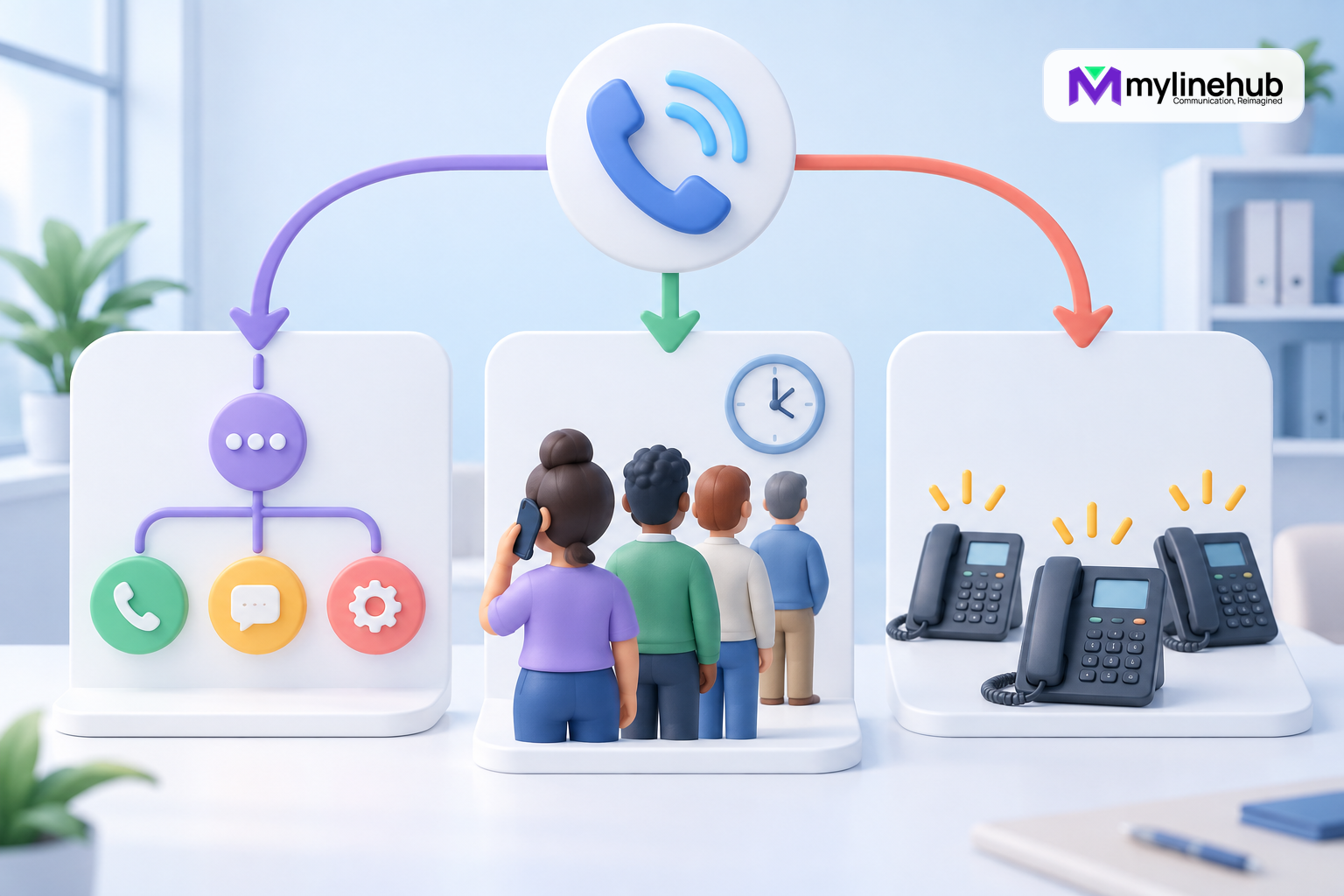
An IVR, a queue, and a ring group solve different business problems. An IVR asks the caller to choose a route. A ring group tries several people as one destination. A queue holds callers and distributes them to available agents using defined rules. They can be combined, but they are not interchangeable. A small team may need only a ring group. A support desk with regular waiting may need a queue. A company with clearly separate departments may put an IVR in front of either one. Choosing the simplest mechanism that fits real demand reduces caller delay and maintenance. MYLO can guide supported configuration, but the business must define its teams, hours, service expectations, fallback behaviour, privacy policy, and provider capacity.
IVR: Let the Caller Choose a Path
Interactive voice response plays a prompt and reacts to keypad input. Its purpose is classification. A caller might choose sales, support, or accounts; a language; or a location. A valid option can lead to an extension, ring group, queue, another menu, voicemail, or an approved external destination.
IVR is useful when callers understand the categories and those categories lead to genuinely different workflows. It is less useful when every choice ends with the same people. The design also needs timeout, invalid-input, retry, and destination-failure rules. External DTMF must be tested through the provider path.
Ring Group: Try a Small Team Together
A ring group treats several extensions as one destination. Depending on the design, all members may ring together or a sequence may be attempted. It is well suited to a small sales desk, reception team, or shared service function where any member can handle the call.
A ring group usually does not provide the same caller-waiting and agent-distribution controls as a queue. If every member is busy, the group must have an explicit timeout and fallback. Excessively long simultaneous ringing can distract staff and still leave the caller without a clear outcome.
Queue: Manage Callers Waiting for Agents
A queue places callers into a managed waiting flow and offers calls to eligible agents under configured rules. It can suit support, booking, or contact-centre work where several callers may wait and staff availability changes. The organisation needs to decide membership, distribution strategy, announcements, maximum wait, overflow, pause behaviour, and reporting ownership.
A queue does not create staffing capacity. It makes waiting orderly, but a queue with too few agents can increase abandonment and frustration. Music or periodic messages should not conceal unrealistic wait times. The business should measure demand, answer performance, and outcomes, then adjust people and process as well as configuration.
Business Comparison
| Question | IVR | Ring group | Queue |
|---|---|---|---|
| Main purpose | Classify and route | Reach one of a small team | Manage waiting and distribution |
| Caller action | Selects an option | Waits for answer | Waits in an ordered flow |
| Best fit | Distinct departments or services | Low-volume shared coverage | Repeated periods of agent contention |
| Main risk | Confusing or deep menus | No structured waiting | Using technology instead of adequate staffing |
| Critical fallback | No/invalid input | No answer or all busy | Maximum wait or no agents |
How the Components Can Work Together
A common design uses an IVR to identify sales or support. Sales may go to a ring group because three employees can answer any enquiry and volume is low. Support may go to a queue because several callers sometimes wait for trained agents. Reception can remain the fallback for invalid input during open hours.
Combining components increases the number of states to test. The IVR needs digit and timeout behaviour; the ring group needs no-answer behaviour; the queue needs agent-unavailable and maximum-wait behaviour. A caller should never disappear between components or cycle indefinitely.
Three Practical Scenarios
A five-person office
All employees can help callers, and volume is low. The main number rings a group, then reaches an owned voicemail. An IVR and queue would add operating work without a clear benefit.
A growing service desk
Several support calls arrive together, and agents need fair distribution. The support DID enters a queue with a defined maximum wait and overflow. Sales uses a separate ring group. No front menu is needed because separate numbers already identify intent.
A multi-department company
One public number serves sales, accounts, and technical support. A short IVR identifies the department. Sales and accounts reach ring groups; support reaches a queue. During closed hours, a schedule bypasses the open menu and sends callers to accurate information and controlled fallbacks.
Capacity and Provider Considerations
Internal users and external channels are different measures. A business may have 20 extensions but only four provider channels. Calls waiting in a queue and calls forwarded to external phones can consume carrier and appliance resources. An external forward commonly uses two external legs while bridged.
Confirm provider limits, expected peak concurrency, codec and media requirements, and how overflow behaves when capacity is exhausted. The design should protect inbound service rather than allowing a separate outbound workload to consume every available path without policy.
How MYLO Supports the Choice
MYLO can help an authorised administrator describe the desired caller experience and identify whether the supported destination should be a menu, group, or queue. It can collect members, schedules, timeouts, prompts, and fallbacks; validate references; prepare an approval-ready change; and verify loaded configuration and live evidence after execution.
The actual call remains under deterministic Asterisk execution. The provider owns external number delivery and channels. The customer owns staffing, memberships, schedules, response promises, recordings, lawful use, and network and endpoint readiness. Advanced workforce management, custom CRM distribution, or unsupported analytics may require separate implementation.
Testing Each Choice
For an IVR, test every digit, no input, invalid input, retry limits, and every destination. For a ring group, test individual member availability, all-busy, no-answer, timeout, and fallback. For a queue, test no agents, one and several agents, caller abandonment, maximum wait, overflow, announcements, and clean agent state changes.
All three require real external tests for provider delivery, caller ID, audio in both directions, hangup, and schedule behaviour. Internal extension calls are helpful diagnostics but do not prove the complete public caller journey.
Migration as the Team Grows
A business does not need to select its forever design on day one. It may begin with a ring group, add a queue when callers regularly encounter busy staff, and add an IVR only when separate services become stable. Each transition should respond to measured demand and include a new operating process, not just a configuration change.
Moving from a ring group to a queue changes staff behaviour. Agents may need to manage availability states, understand distribution, and respond to queue alerts. A supervisor may need to own membership and review waiting outcomes. If those responsibilities are absent, the queue can look sophisticated while producing worse results.
Adding an IVR creates a customer-facing taxonomy. Marketing, support, and administration should agree on the words. If a department is renamed, both recordings and destinations need review. Keep a versioned call-flow diagram and an acceptance matrix so the next change begins from current evidence rather than memory.
Conversely, simplify when volume falls or teams merge. Removing a redundant menu or queue can reduce delay and failure points. The correct architecture is the one the current organisation can operate reliably, within provider and appliance capacity, while meeting the caller’s real need.
Selection Checklist
- Do callers need to choose among genuinely different destinations?
- Can any member of a small team answer the same request?
- Do callers regularly need to wait for agents?
- What is the expected peak and provider channel capacity?
- Who owns membership and availability changes?
- What happens on invalid input, no answer, no agents, and maximum wait?
- Are open, closed, and holiday schedules defined?
- Can the team operate and test every introduced component?
- Are privacy, recording, retention, and access rules approved?
Use an IVR to classify, a ring group to share ringing, and a queue to manage waiting. Start with the smallest combination that solves the real business problem. For simple menu patterns, review five IVR designs for small businesses.
Define Acceptance Before Launch
For a ring group, acceptance should prove member order or simultaneous ringing, caller ID, timeout, all-busy behaviour, and fallback. For a queue, it should prove agent availability changes, distribution, announcements, maximum wait, no-agent behaviour, abandonment, and overflow. For an IVR, it should prove every valid digit, DTMF reception, no input, invalid input, retries, and destination failure.
Test through the public provider during open and closed schedules, not only from internal extensions. Record expected and observed outcomes with dates and responsible owners while avoiding unnecessary caller data. When components are combined, retest the full chain: a correct menu does not prove the queue works, and a working queue does not prove the carrier delivers the DID. Acceptance evidence should match the scope of the business promise.
Continue planning
Continue with How Can a Small Business Set Up an Inbound Support Number?; How to Handle Calls Outside Business Hours; How a Multi-Level IVR Works. For deeper implementation context, use MyLineHub technical architecture guidance.
For a requirement outside the prepared MYLO scope, discuss the exact outcome with MyLineHub.
Want to see API-driven CRM + Telecom workflows in action? Try the WhatsApp bot or explore the demos.
Comments (0)
Be the first to comment.