How MYLO Helps Plan an IVR Through Conversation
MYLO can help an authorised administrator plan a supported IVR by turning a business conversation into a structured, reviewable proposal.
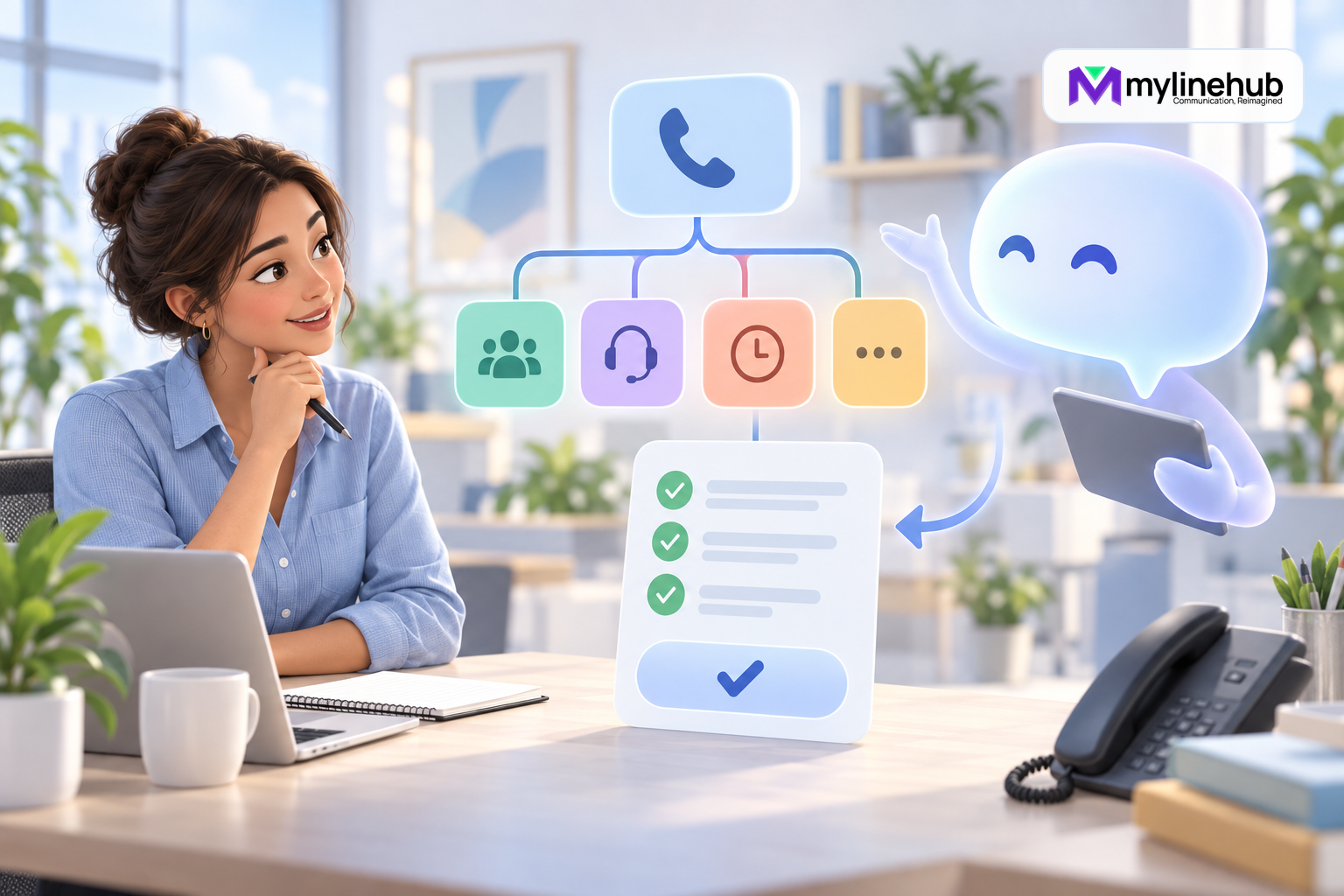
MYLO can help an authorised administrator plan a supported IVR by turning a business conversation into a structured, reviewable proposal. The person can explain who calls, why they call, when teams are available, and what should happen if nobody answers. MYLO asks for missing facts and presents the intended route in understandable terms. It does not receive a vague instruction and silently change the phone system. AI proposes, a responsible human approves, deterministic services validate and apply, and Asterisk executes the live calls.
Begin With the Business Outcome
Traditional phone-system work often begins with technical fields: contexts, destinations, time conditions, recordings, and extension lists. Those fields matter, but a business owner usually begins somewhere else: “I want appointment callers to reach reception, billing callers to reach accounts, and everyone else to have a human fallback.” MYLO’s conversational layer helps capture that intention before it is translated into an approved operation.
A useful planning conversation establishes the public number, caller groups, menu wording, destination roles, opening hours, ring time, overflow, no-answer behaviour, invalid input, no input, after-hours treatment, and any message process. It also identifies prerequisites such as provider service, endpoints, recordings, permissions, and responsible owners. Missing facts remain visible instead of being replaced with convenient guesses.
The outcome must fit the supported MYLO appliance boundary. A request involving a specialist CRM, medical workflow, payment system, unusual provider, large multi-site architecture, or bespoke application may require separate analysis and a custom MyLineHub implementation. Conversation makes the requirement easier to describe; it does not make every requirement included.
What a Planning Conversation Can Sound Like
An administrator might say: “During office hours, offer sales, support, and accounts. Sales should ring Maya and Arun for 25 seconds. If they do not answer, include reception. Support should ring the service desk. After hours, play our opening times and offer voicemail.” MYLO can separate that request into routes, groups, timing, and fallbacks, then ask targeted questions.
- Which inbound number should use this menu?
- What are the exact office hours and time zone?
- Which approved extensions belong to each group?
- What should happen on invalid or missing keypad input?
- Who owns the voicemail and how quickly is it reviewed?
- Has the greeting been approved, recorded, and checked?
- Should public holidays follow the same closed message?
These questions are not conversational decoration. Each answer closes an ambiguity that could otherwise become a failed or unsafe caller journey. If the administrator cannot identify the voicemail owner, MYLO should not invent one. If office hours are uncertain, the proposal should remain incomplete until the responsible person supplies them.
AI Proposes; It Does Not Become Telephony Authority
Language models are useful for understanding ordinary phrasing, summarising intent, explaining options, and recognising that a requirement lacks important details. They are probabilistic, which means their text is not a safe substitute for permissions, schema validation, supported-operation checks, or live-state evidence.
MYLO therefore keeps consequential execution bounded. The conversational layer produces a structured proposal rather than arbitrary configuration text. Deterministic Python services check the operation, validate fields and relationships, apply permissions and approval policy, and use controlled adapters for supported changes. Asterisk remains the authority for actual telephony configuration and call execution. Linux remains the authority for machine and network state. MYLO’s database stores the application information it owns.
A reference article, learned example, or earlier conversation may help explain a pattern, but it is not proof of the current system state. Before a proposal uses a destination, recording, trunk, or number, controlled services must obtain appropriate current evidence. This separation prevents helpful knowledge from becoming accidental authority.
The Human Approval Step
Before a consequential supported change is applied, the responsible person should see what will change in business terms: which number, which menu, which digit maps to which destination, which hours apply, how long each group rings, and what every fallback does. The review should also show unresolved prerequisites or risk-relevant effects.
Approval is meaningful only when the reviewer has authority and enough information. A receptionist may help describe the desired experience while a telephony administrator or business owner approves the route. Privacy-sensitive recording, external forwarding, or access changes may require additional review under organisational policy. Approval should be attributable and recorded; it should not be inferred from silence.
If the proposal is wrong, the user returns to the conversation and corrects it. The system should regenerate or amend the proposal before approval rather than applying the change and hoping to repair it later. A preview is a decision surface, not merely a friendly summary.
Deterministic Validation and Application
After approval, deterministic services verify that the request is supported and internally consistent. They can check required identifiers, allowed menu digits, known destinations, time formats, duplicate mappings, permissions, safe file boundaries, and whether referenced objects are available through controlled interfaces. A failure should stop the operation with a useful explanation rather than inviting the language model to improvise around a guardrail.
The controlled service then applies the approved change through the product’s authoritative path. It should preserve evidence of the request, approval, result, and failure if one occurs. Where a change requires an Asterisk reload or related action, completion means that the controlled action succeeded—not simply that explanatory text was generated.
Deterministic application also protects repeatability. The same approved structured input should have predictable effects. Runtime decisions such as campaign pacing, retry timing, channel capacity, and call progression remain deterministic rather than waiting for an AI response.
Conversation Does Not Eliminate Prerequisites
The public number and SIP trunk still come from a telecom provider. The business still needs sufficient channels, a suitable network, compatible endpoints, correct firewall and media handling, and power resilience. Employees still need approved extensions and roles. Greetings still need accurate wording and usable audio. A conversational interface can expose these dependencies clearly, but it cannot remove them.
The business also owns its operating policy. It decides who answers, who receives overflow, who checks voicemail, which hours are promised, and what privacy notices apply. MYLO can ask these questions and maintain structured product state; it cannot decide the organisation’s legal basis or invent a responsible team.
Privacy and Security During Planning
Describe routing requirements without pasting unnecessary customer records, passwords, provider secrets, payment data, patient details, student details, or confidential case information into the conversation. Most IVR planning needs roles, extension identifiers, hours, and generic caller purposes—not the content of real calls.
- Use individual authorised accounts and least-privilege roles.
- Keep provider and infrastructure credentials in approved secret handling.
- Review proposed recordings, forwarding, and data access under policy.
- Collect only the information needed to define and operate the route.
- Apply retention and deletion rules to conversations, approvals, logs, and messages.
- Protect backups, exports, notifications, and diagnostic evidence.
The organisation remains responsible for privacy, recording, employment, sector, and telecommunications obligations. Guided configuration is not a compliance certification.
Verification Completes the Workflow
A successful apply is not the final proof. Call the public number from an external network and exercise every approved path: each digit, no input, invalid input, primary destination, overflow, no answer, closed hours, voicemail, and transfer. Confirm caller-to-employee and employee-to-caller audio. Check that displayed caller information and timing behave as expected.
MYLO can help explain controlled evidence, but real telephony evidence remains authoritative. Record the acceptance result and repeat testing after provider, network, endpoint, recording, staffing, or route changes. If a test fails, diagnose the correct layer—provider delivery, number normalisation, dialplan, endpoint, firewall, media, or business destination—instead of asking the AI to guess.
Plan Versioning, Rollback, and Audit Evidence
Versioning and rollback belong in the conversation too. The reviewer should know which currently approved behaviour the proposal replaces, when the new route takes effect, and how service will be restored if acceptance fails. A rollback is not permission to skip review; it is a prepared recovery action with its own authority and evidence. For a high-impact number, schedule the change during a controlled window and make the responsible tester available immediately afterward.
The audit trail should connect the original request, clarified intent, structured proposal, approver, deterministic result, and real-call acceptance. That chain helps another administrator understand why the route exists without treating old conversational text as current truth. When requirements later change, begin from current live evidence and the new business outcome rather than blindly replaying an earlier answer.
Good conversational planning also identifies when the safest result is no change. If required destinations do not exist, ownership is unclear, or the requested operation falls outside supported boundaries, MYLO should explain the gap and leave the live route untouched until an authorised person resolves it.
Conversation-to-IVR Checklist
- State the caller outcome and the public number.
- Define short choices using caller language.
- Name approved destinations, hours, timing, and fallbacks.
- Resolve missing prerequisites without inventing values.
- Review the structured proposal in business terms.
- Obtain explicit approval from the responsible human.
- Allow deterministic services to validate and apply the supported operation.
- Verify every path with real external calls and two-way audio.
MYLO’s conversational value is clarity: it helps people express and inspect what they want. Safety comes from the boundaries around that conversation. AI proposes, humans approve, deterministic code enforces, and live telephony evidence proves whether the caller journey works.
Conversation Produces a Controlled Proposal
MYLO asks only the missing questions needed to turn the business description into a structured IVR proposal. The customer reviews the destinations, prompts, invalid and timeout behaviour, hours and recording choice. After approval, deterministic services validate the change, preserve the required backup, apply the Asterisk configuration and verify it; a real call then proves the public route rather than trusting an AI statement that the work is done.
Continue planning
Continue with How Can a Small Business Set Up an Inbound Support Number?; How Recruitment Firms Can Route Candidate and Employer Calls; Why an Inbound Route Must Be Tested With a Real Call. For deeper implementation context, use MyLineHub technical architecture guidance.
For a requirement outside the prepared MYLO scope, discuss the exact outcome with MyLineHub.
Want to see API-driven CRM + Telecom workflows in action? Try the WhatsApp bot or explore the demos.
Comments (0)
Be the first to comment.