SIM-Based vs Server-Based Autodialer: Choosing the Right Dialing Architecture
A practical comparison of SIM-based and server-based autodialers—covering architecture, scalability, compliance, costs, and which business size each model truly fits.
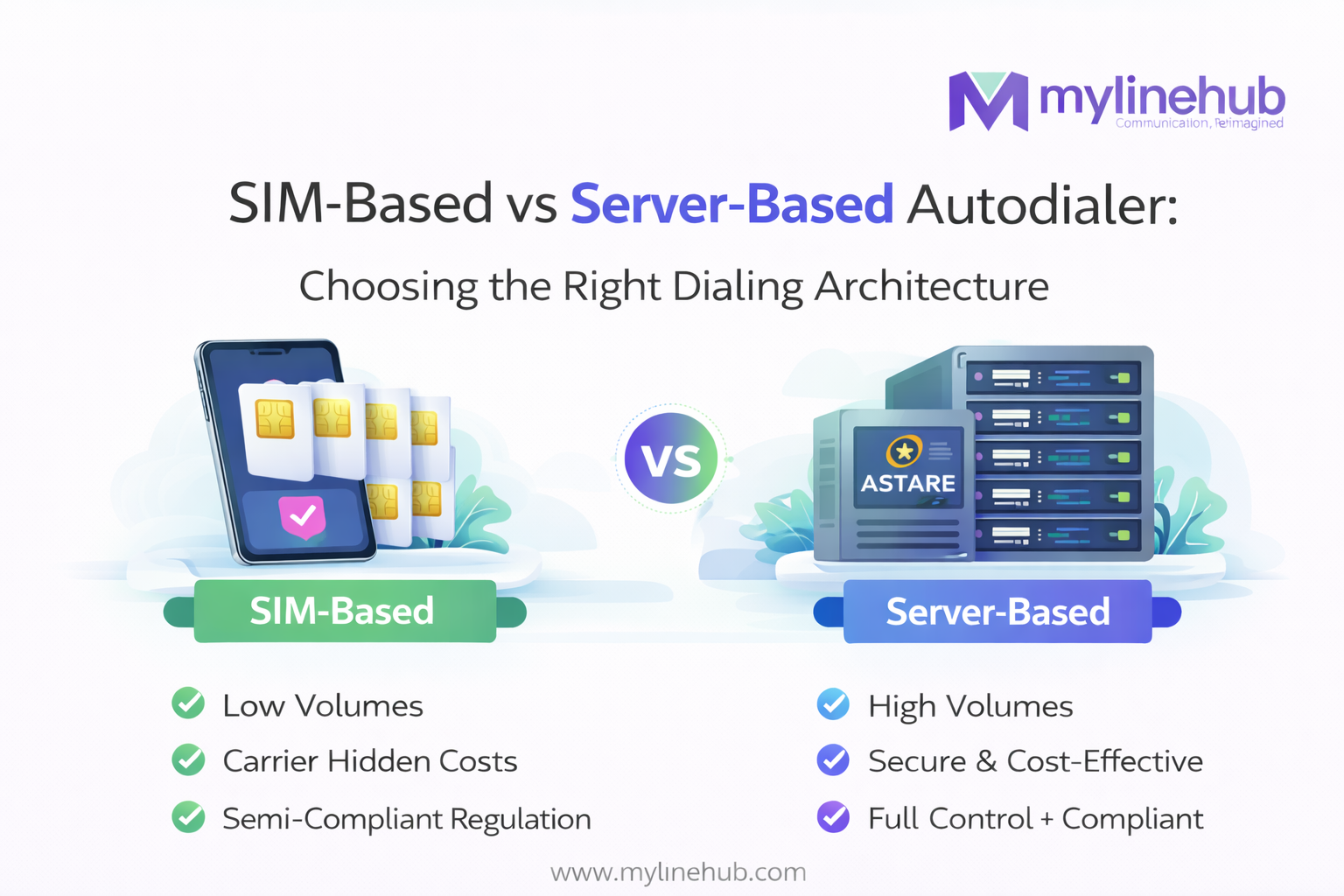
Autodialers generally fall into two categories: SIM-based and server-based 📞
Both can place outbound calls — but their architecture, scalability, reliability, and long-term suitability are very different.
This article explains how each model works, where SIM-based dialing still fits, and why modern contact centers increasingly choose server-based autodialers.
What Is a SIM-Based Autodialer?
A SIM-based autodialer uses physical SIM cards (GSM) inserted into mobile devices to place outbound calls. The App itself handles calling on mobile phone. While it has concerns regarding automation needs as developers does not get free hold of voice hence IVR, AI calling seems challanging here.
Each SIM behaves like a mobile phone number:
- Calls go directly over the mobile network
- Limited concurrency per SIM
- Physical hardware dependency 📦
This model became popular where SIP infrastructure was unavailable or where mobile termination was cheaper.
What Is a Server-Based Autodialer?
A server-based autodialer runs on software — typically using Asterisk or FreePBX — and places calls via SIP trunks.
Instead of physical SIMs:
- Calls are software-controlled
- Concurrency scales by server capacity
- Logic is centralized and programmable
This model powers modern contact centers, CRMs, IVRs, and AI-driven workflows.
Architecture Comparison
Diagram: Physical SIM infrastructure vs software-based dialing
Pros & Cons: SIM-Based Autodialer
✅ Advantages
- Works without SIP providers
- Simple for very small setups
- Appears like mobile-originated calls
⚠️ Limitations
- Hardware-heavy and failure-prone
- Scaling requires more SIMs and gateways
- High maintenance and SIM rotation
- Limited reporting and automation
- Weak CRM and API integration
Pros & Cons: Server-Based Autodialer
✅ Advantages
- Massive scalability via servers
- Deep CRM, WhatsApp, and API integration
- Supports IVR, queues, AI calls, call routing
- Centralized monitoring and reporting
- No physical SIM dependency
⚠️ Considerations
- Requires SIP trunking
- Needs proper server and network setup
Feature Comparison
| Capability | SIM-Based | Server-Based |
|---|---|---|
| Scalability | Low | High |
| CRM Integration | Minimal | Full API |
| IVR & AI Calls | Not practical | Native support |
| Maintenance | High | Low |
Which Business Size Fits Which Model?
- Very small teams (1–5 agents): SIM-based may work short-term
- Growing teams (5–20 agents): Server-based strongly recommended
- Mid & enterprise contact centers: Server-based only
Why Server-Based Autodialers Are the Future
Modern contact centers require:
- IVR-driven routing
- AI-assisted calling
- CRM-triggered workflows
- WhatsApp and omnichannel integration
- Full operational visibility
These requirements are impossible to meet reliably with SIM-based infrastructure.
Key Takeaway
SIM-based autodialers are a legacy workaround. Server-based autodialers are a long-term architecture.
For businesses that value scale, control, and automation, server-based dialing using Asterisk and platforms like MYLINEHUB is the clear choice 🚀
Want to see API-driven CRM + Telecom workflows in action? Try the WhatsApp bot or explore the demos.
Comments (0)
Be the first to comment.