Can My CRM Make Calls Through MYLO?
Your CRM can remain the place where your team works while MYLO provides the telephony layer underneath. This article explains the business flow and separates standard MYLO from broader custom integration work.
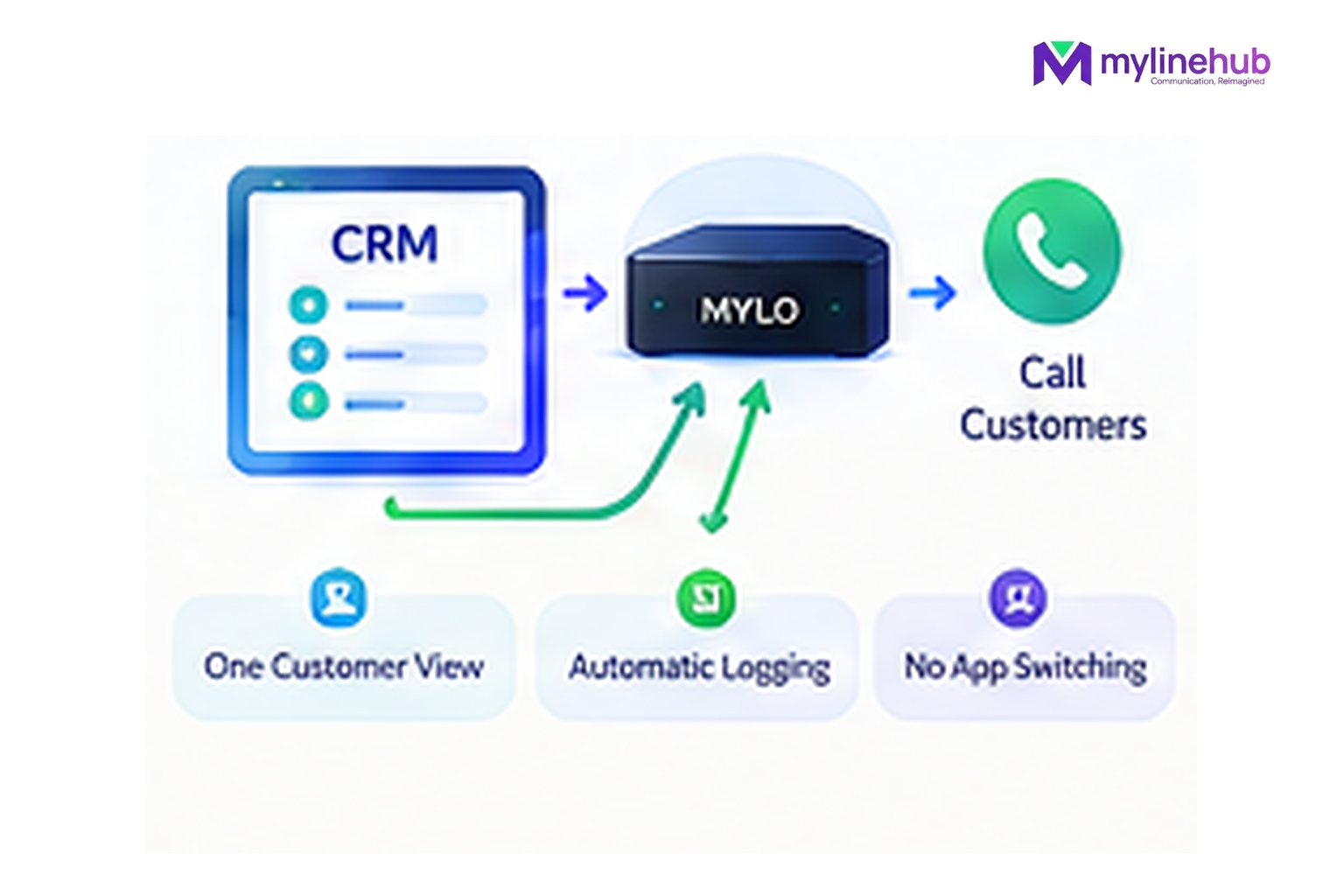
Yes, MYLO v0.35 exposes a fixed v1 API for DIDs, outbound/test calls, campaigns, runs, customers, attempts and recordings, plus a durable call-event stream for application-server integrations. That gives a CRM a supported way to request and observe telephony without turning the CRM itself into the phone system.
Quick answer
- Start from the business outcome; MYLO uses conversation to gather or clarify the information it needs.
- Consequential telephony work stays inside the product's permissions, validation and approval boundaries.
- The telecom provider remains responsible for public numbers, carrier service, capacity and provider-side conditions.
Keep CRM workflow and telephony responsibilities separate
Keep the Responsibilities Clean
The CRM owns customer and business workflow. MYLO owns the local telephony application boundary. Asterisk executes the actual call. The telecom provider supplies the external network service. Keeping those four responsibilities separate makes integration easier to reason about and avoids storing telecom configuration in the CRM.
Authentication Comes Before the Call API
The public API is authenticated. A business application should first follow the supported login/token flow and then call the permitted v1 endpoint. Do not hard-code a browser session or copy credentials into frontend JavaScript. The existing guide MYLO API: authentication first explains the sequence.
A CRM Can Request a Call and Track Its Result
v0.35 includes POST /api/v1/calls/outbound and a call-status endpoint, together with the call-event SSE contract for durable sequence-based replay. The application can therefore submit an authorised call request and observe lifecycle events without scraping the MYLO browser.
Do Not Confuse Standard MYLO With the Broader MyLineHub Platform
MyLineHub open source contains broader CRM/telecom architecture material and different integration possibilities. Standard MYLO is a single local appliance with a fixed v1 API boundary. If your CRM requires a materially different workflow, multiple PBXs or a custom orchestration layer, scope it as a Custom Requirement rather than assuming every MyLineHub feature is bundled into MYLO.
Continue From Here
Current public sources checked — 30 September 2026
For time-sensitive Indian telecom or data-protection statements in this article, prefer the current regulator, government or provider source over an old blog or forum post.
- MeitY — Digital Personal Data Protection Rules, 2025
Official MeitY publication page for the Digital Personal Data Protection Rules, 2025 and commencement material.
Custom Requirements and Telecom Responsibility
MYLO configures and operates the customer's local telephony layer; it is not the telecom carrier. Numbers, trunk service, calling charges and provider-side permissions remain with the customer's telecom provider. Where a requirement sits outside the standard MYLO package, MyLineHub can discuss it as a Custom Requirement.
Customisation does not override telecom-provider conditions, customer-consent obligations or applicable Indian telecom requirements. The final calling design must use services and number-routing methods that the business is permitted to use.
Want to see API-driven CRM + Telecom workflows in action? Try the WhatsApp bot or explore the demos.
Comments (0)
Be the first to comment.