How MYLO Verifies That a Telecom Change Really Worked
A telecom change is not successful merely because a form saved, a file was written or a command returned without an error. Customers experience an end-to-end call path: provider, network, Asterisk, routing, endpoint or IVR, media and events.
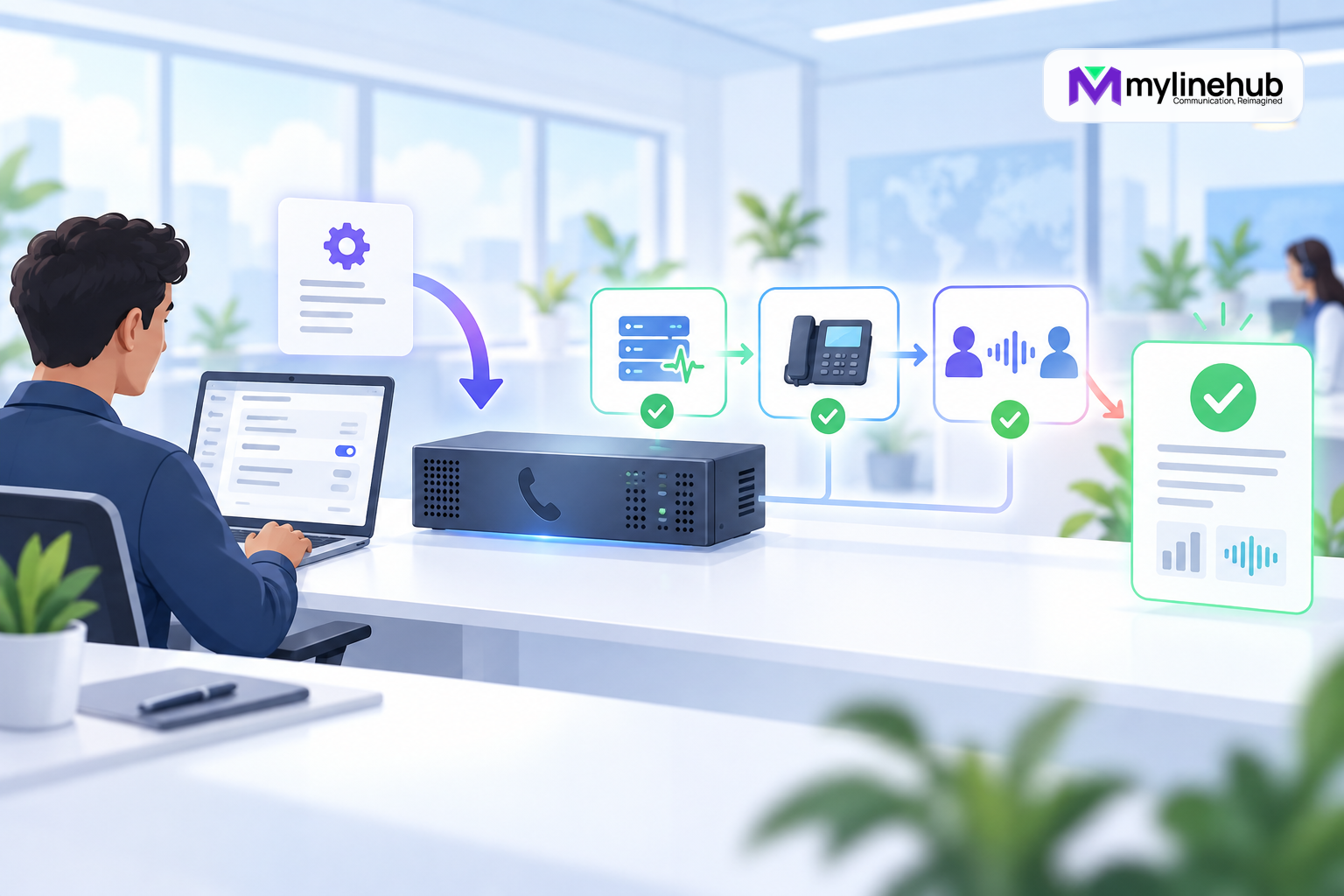
A telecom change is not successful merely because a form saved, a file was written or a command returned without an error. Customers experience an end-to-end call path: provider, network, Asterisk, routing, endpoint or IVR, media and events. MYLO verifies a change by moving through that evidence in order, from the smallest technical check to a controlled real call.
This approach prevents a common operational mistake. A team sees “saved successfully,” assumes the work is finished, and discovers later that calls ring the wrong group or have one-way audio. MYLO separates application of a change from proof that the promised business outcome now works.
First prove that the intended file was written
After an approved configuration proposal, deterministic code writes only the authorised Asterisk scope. The first verification asks whether the expected file or value reached the correct location, whether the write was atomic, and whether protected fields were resolved locally. This is a narrow but necessary check.
The evidence should link the written scope to the approved proposal and the pre-change snapshot. A mismatch in path, checksum, generated content or manifest means the process stops. MYLO should not move forward simply because some file exists. It must be the intended representation of the approved difference.
SIP passwords, API keys and other secrets should not appear in ordinary verification output. A result can say that a required credential reference was present and resolved without copying the value into chat, logs or run events. The goal is evidence, not disclosure.
Then validate and reload Asterisk
A file on disk does not automatically affect live calls. MYLO next performs the supported syntax and configuration checks, followed by the relevant reload or restart when appropriate. A validation failure is an operational failure even if the write itself succeeded.
The reload result must be captured, but it is not the final proof. A service may accept a reload while a trunk remains unregistered, an endpoint is unreachable or a dialplan destination is wrong. The useful message distinguishes these layers: “configuration validated and reloaded” is precise; “your phone system is working” would be premature.
If validation or reload fails, MYLO follows the protected recovery path. It preserves the failure evidence, restores the previous captured scope when the operation requires that recovery, reloads the prior state and verifies it. A confident AI explanation must never override the deterministic failure result.
Read live state from the source of truth
Once Asterisk has loaded the configuration, verification examines Asterisk’s current state. The exact observation depends on the change: endpoint status, trunk registration, dialplan availability, queue or agent membership, channel state, or the presence of the intended route. MYLO reads these facts rather than trusting an old database row or a proposed value.
Linux remains authoritative for interfaces, addresses, routes, processes and storage. If the test suggests a network or host problem, MYLO should inspect bounded live Linux evidence and say which layer is failing. A stale setup record must not be reported as the current address, and a successful ping must not be presented as proof that SIP registration or RTP audio works.
The carrier remains authoritative for its own network, number routing and policy. MYLO can observe local responses and correlate events, but it cannot claim to have repaired a provider-side outage or routing change. Clear ownership turns a failed test into the next useful action.
A real call proves more than a status screen
The strongest verification is a controlled call through the actual path affected by the change. For an inbound number, call it from outside the business. For an outbound route, use an authorised destination. For an IVR, listen to the prompt, send keypad input and check the selected destination. For an agent flow, confirm the expected device or mobile number receives the call.
Use a representative but low-risk test. One call can prove the route without contacting an entire lead list. A campaign should have its own functional test before Start approval; creating the campaign or previewing its settings does not demonstrate that the customer, caller ID, operator and recording path work together.
The test should have an expected result stated in advance. “Place a call and see what happens” encourages vague acceptance. “The external caller hears the support greeting, presses 2, reaches extension 204 and can speak in both directions” creates evidence that another person can evaluate.
Audio is a separate verification layer
Signalling and media travel through related but different paths. A call can ring and connect while audio fails in one or both directions. That is why MYLO should not treat an answered status as proof of a working conversation.
For a voice test, confirm that each party can hear the other, that speech is usable, and that the call remains stable long enough to reveal an obvious path problem. Where the flow uses prompts or recording, confirm the relevant media behaviour within the approved privacy policy. Do not copy recordings or sensitive customer speech into general diagnostic material.
One-way audio often points to RTP, NAT, firewall or advertised-address problems rather than to the business route itself. MYLO should preserve the call identifiers and bounded timing evidence needed for investigation, then direct the issue to the network or provider boundary supported by the facts.
Events connect the stages
Call events provide a time-ordered account of what the system observed: origination or arrival, channel creation, ringing, answer, bridge, keypad input, hangup and classified outcome where applicable. The precise events vary by flow, but they should help answer the verification question without dumping every log line.
Correlation matters. The verification record should link the test call to the approved operation and record the identifiers required to inspect it later. If the visible result says “no answer,” the underlying evidence should distinguish customer no-answer from agent failure, provider rejection or a local routing problem.
Events are evidence, not a replacement for the source systems. Asterisk is authoritative for live telephony behaviour, deterministic MYLO services own workflow state, and the provider owns its external service. The final explanation can combine these facts, but should not blur their ownership.
An evidence ladder for common changes
- Endpoint: approved file, syntax check, reload, live endpoint state, registration and a two-way extension call.
- SIP trunk: configuration load, authentication or registration state as applicable, provider response, authorised inbound or outbound call, and audio.
- Inbound route: loaded number match, external call, expected greeting or destination, keypad behaviour and final hangup evidence.
- Queue or ring group: loaded membership, representative available and busy cases, ringing policy, answer and overflow outcome.
- Campaign: persisted approved configuration, representative lead, correct caller ID, operator or IVR destination, events, recording rule and explicit readiness before Start.
What a failed verification should say
A useful failure report identifies the last successful layer and the first failed one. For example: the file was written, syntax validation passed and Asterisk reloaded; the trunk then returned an authentication rejection, so no real outbound call could complete. That message is more actionable than “verification failed.”
The report should also say what MYLO did next: stopped without further mutation, restored the previous scope, paused the campaign, or left the approved configuration in place pending provider action. It should not automatically retry a consequential change or originate repeated calls merely because the test did not succeed.
Where a human decision is needed, present the evidence and the available bounded choices. AI can translate technical detail into plain language, but approval, execution and state transition remain deterministic and authorised.
Acceptance checklist
- Does the record identify the approved proposal and exact configuration scope?
- Was the write atomic and was its result checked without exposing secrets?
- Did validation and reload succeed?
- Does live Asterisk or Linux state match the intended design?
- Was the real affected call path tested with a stated expected result?
- Were two-way audio and any required prompt, keypad or recording behaviour checked?
- Can the events be correlated to the test and explained in business language?
- If something failed, is the ownership and recovery status explicit?
Only when the relevant rungs agree should a team call the change operationally successful. MYLO’s value is not a reassuring success message; it is a traceable chain from authorised intent to a call that works.
Assign a clear owner to each verification layer
Verification is faster when each failure has an owner. The Configuration Agent owns the approved MYLO journey and local Asterisk evidence. The office-network owner handles switching, firewall, NAT and Internet-path faults. The SIP provider handles its registration service, number routing and external rejection. The business owner confirms that the customer-facing result is correct.
A single person may cover several roles in a small company, but the evidence should still identify the layer. This prevents expensive hand-offs such as asking the carrier to repair an IVR destination that Asterisk never loaded, or repeatedly changing a local password when the provider account is suspended.
Agree on acceptance before the maintenance window. Record the test number, calling direction, expected prompt or agent, audio requirement and rollback decision point. Keep the test proportionate and protect customer data. The final status should be one of three clear outcomes: verified and accepted; restored to the previous verified state; or stopped with a named unresolved dependency.
A scheduled follow-up can be useful for changes affected by business hours or real traffic, but it supplements the immediate functional test. The team should never leave an operation marked successful solely because no complaint arrived.
Five Different Levels of Evidence
A file written is not the same as a valid configuration; a valid configuration is not the same as a successful reload; a successful reload is not the same as correct runtime state; and correct-looking runtime state is not the same as a real customer path working. MYLO should report which level was proved and use a real inbound call, campaign functional test or trunk-connectivity evidence when that is the required acceptance test.
Continue planning
Continue with Is MYLO a PBX, an AI Agent or a Complete Appliance?; What Does the MYLO Restore Button Actually Restore?; Administrator vs Configuration Agent vs Dialer User. For deeper implementation context, use MyLineHub technical architecture guidance.
For a requirement outside the prepared MYLO scope, discuss the exact outcome with MyLineHub.
Want to see API-driven CRM + Telecom workflows in action? Try the WhatsApp bot or explore the demos.
Comments (0)
Be the first to comment.