Can MYLO Work When AI Is Temporarily Unavailable?
Yes—existing telephony can continue when the configured AI provider is temporarily unavailable, provided the local appliance, Asterisk, network, power and required telecom services are healthy.
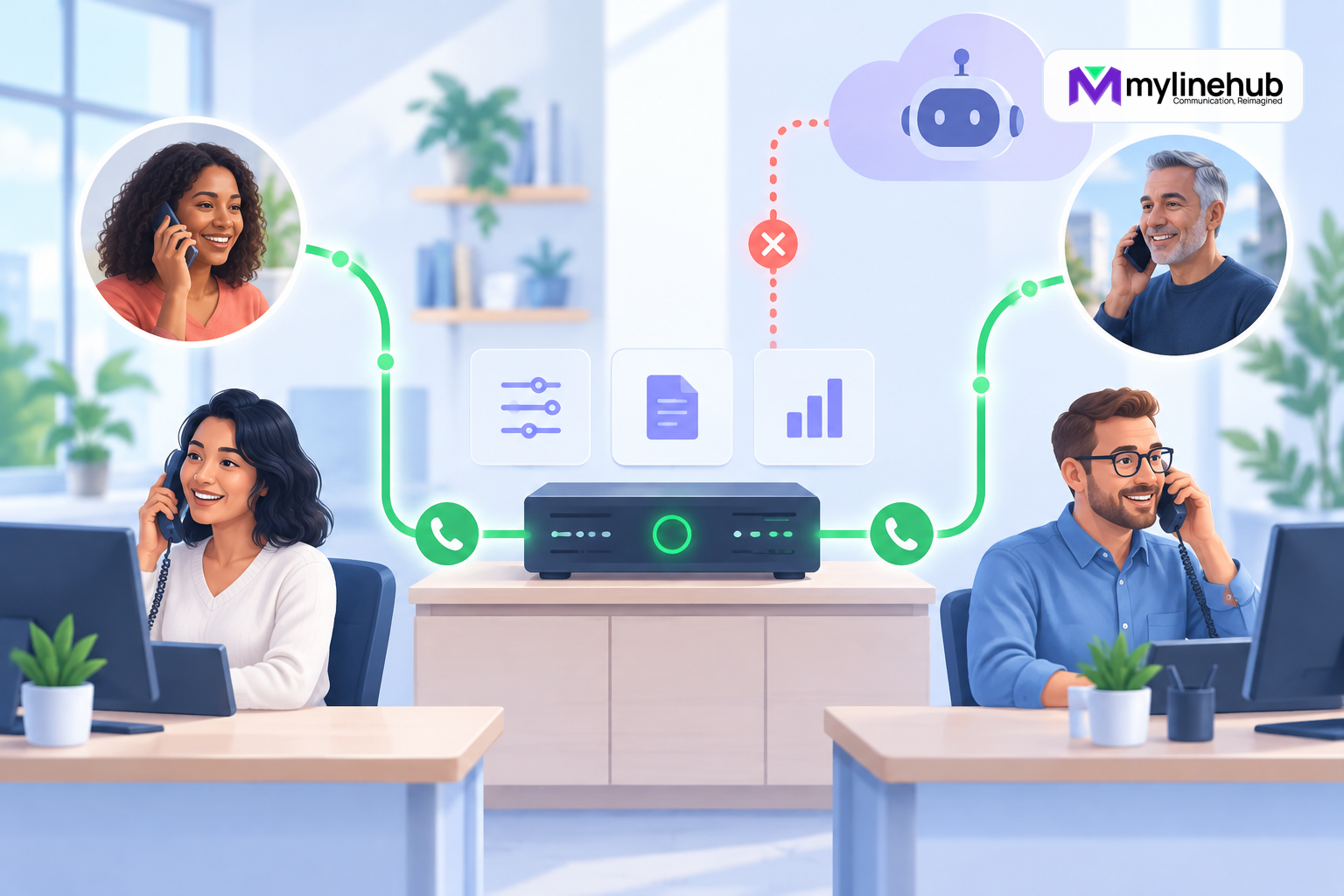
Yes—existing telephony can continue when the configured AI provider is temporarily unavailable, provided the local appliance, Asterisk, network, power and required telecom services are healthy. What becomes unavailable is the part of MYLO that needs external AI processing, such as conversational interpretation or AI-assisted proposal drafting.
This is not a promise that every feature works offline. It is a separation of responsibilities. Asterisk runs calls, deterministic MYLO services enforce operational rules, and the AI layer helps understand language and documents. Losing one dependency should not be described as losing all three.
Existing telephony is local
Once a supported configuration has been approved, applied and loaded, Asterisk remains the authority for the live phone system. Extension calls, inbound routes, outbound routes, IVRs and other configured behaviour do not need a new language-model answer for every call.
That means a short AI-provider outage should not dismantle a working PBX. A desk phone can remain registered, an inbound call can follow its route and an IVR can process keypad input as long as their actual dependencies are available. The AI provider is not in the media path merely because AI helped prepare the configuration.
The exact result still depends on the installation. A cloud SIP trunk needs the network path to its provider. A mobile forwarding flow needs the carrier. A locally registered extension depends on the office LAN and appliance. AI availability is only one line in that dependency map.
Deterministic operations can continue
MYLO assigns facts and state transitions to deterministic services. Authorisation, campaign state, pacing, capacity, retry eligibility, caller-ID selection, event recording and other defined operations should not wait for an AI decision during normal execution.
An approved campaign that is already running should therefore not require a model response before each next lead. Its scheduler follows persisted state and bounded rules. Similarly, reading current telephony status or showing an existing operation record can remain available if those functions do not invoke external semantic processing.
“Can continue” does not mean “must continue regardless of every fault.” A deterministic prerequisite may disappear: all authorised campaign caller IDs may become unavailable, the SIP trunk may fail or the appliance may restart. MYLO should respond according to its defined operating policy, such as pausing safely and requesting approval to Resume. That is separate from AI availability.
Conversational assistance may be limited
When MYLO needs the selected AI provider to interpret an open-ended request, summarize a document or draft a semantic proposal, that step may not be possible during the outage. The interface should say which capability is unavailable and preserve the boundary instead of fabricating an answer or attempting a partial change.
A user might still be able to reach the local browser and inspect deterministic status. However, a prompt such as “Build an IVR for these departments from this provider document” may need to wait until the provider is reachable. MYLO should avoid sending the same material repeatedly in uncontrolled retries.
If input is retained for a later retry, the product should make that clear and follow the configured privacy and retention policy. A queued request should not silently become an approved configuration change when connectivity returns.
No consequential half-change
The safest failure occurs before mutation. If AI-assisted proposal preparation cannot finish, MYLO should leave the current Asterisk configuration alone. The system must not apply a partly interpreted request, ask local code to guess missing fields or treat an old model response as approval.
If the outage occurs after a complete proposal has already been produced, later stages may still be possible if they are fully deterministic and supported: authorisation, human approval, pre-change snapshot, validation, execution and verification. Whether the interface permits that continuation depends on the actual recorded operation state, not on a general claim that all work is offline-capable.
At every stage, the user should be able to tell what completed and what did not. “AI provider unavailable; no configuration was changed” is a safe and useful result.
Provider restoration does not prove telecom health
When the AI provider becomes reachable again, MYLO can resume the semantic feature that depended on it. This does not automatically repair a SIP trunk, Internet circuit, DNS problem or Asterisk service. Each dependency has its own authority and verification.
Likewise, a healthy SIP trunk does not prove that the AI provider is reachable. The services may use different endpoints, policies and credentials. Troubleshooting should identify the failed path rather than use one successful connection as a universal health check.
After provider restoration, the user can retry the question or document task intentionally. MYLO should rebuild current context where needed because live state may have changed during the outage. A stale proposal must not be assumed correct merely because it was drafted earlier.
How to recognise an AI-only outage
A likely AI-only outage has a specific pattern: users can open the local MYLO interface, Asterisk remains active, normal test calls work, but an AI-assisted request returns a provider authentication, quota, timeout or reachability error. The operation record should identify that dependency without exposing the customer’s provider key.
Check the configured provider account, key status, billing or quota, model availability and network reachability according to the provider’s current documentation. The customer controls this account. MYLO cannot renew an external subscription or change provider policy on the customer’s behalf.
If local telephony also fails, treat it as a broader incident. Check appliance power, Linux services and interfaces, Asterisk state, SIP-provider reachability and the relevant real call path. Avoid assuming the visible AI error caused every symptom.
A practical business example
A support office has a working inbound number, ten extensions and an active reminder campaign. Its configured AI provider experiences a temporary outage. Customers can still call the support number and reach the existing IVR because Asterisk already holds the approved configuration. Agents continue ordinary extension calls.
The deterministic dialer can continue an already approved campaign while its required telecom dependencies remain healthy. A supervisor can monitor permitted operational data. However, the supervisor cannot ask MYLO to interpret a new provider PDF and design another trunk while the semantic service is unavailable.
MYLO reports the limitation and makes no new configuration change. When provider access returns, the supervisor retries the document task, reviews the newly prepared proposal and follows normal approval, backup and verification. There is no need to rebuild the working PBX just because conversational assistance paused.
Plan for safe degradation
- Document which MYLO functions use external AI and which are local deterministic operations.
- Keep provider account ownership, billing and key rotation responsibilities current.
- Train users to recognise “AI assistance unavailable” as different from “phone system unavailable.”
- Do not put the language model in the per-call execution path for ordinary telephony.
- Make failed semantic requests stop before consequential mutation.
- Preserve clear non-secret error evidence for the responsible administrator.
- Retest current context after recovery before approving a proposal.
- Maintain separate power, network and SIP-provider continuity plans.
The business answer
MYLO is an on-prem telephony management platform with an AI-powered semantic layer, not a phone system that must ask an external model what to do on every call. When AI is unavailable, existing local telephony and supported deterministic work can continue according to their real dependencies.
The unavailable portion should fail clearly and safely: no invented interpretation, no secret exposure, no automatic approval and no half-applied configuration. Once the provider returns, the user can resume the semantic task through the normal proposal and approval journey. That separation is what allows AI assistance to be useful without making it the single point of control for the business’s calls.
Test continuity before an outage
A business should confirm the separation under controlled conditions rather than discover it during a provider incident. Document the calls that must continue, the local pages users need, and the AI-assisted tasks that can wait. Perform an authorised test in a maintenance window using a safe method that does not disable unrelated Internet or telecom service.
Verify representative internal and external calls, two-way audio and the current inbound destination. Confirm that an AI-assisted request fails clearly without changing configuration. Check that users can distinguish the provider error from a SIP or appliance alarm and know whom to contact for each dependency.
Review campaign behaviour separately. A running campaign should follow deterministic state and prerequisites, while creation or semantic planning may be unavailable. Define whether operations staff should Pause during a wider incident and who may approve Resume. Do not infer the answer from the AI status alone.
Record the test date, installed version, topology and result, because continuity depends on the customer’s actual arrangement. Repeat the exercise after material provider, network or architecture changes. This gives the business evidence for its own deployment instead of relying on a universal offline claim.
Continue planning
Continue with Is MYLO a PBX, an AI Agent or a Complete Appliance?; Why SIP Credentials Must Stay Out of Chat and AI Prompts; What Happens When the Office Internet Connection Goes Down?. For deeper implementation context, use MyLineHub technical architecture guidance.
For a requirement outside the prepared MYLO scope, discuss the exact outcome with MyLineHub.
Want to see API-driven CRM + Telecom workflows in action? Try the WhatsApp bot or explore the demos.
Comments (0)
Be the first to comment.