Why SIP Credentials Must Stay Out of Chat and AI Prompts
SIP credentials allow a phone, application or trunk to authenticate with a telephony service. They are not the same as a person’s MYLO login, and they should not be pasted into MYLO chat, sent to an AI provider, copied into ordinary logs or left inside an attachment.
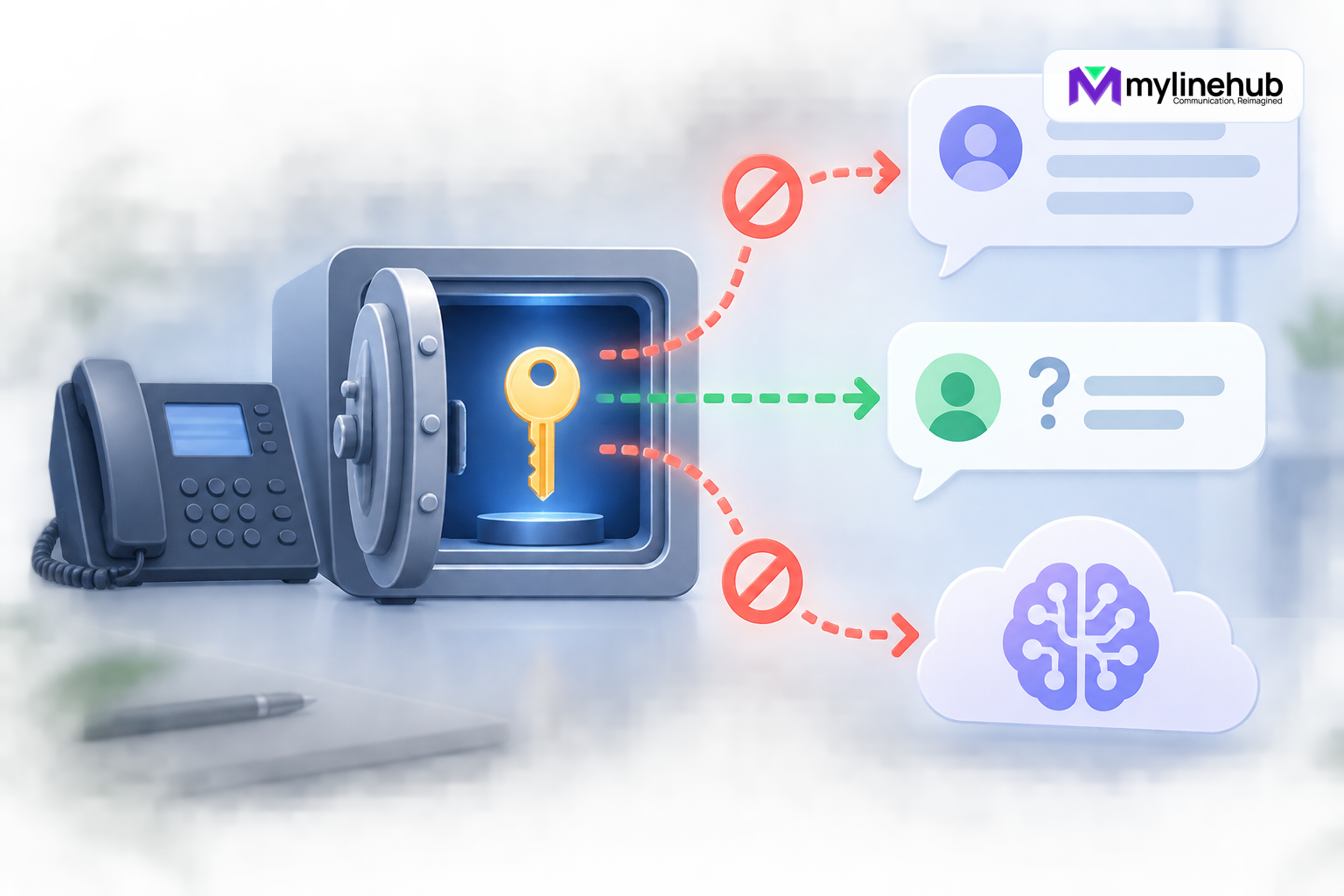
SIP credentials allow a phone, application or trunk to authenticate with a telephony service. They are not the same as a person’s MYLO login, and they should not be pasted into MYLO chat, sent to an AI provider, copied into ordinary logs or left inside an attachment. The AI can help reason about a credential field without knowing the secret value.
Keeping credentials outside the conversational path is a product-safety decision. It reduces the number of places from which a secret must later be removed, limits accidental disclosure and keeps configuration work inside an authorised deterministic process.
SIP credentials and MYLO logins serve different identities
A MYLO login identifies a human user and connects that person to roles, pages, approvals and operation history. SIP credentials identify a telephony endpoint, profile or trunk to Asterisk or a provider. Sharing one does not grant the function of the other.
This distinction prevents confusing support practices. Resetting a MYLO password should not silently rotate every telephone’s SIP secret. Retrieving an endpoint credential should not sign a person into the management interface. Each credential belongs to its own authority, lifecycle and audit path.
A profile in MYLO’s telephony context represents a PJSIP endpoint. Its authentication value is used by the telephony service and device. The model may need the profile name, intended user and registration state to assist; it does not need the password.
Chat creates unnecessary exposure
Conversational history is designed to preserve useful context. That makes it the wrong place for a reusable secret. A password pasted into a message may be visible to other authorised readers of the conversation, included in support screenshots, copied into exports or selected as context for an external AI request.
Deleting one visible message later may not remove every copy or downstream event. The safer design prevents the credential from entering ordinary chat at all. MYLO should provide protected forms or authenticated retrieval routes for the small number of tasks that genuinely require the value.
The user should describe the symptom instead: “Extension 204 cannot register after the handset was replaced.” MYLO can inspect permitted status, ask whether the device was provisioned, and guide the user to an administrator-controlled credential function without requesting the password in conversation.
AI prompts rarely need the secret
A language model can explain authentication structure, compare a provider document with required fields and draft a proposal using typed placeholders. It does not need to verify the credential by reading it. Actual authentication success is a deterministic observation from Asterisk or the provider response.
Sending a secret to the model adds provider-side processing and retention questions without improving the core task. The customer selects and controls the AI-provider account, but the narrowest safe request still excludes credentials. MYLO should send only the user’s question and selected, purpose-limited, sanitized context.
Local deterministic code can resolve a protected placeholder after the user is authorised and the consequential change is approved. The model receives enough meaning to understand that authentication exists while the execution service receives the actual value only where needed.
Protected local storage and retrieval
SIP secrets should be stored using MYLO’s protected credential architecture rather than in articles, notes or chat transcripts. Retrieval is an administrative function exposed through an authenticated browser or API boundary. Exact availability depends on the installed version and configured permissions.
Protected retrieval should be deliberate and narrow: identify the endpoint or profile, verify the requesting account, return only the required value, and record the administrative action without copying the secret into the audit message. A person should not retrieve every endpoint password when configuring one handset.
Display also needs care. A browser can reveal a value to an authorised administrator, but screenshots, screen sharing and copied clipboard content can still leak it. Reveal only when necessary, avoid leaving it visible, and provision the intended device promptly.
Logs and run events must not echo credentials
Operational evidence should answer questions such as whether authentication was attempted, which endpoint was involved and what failure category occurred. It should not reproduce the password. A log line containing a complete connection string or generated configuration can undermine an otherwise secure prompt boundary.
MYLO’s ordinary run events should therefore report protected-field presence and deterministic results rather than values. Error handling needs the same discipline. Exception messages, debug bundles and API responses should be checked for secret leakage before being exposed to normal users or support channels.
Special protected audit requirements, if present, must remain separate from ordinary logs and follow explicit access and retention rules. “It is in an audit record” is not enough justification to make a credential broadly searchable.
Attachments are another conversational path
Provider PDFs, handset exports and screenshots often contain credentials. Attaching them directly to a chat can disclose more than typing the password. Users should choose the smallest relevant document and let the supported sanitization step identify protected values before any AI processing.
Typed placeholders preserve meaning: the model can see that an authentication username and secret are required without seeing either value. Free-text review still matters, because a password may appear in an unusual note or image that automated processing cannot classify reliably.
If a secret was already shared, treat it as exposed according to business policy. Remove further copies, review relevant access and rotate the credential through the approved process. Do not paste it into another chat message while asking how to fix the first disclosure.
Rotation is a controlled telephony change
Rotating a SIP secret affects at least two sides: the authoritative telephony configuration and the device or provider that authenticates. Changing only one side causes registration failure. Rotation therefore needs a planned window, correct scope, approval, backup where Asterisk-owned state changes, coordinated provisioning and verification.
The proposal can show that a credential will rotate without displaying the old or new value. After approval, deterministic code generates or accepts the protected value through the supported boundary, applies it atomically and records non-secret evidence. The administrator provisions the corresponding authorised device or follows the provider’s controlled process.
Verification checks live registration and a representative call with two-way audio. If the change fails, recovery follows the captured scope and evidence. Repeatedly sharing the secret among staff is not a recovery method.
A practical endpoint example
An employee replaces a desk phone and asks a Dialer User for the extension password. The Dialer User has no reason to access profile credentials and does not receive Administrator rights for convenience. Instead, the request goes to the authorised administrator.
The administrator verifies the intended extension and uses the protected credential route. If policy calls for rotation rather than retrieval, a Configuration Agent prepares the supported proposal and the administrator approves it. The new value is handled locally, not copied into MYLO chat or sent to the AI provider.
The handset is provisioned, Asterisk reports the expected endpoint state, and the team makes a two-way test call. The operation history records who requested and approved the change, which profile was affected and whether verification passed—without storing the secret in the ordinary event.
Credential-handling checklist
- Keep MYLO user passwords and SIP endpoint or trunk credentials conceptually separate.
- Never paste SIP secrets into chat, AI prompts, tickets or ordinary notes.
- Review attachments and sanitize provider documents before AI processing.
- Use the authenticated protected UI or API route only when authorised retrieval is necessary.
- Limit retrieval to the specific endpoint or profile required.
- Prevent secrets from appearing in logs, run events, screenshots and error messages.
- Rotate suspected exposed credentials through an approved, coordinated change.
- Verify registration and a real two-way call after provisioning or rotation.
The safe operating principle is straightforward: AI handles meaning, authorised local services handle secrets, and Asterisk proves whether authentication and calling work.
Respond correctly when a credential is exposed
If a SIP secret appears in chat, an attachment, a screenshot or an ordinary log, assume the value may have been seen outside its intended boundary. Preserve the minimum incident evidence, restrict further access and notify the responsible administrator. Do not repeat the secret in an email or ticket to describe the problem.
Determine which endpoint, trunk or provider account uses the value and whether suspicious registration or calling activity occurred. Then rotate it through the supported approved process, coordinating both sides of authentication. A local change alone can disconnect service if the handset or provider is not updated.
After rotation, verify live registration, place a controlled two-way call and check that the old credential no longer works where the architecture allows that confirmation. Review related logs for leakage and address the path that caused the exposure, such as an unsafe diagnostic command or unreviewed document upload.
The incident is complete only when the new state works and the process gap is corrected. The lesson should be recorded without preserving the secret itself. This turns a credential mistake into a stronger operating boundary rather than another copy of the compromised value.
Credentials Are Execution Secrets
A SIP password is an execution secret, not conversational knowledge. The model needs to know that a credential exists and which provider account it belongs to; it does not need the password text in model context. An authorised runtime service retrieves protected material outside the prompt when deterministic execution genuinely requires it.
Continue planning
Continue with Is MYLO a PBX, an AI Agent or a Complete Appliance?; How MYLO Sanitizes Telecom Documents Before AI Processing; Can MYLO Work When AI Is Temporarily Unavailable?. For deeper implementation context, use MyLineHub technical architecture guidance.
For a requirement outside the prepared MYLO scope, discuss the exact outcome with MyLineHub.
Want to see API-driven CRM + Telecom workflows in action? Try the WhatsApp bot or explore the demos.
Comments (0)
Be the first to comment.