Open-Source Options for Asterisk AI Voice — Complete Landscape
A complete landscape of open-source components for Asterisk AI voice: RTP tools, STT/TTS options, WebRTC, and why duplex is the key missing piece.
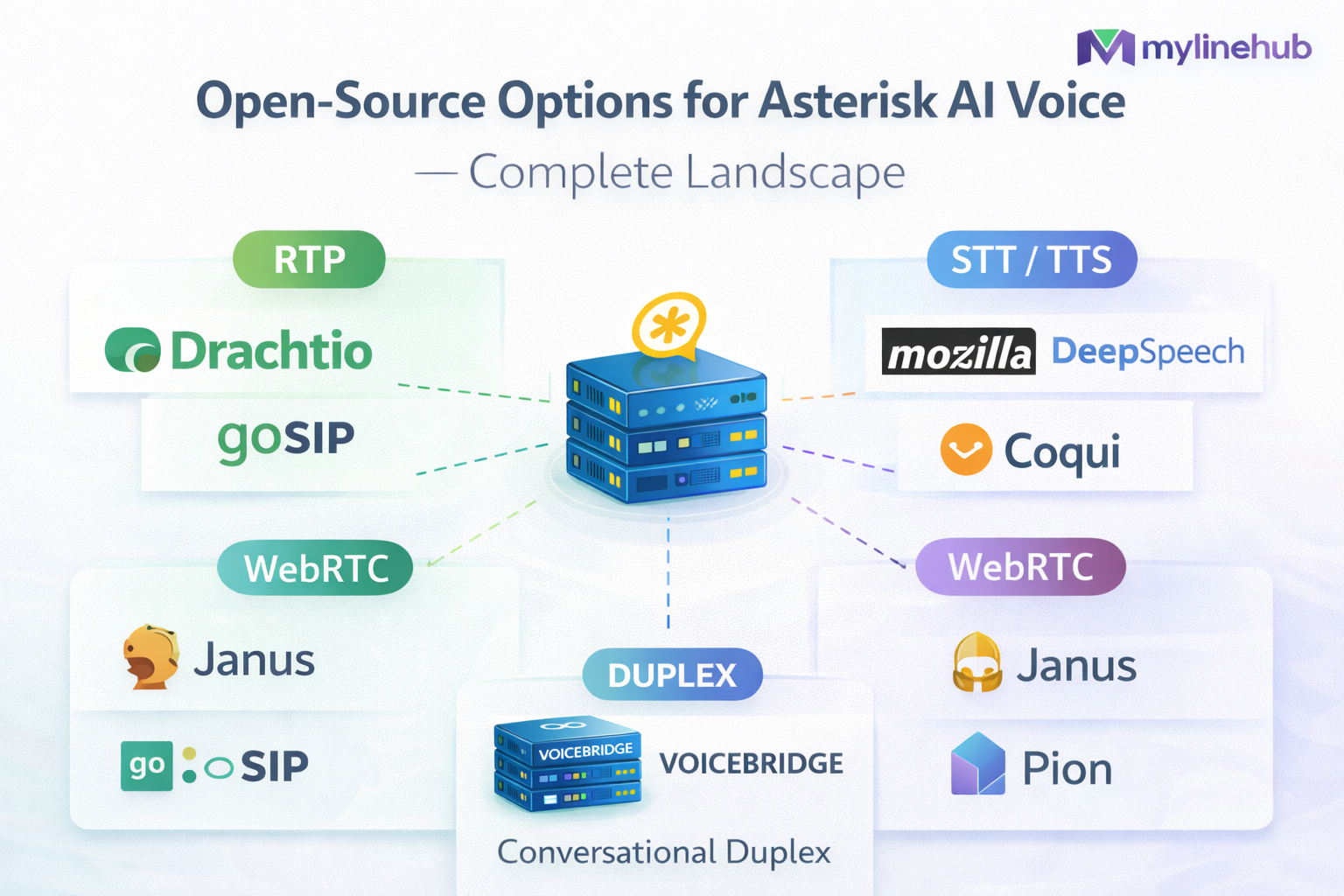
Open-Source Options for Asterisk AI Voice — Complete Landscape
This article maps the open-source landscape for AI calling solutions that integrate with Asterisk/FreePBX, explaining both architectural patterns and real production suitability. Many projects exist, but they differ radically in how they handle media, whether they support full-duplex real-time conversational AI, and how they scale in real environments.
This is not just a list — it is a comparison of architectural models, RTP/media strategies, scaling, NAT behavior, and engineering tradeoffs.
Wherever possible, implementations are linked to the code structure where they matter.
To ground this discussion, we reference one open-source project in detail: MYLINEHUB VoiceBridge, a production-oriented duplex RTP bridge for Asterisk-AI calling: https://github.com/mylinehub/omnichannel-crm/tree/main/mylinehub-voicebridge .
Why This Landscape Matters
“Open-source AI voice” can mean very different things:
- A simple AGI script that calls some AI and plays audio
- An ExternalMedia client that receives RTP but sends static audio files
- A “bot framework” that handles dialogs but not real-time media
- A full-duplex, real-time media engine with barge-in and timing
What you choose should match not only your feature goals (e.g., “talk over the caller”), but also your operational and scalability goals.
Categories of Open-Source AI Voice Integration with Asterisk
1. AGI-Based Bots
Uses the classic AGI interface to Asterisk. Examples include:
- Custom AGIs in Python/Node
- FreePBX AGI scripts with AI integration
These scripts usually:
- Answer calls
- Play audio files
- Record caller audio
- Send to STT, send to AI, generate TTS
- Play TTS output back
Architectural model:
Dialplan → AGI script → blocking I/O (play/record) → next turn
Strengths:
- Easy to start
- Works for IVR flows
- No continuous media streaming
- Cannot handle true duplex or barge-in
- Turn-based only
AGI solutions are not considered “real-time AI voice”; they are turn-based voice bots.
2. ExternalMedia-Based Samples
Asterisk’s ExternalMedia allows you to create an RTP endpoint and attach it to a bridge. Several community examples show how to receive RTP packets.
Typically these are simple scripts/clients:
- Receive RTP
- Send back pre-rendered audio
Limitations:
- No strict RTP timing control
- Often hard-coded ports
- No NAT/Symmetric learning
- No barge-in, no continuous AI streaming
3. Bot Frameworks + Telephony Adapters
Examples (ecosystem category, not VoiceBridge projects):
- Rasa with telephony connectors
- Botpress with SIP adapters
These usually separate:
- dialog logic
- media transport
- integration adapter
This separation is architecturally clean, but media adapters are typically simple and not engineered for true duplex under NAT/firewall at scale.
4. Full-Duplex RTP Bridges (e.g., VoiceBridge)
These are designed from the ground up for real media:
- continuous RTP streaming
- proper port planning
- dual legs (inbound + outbound)
- AI streaming integration
VoiceBridge is a prime example in the open-source world of this category.
Key Criteria to Evaluate Open-Source AI Voice Solutions
- Duplex audio (simultaneous send/receive)
- Barge-in support (stop TTS if the caller interrupts)
- Media timing correctness (RTP clock, payload, pacing)
- NAT/firewall practicality (symmetric learning)
- Session lifecycle management
- Scalability (hundreds of concurrent calls)
- Debuggability (packet-level tools like Wireshark)
- Security posture (ARI isolation, firewall rules, secrets handling)
Open-Source Candidates in Each Category
AGI Scripts & Frameworks
Community submissions often include sample AGI bots in Python and Node. None of these aim for continuous media — they play and record files.
Good for:
- simple menus
- DTMF dialogs
- turn-based bot flows
Not recommended for real AI calls with barge-in or duplex audio.
ExternalMedia Demos and Scripts
These exist in community repos but are not maintained production engines.
- sample Node.js + ARI UDP client
- Python RTP receiver with minimal send back
Common drawbacks:
- RTP is treated as simple UDP
- No NAT endpoint learning
- No scaling strategy
- No barge-in or AI streaming model
Bot Frameworks with SIP Adapters
Some projects aim to connect telephony to dialog systems like Rasa or Botpress. These can be open source, but the telephony layer is often glue code — not a fully engineered media engine.
Typical architecture:
- Asterisk SIP → Adapter → Framework
- AI logic in framework → response
- Playback back to caller
Unless the adapter implements continuous RTP and truncation logic, the result is turn-based at best.
Full-Duplex Bridges (Production-Grade)
This category is narrow in the open-source world.
The leading example is:
- MYLINEHUB VoiceBridge — engineered for duplex media
What makes it production-grade:
- RTP packetizer with timestamp/sequence/payload discipline
- Symmetric endpoint learning to avoid one-way audio
- Dual external media legs (in/out)
- Session model and lifecycle cleanup
- Realtime AI streaming integration with interruption handling
- Containerized deployment support and metrics
Key implementation areas referenced in the project:
ari/impl/AriBridgeImpl.javaari/impl/ExternalMediaManagerImpl.javartp/RtpPacketizer.javartp/RtpSymmetricEndpoint.javartp/RtpPortAllocator.javasession/CallSession.javaai/impl/RealtimeAiClientImpl.javaai/impl/OpenAiRealtimeTruncateManager.java
Detailed Comparison Against Important Requirements
Duplex Audio
| Option | Duplex Support |
|---|---|
| AGI scripts | No |
| ExternalMedia scripts | Partial† (but unstable) |
| Rasa/Botpress adapters | No (turn-based) |
| VoiceBridge | Yes (engineered) |
†ExternalMedia demos often do not implement pacing, NAT symmetry, or barge-in.
Barge-In / Real-Time Cut-Through
| Option | Barge-In Support |
|---|---|
| AGI | No |
| ExternalMedia demos | No |
| Bot frameworks | Framework-specific only |
| VoiceBridge | Yes (truncation logic) |
RTP Correctness & NAT Safety
| Option | RTP Discipline | Symmetric NAT Handling |
|---|---|---|
| AGI | None | N/A |
| ExternalMedia demos | Minimal | No |
| Bot frameworks | None | N/A |
| VoiceBridge | Yes | Yes |
Scaling & Production Readiness
Most open-source AI calling experiments fail to address:
- session lifecycle and cleanup
- udp port exhaustion and allocation
- container deployment + metrics
- NAT/firewall interactions
- event-driven state (hangups, bridge events)
VoiceBridge explicitly addresses these concerns through session management code and deployment artifacts.
When Simple Solutions Are Actually Enough
If your use case is:
- simple IVR prompts
- short turn-based dialogs
- no expectation of interruptions
An AGI script or a Botpress adapter may suffice. They are easy to prototype but do not scale to natural conversational AI.
When You Really Need Full-Duplex
If your goals include:
- simultaneous talk+listen
- fast barge-in cut-through
- call quality equivalent to human attendants
- production NAT/firewall resilience
- hundreds of concurrent AI calls
the only open-source option in this landscape that has been engineered for those requirements is VoiceBridge.
Final Thoughts
The open-source landscape for AI voice on Asterisk is rich in ideas but sparse in genuinely production-ready full-duplex solutions. Many paths exist for experimentation — AGI scripts, ExternalMedia demos, bot frameworks — but each has limitations that surface in real calls.
VoiceBridge is designed to address what most people discover too late: the intersection of RTP correctness, NAT safety, session lifecycle, and real-time AI streaming.
Evaluate any solution not by what it does in a lab but by how it behaves during:
- peak usage
- one-way audio conditions
- jitter spikes
- WAN/NAT variability
- agent interruptions
Want to see API-driven CRM + Telecom workflows in action? Try the WhatsApp bot or explore the demos.
Comments (0)
Be the first to comment.