Build Your Own Embedded Telecom & AI Voice Devices Using MYLINEHUB Open Source
Learn how to build embedded voice devices—intercoms, emergency listeners, AI translators, and smart calling terminals—using open-source telecom with Asterisk, FreePBX, and MYLINEHUB VoiceBridge.
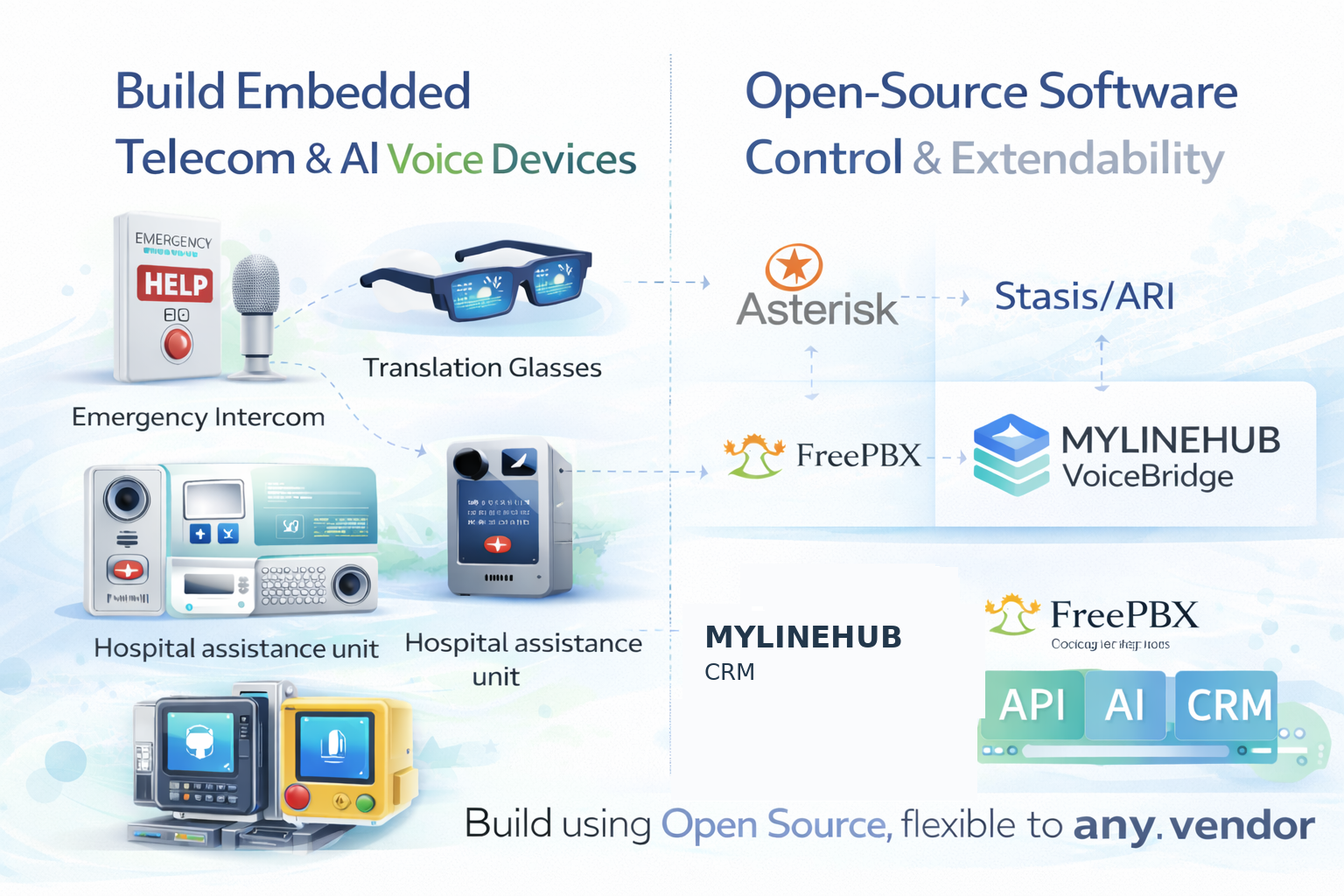
Build Your Own Embedded Telecom & AI Voice Devices Using Open Source
The future of communication is no longer limited to phones, apps, or call centers. Real innovation is happening inside embedded voice devices — smart intercoms, emergency listeners, AI translators, and autonomous calling terminals.
With MYLINEHUB + Asterisk + VoiceBridge, developers can now build complete telecom-enabled hardware using fully open-source architecture.
Real-World Embedded Voice Device Examples
- Apartment emergency intercom connected to AI support
- Hospital bedside voice assistance unit
- Industrial safety alert voice terminal
- AI live translation wearable glasses
- Smart visitor management intercom
These are not futuristic ideas — they are practical systems already being built using open telecom stacks.
Step 1 — Choose Embedded Hardware Board
Common production-ready boards include:
- Raspberry Pi → Best for full Linux telecom stack
- ESP32 + Audio Codec → Low-cost voice streaming device
- Custom ARM Linux Board → Industrial deployments
Hardware must support:
- Microphone and speaker interface
- Network connectivity (Ethernet/Wi-Fi/4G)
- Real-time audio processing
Step 2 — Add Telecom Calling Capability (Open Source)
Every embedded telecom device requires a SIP or audio streaming stack.
Using open source:
- SIP stack → PJSIP, baresip, Linphone SDK
- Audio codecs → PCMU / PCMA / Opus
- RTP media handling → native telecom standard
This allows the device to behave like a real phone inside a telecom network.
Step 3 — Connect Device to Asterisk / FreePBX
Asterisk becomes the telecom control layer:
- Call routing
- Queues and IVR
- Recording and monitoring
- PSTN or SIP trunk connectivity
The embedded device simply registers as a SIP endpoint and can now participate in real telecom calls.
Step 4 — Integrate with MYLINEHUB VoiceBridge AI
This is where communication becomes intelligent.
- Asterisk sends call to Stasis application
- VoiceBridge extracts live RTP audio
- AI performs speech recognition, reasoning, and response
- Audio is streamed back to the embedded device in real time
The result: a fully autonomous AI voice device.
What You Can Build Using This Architecture
- AI apartment emergency listener that auto-calls help
- Voice-controlled industrial machine assistant
- Smart door intercom that talks to visitors
- Wearable translation glasses showing real-time speech translation
- Autonomous customer-service voice kiosk
Because the entire telecom + AI stack is open source, innovation is no longer blocked by vendors.
Why Open Source Matters Here
- Full access to telecom signaling and media
- No per-minute AI or CPaaS lock-in
- Hardware + software freedom
- Unlimited customization for new devices
MYLINEHUB provides the missing layer: AI + CRM + Telecom unified together.
Final Thought
The next generation of communication will not live only in apps. It will live inside devices that can listen, think, and respond.
With MYLINEHUB open-source telecom and VoiceBridge AI, developers can build those devices today — without waiting for big tech platforms.
The future of telecom is programmable, embedded, and open.
Want to see API-driven CRM + Telecom workflows in action? Try the WhatsApp bot or explore the demos.
Comments (0)
Be the first to comment.