FreeSWITCH Dialplan vs Asterisk Dialplan
A dialplan is the policy layer that decides what happens after a telephony engine receives a call. It can send a caller to an employee, an IVR, a queue, an announcement, a conference, or an outside carrier.
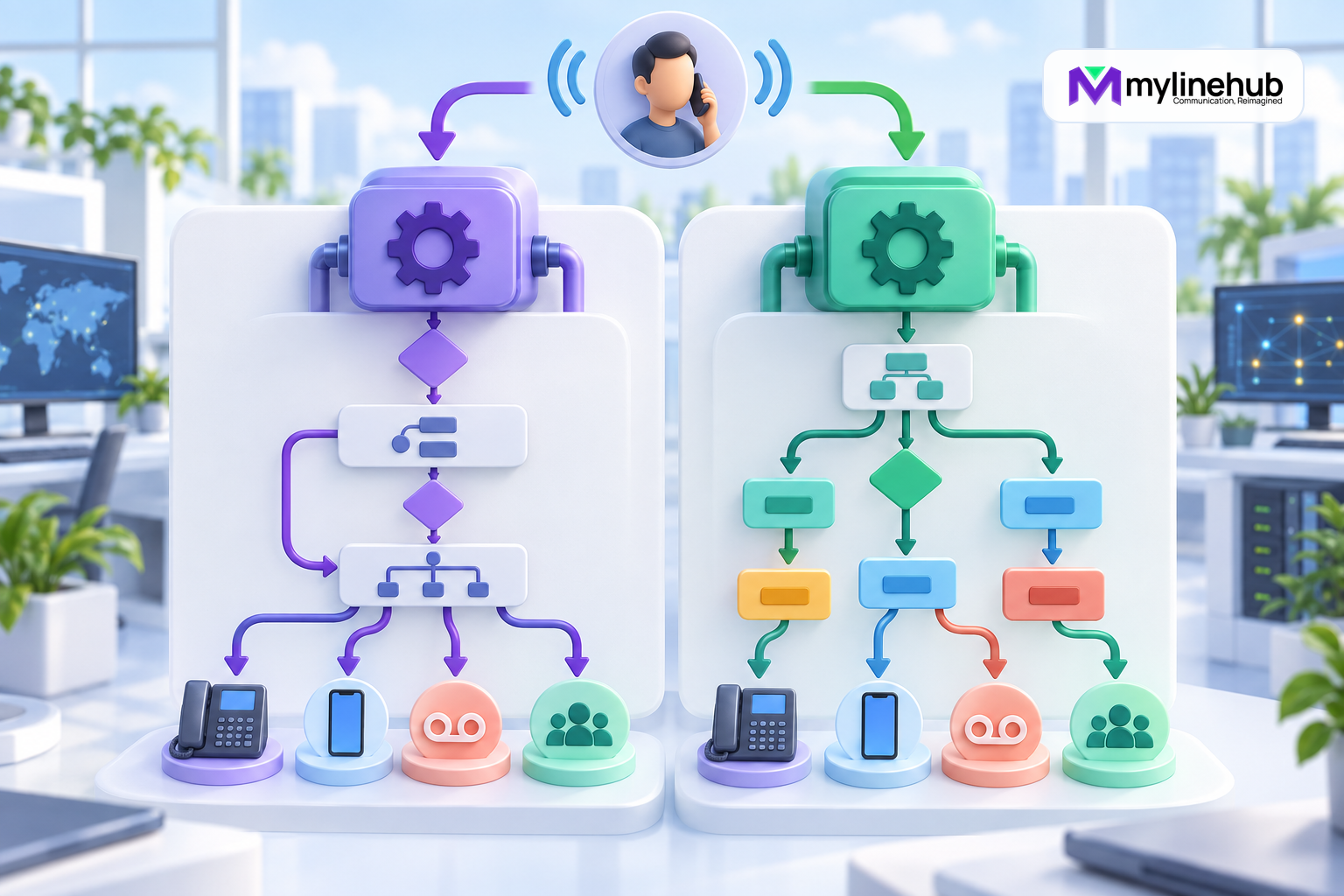
A dialplan is the policy layer that decides what happens after a telephony engine receives a call. It can send a caller to an employee, an IVR, a queue, an announcement, a conference, or an outside carrier. FreeSWITCH and Asterisk can both implement sophisticated business call flows, but their common configuration models encourage different ways of organizing and reviewing that logic. The useful question is not which example has fewer lines. It is which model your team can understand, secure, test, observe, and maintain.
What both dialplans do
Both engines receive a channel with facts such as source, destination, signaling context, caller identity, and variables. They compare those facts with configured rules, select a path, and invoke applications. Both can set variables, branch on conditions, play audio, collect digits, bridge endpoints, transfer calls, and record outcomes. Both need explicit handling for invalid input, timeouts, unavailable destinations, and upstream failure.
The dialplan is only one layer. Endpoint authentication, SIP transport, number normalization, codec negotiation, network reachability, RTP media, recording policy, and external applications surround it. A correct route can still produce a failed call when a gateway is down or media cannot cross a firewall. Production testing therefore follows the whole journey rather than stopping when configuration loads.
The Asterisk mental model
Asterisk's traditional dialplan is normally organized in extensions.conf. Contexts divide it into named areas. Each context contains extensions, and each extension contains priorities that invoke applications in sequence. Here, an extension is a named set of instructions, not necessarily a physical telephone. It may dial a device, start an IVR, enter a queue, or run another business rule.
Contexts are also security and class-of-service boundaries. A channel driver places an incoming call in a configured context. Asterisk looks for a matching extension there and in deliberately included contexts. A carrier trunk should not casually share the same permissions as a trusted office device. Inbound traffic, internal users, restricted users, administrative features, and outbound routes are clearer when their entry contexts and includes are explicit.
Priorities give Asterisk a procedural reading order. The first step runs, then the next available priority runs unless an application branches, transfers, hangs up, or otherwise changes control. Labels, subroutines, functions, pattern matches, and conditional applications allow larger flows to be composed. Operators commonly troubleshoot by asking which context received the call, which extension matched, and which priority executed next.
The FreeSWITCH mental model
FreeSWITCH commonly uses an XML dialplan. A call enters a context selected through the SIP profile, directory attributes, or channel variables. Extensions in that context contain conditions. When conditions match, actions set variables or invoke applications. Anti-actions can handle a failed condition, and continuation behavior controls whether evaluation moves into later extensions.
This model encourages an operator to inspect facts on a channel before choosing behavior. A condition might evaluate a destination, time, caller attribute, or calculated value. Actions can answer, bridge, transfer, play media, collect DTMF, set state, or call another application. Troubleshooting commonly asks which context was selected, which conditions matched, when variables expanded, and which actions were executed.
FreeSWITCH often distributes configuration responsibilities. The directory describes users and related attributes. SIP profiles describe signaling listeners, gateways, and the context used for inbound traffic. The dialplan describes call treatment. This separation can be clean and scalable, but reviewers must trace all relevant configuration sources rather than assuming the route file tells the complete story.
Conditions versus ordered priorities
The largest difference is conceptual. An Asterisk route often reads like a small program: match a destination, perform step one, perform step two, and branch when an outcome requires it. A FreeSWITCH route often reads like a rule evaluation: test channel facts, build actions, and decide whether matching continues. Both systems support procedural and conditional behavior, but their common structures shape how people reason about them.
This affects code review. In Asterisk, a missing priority, an overly broad include, or an unexpected pattern match may change the path. In FreeSWITCH, a condition, variable-expansion moment, break behavior, or continuing extension may change the result. A safe review checklist should use the native execution model rather than assumptions learned from the other engine.
Matching order can create hidden risk
Many incidents begin with an incorrect assumption about matching. A broad number pattern may capture traffic intended for a narrow rule. An included context may expose an expensive route. A FreeSWITCH extension may continue evaluating when its author expected processing to stop. A value may be expanded before or after another action changes it.
Document which context receives every trunk, device class, and application-originated call. Give each route a clear owner. Use narrow, testable matches and a controlled final failure for unmatched destinations. Confirm the installed release's matching and continuation rules from official documentation; visual position in a file is not always enough to predict execution.
Reuse, generation, and application control
Both platforms provide ways to avoid duplication. Asterisk offers included contexts, subroutines, variables, functions, and external control interfaces. FreeSWITCH offers transfers, variables, reusable XML, dynamic XML retrieval, scripting, and the Event Socket. Reuse improves consistency, but excessive indirection makes change impact hard to see.
Stable telephony policy often belongs near the dialplan: number normalization, office-hours entry, emergency restrictions, and deterministic fallbacks. Complex customer workflows, frequently changing business logic, or distributed data may belong in an application using a supported control interface. External control adds authentication, timeout, availability, and network dependencies, so the dialplan still needs safe behavior when that application is unavailable.
Security and privacy belong in route design
A dialplan authorizes access to chargeable and sensitive capabilities. Separate untrusted inbound traffic from internal dialing. Restrict international or premium destinations by role. Protect recording controls, paging, voicemail administration, and feature codes. Ensure a transfer cannot escape into a route the original caller was not authorized to use.
Never put live SIP passwords, tokens, customer numbers, or recordings into public examples, review chats, or AI prompts. Use placeholders and sanitize traces. Restrict configuration and control interfaces through network policy and application authentication. A syntactically valid dialplan can still cause toll fraud, privacy exposure, or unauthorized recording.
How to test either dialplan
Write a call matrix before changing production. Include normal inbound calling, an unavailable agent, invalid IVR input, no input, after-hours treatment, an allowed outbound destination, a prohibited destination, carrier failure, and every fallback path. For each case, state the expected signaling, caller identity, audio, recording behavior, user experience, and final report outcome.
Validate configuration, take a restorable backup, and use the platform's supported reload or deployment process. Then place real calls. Confirm audio in both directions, DTMF, transfers, timeouts, caller ID, hangup behavior, and reporting. Logs explain why the engine made a decision, but a successful reload is not proof of service.
Test negative paths as carefully as happy paths. A failed trunk must not loop. Invalid input should have a finite and understandable outcome. An unauthorized outbound call must not find an alternate route. Record evidence and the rollback trigger so another operator can judge whether the release succeeded.
Operations and troubleshooting
A support runbook should start with the visible symptom, then isolate layers. Confirm the endpoint or trunk state, inspect SIP signaling, identify the chosen context and route, follow the application decisions, and finally verify the negotiated media path. Changing dialplan logic is inappropriate when the real problem is registration, DNS, a firewall, NAT, or codec negotiation.
Use correlation identifiers so call detail records, application events, and engine logs can be connected without publishing customer data. Keep a sanitized example of each important call type. After an upgrade, replay the functional matrix because a parser accepting the old configuration does not prove that every module behaves identically.
Performance and maintainability
Neither dialplan becomes production-grade by being clever. Repeated database queries, blocking external calls, or unnecessarily complex regular expressions can add latency. Large generated configurations can be effective when their source is reviewed and the generated result is reproducible. Hand-edited production files without ownership or version history create avoidable risk.
Use clear names based on business purpose. Keep route boundaries small. Document inputs, outputs, failure behavior, and external dependencies. Prefer one obvious path over several implicit fallbacks. Monitor call setup time and error distribution after changes, not only CPU usage.
Choosing for a business
Asterisk may feel natural to teams that prefer step-by-step application execution and already use its dialplan, PJSIP, AMI, or ARI ecosystem. FreeSWITCH may suit teams that prefer condition-driven XML, its event-oriented integration model, and its surrounding media architecture. Existing skill, documentation discipline, observability, and ownership usually matter more than theoretical feature parity.
Do not decide from a toy snippet. Implement the same representative journey on each shortlisted platform: inbound number, business-hours branch, IVR, queue or ring strategy, outbound route, failure path, and reporting integration. Ask the people who will operate it to explain the match, deploy a controlled change, diagnose a failed test, and restore the previous state.
Practical review checklist
- Can more than one person explain how a call enters and leaves each context?
- Are authorization boundaries visible and covered by negative tests?
- Can configuration be reviewed, versioned, backed up, and restored?
- Are external dependencies given timeouts and deterministic fallbacks?
- Can operations correlate signaling, route decisions, media, and outcomes?
- Are upgrades, modules, and regression tests owned by a named team?
- Does every critical route have an observable and finite failure outcome?
Version and documentation caveat
This comparison describes durable architecture, not every option in every release. Modules, defaults, syntax, and reload limitations change. Before implementation, consult documentation for the exact installed versions and validate in a non-production environment. Primary references reviewed in September 2026 include the official Asterisk dialplan documentation, its guide to contexts, extensions, and priorities, and the official FreeSWITCH Users Manual.
Bottom line
FreeSWITCH and Asterisk can both run disciplined business call flows. Asterisk commonly expresses the journey as ordered applications inside contexts and extensions. FreeSWITCH commonly evaluates conditions and executes actions within an XML-centered configuration model. The production choice is the one your organization can secure, observe, test, and maintain through change—not the one whose smallest demonstration looks most familiar.
Continue planning
Continue with MYLO Appliance vs MyLineHub Open Source: Which Path Fits?; FreeSWITCH vs Asterisk: A Business Decision Guide; FreeSWITCH SIP Profiles vs Asterisk PJSIP Endpoints. For deeper implementation context, use MyLineHub technical architecture guidance.
For a requirement outside the prepared MYLO scope, discuss the exact outcome with MyLineHub.
Want to see API-driven CRM + Telecom workflows in action? Try the WhatsApp bot or explore the demos.
Comments (0)
Be the first to comment.