What Is Asterisk, and Why Is It Used in Business Telephony?
Asterisk is an open-source communications engine that can act as the telephony core of a business phone system.
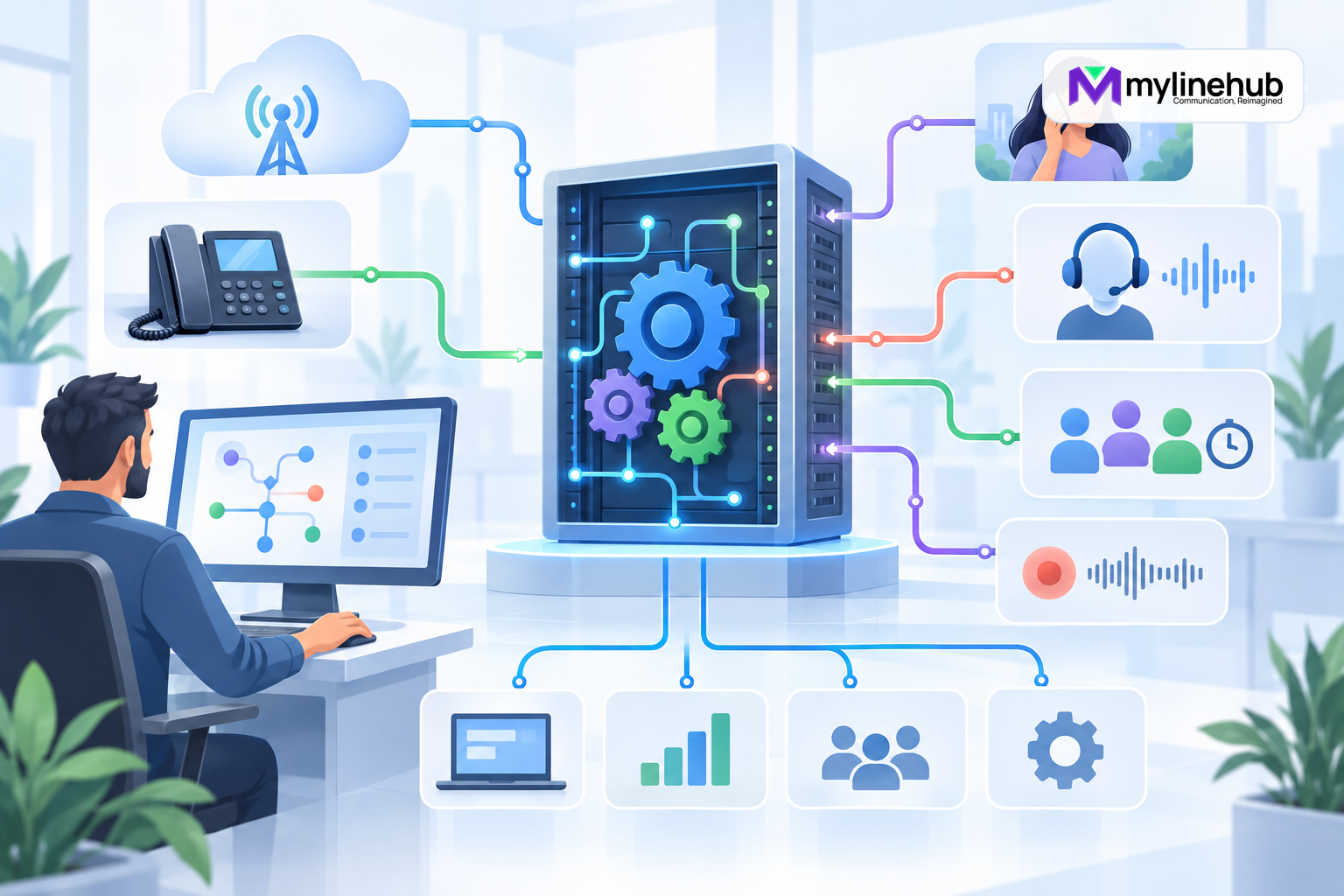
Asterisk is an open-source communications engine that can act as the telephony core of a business phone system. It accepts calls from endpoints and providers, evaluates routing logic, runs applications such as playback, queues, conferencing, and voicemail, and creates the channels that connect people. It is not by itself an Internet service, SIP provider, phone number, CRM, or complete operating procedure.
Think of Asterisk as a Call-Control Engine
A call entering Asterisk creates a channel representing one call leg. The dialplan selects what should happen: answer, play a prompt, collect digits, ring extensions, enter a queue, bridge to another channel, record where approved, or end with a defined result. A typical conversation between two parties uses at least two legs joined by a bridge.
This model explains why “the call failed” is incomplete. The provider leg, customer leg, agent leg, route, application, and media can each behave differently.
Protocols Connect Asterisk to Other Systems
Businesses commonly use SIP for signalling and RTP for audio. PJSIP is the modern Asterisk SIP stack used to define endpoints, authentication, address matching, registrations, and transports. A trunk connects Asterisk with a telecom provider; endpoints connect phones, softphones, gateways, or other systems.
Signalling and media must both work. A call can ring and answer while audio fails because RTP follows different addresses and ports. Registration can be healthy while number routing is wrong, and a provider may use address trust instead of registration.
The Dialplan Expresses Business Routing
The dialplan organises matching and actions into contexts and extensions. Contexts are security and routing boundaries, not merely folders. Incoming provider calls should enter only the routes intended for them; internal endpoints should not receive unrestricted access simply because they can register.
Business logic includes number normalisation, time conditions, IVR choices, queues, ring groups, voicemail, caller identity, outbound selection, and failure paths. Keep it understandable and testable. Complex customer or campaign workflows may belong in an application layer that calls supported telephony operations rather than embedding everything in dialplan.
Applications Provide Reusable Capabilities
Asterisk includes applications for answering, dialing, playing audio, collecting digits, queues, conferencing, voicemail, recording, and many other tasks. Modules provide channel drivers, codecs, resources, and interfaces. Load only what the deployment needs, understand dependencies, and review changes against the installed version.
Capabilities are building blocks. A queue does not automatically define staffing policy, and recording does not automatically satisfy notice or retention requirements. The business design must surround the technical feature.
Interfaces Enable External Control
The Asterisk Manager Interface exposes events and administrative actions; the Asterisk REST Interface supports application-controlled communications through Stasis; call files can request defined outbound operations; and call-detail records provide reporting evidence. Each interface has different security, state, and programming implications.
Do not expose these interfaces broadly to the Internet or give an application unrestricted administrative access. Use network controls, dedicated credentials, least privilege, bounded commands, and application-level validation.
Why Businesses Choose Asterisk
Asterisk is flexible, widely understood, and capable of supporting small office PBXs, contact-centre routing, gateways, conferencing, IVRs, integrations, and specialised call applications. It can run on ordinary Linux hardware and work with many providers and endpoints, reducing dependence on one proprietary appliance.
Flexibility is not the same as simplicity. Someone must own architecture, security, provider relationships, testing, upgrades, monitoring, backups, documentation, and incident response. An open-source licence does not make operations free.
Asterisk and MYLO Have Different Roles
In a MYLO appliance, Asterisk remains the authority for loaded telephony configuration, endpoints, dialplan execution, channels, and live call evidence. MYLO helps a business express intent, review proposals, approve supported changes, operate campaigns, and understand reporting. It should not replace observed Asterisk state with a plausible AI answer.
Linux remains authoritative for interfaces, addresses, routes, processes, and host resources. The telecom provider remains authoritative for service in its network. Keeping these boundaries visible makes troubleshooting and change control safer.
Security Requires More Than a Strong Password
Restrict signalling, media, management, and web access to intended networks. Use current supported software, protect SIP and API credentials, remove sample or unused accounts, control outbound destinations, monitor unusual attempts, and prevent logs from exposing secrets. Network ACLs complement authentication; they do not replace it.
Separate administrator, application, and endpoint identities. Apply rate, cost, and destination controls appropriate to the business. Treat unexpected call activity as a potential financial and privacy incident.
Availability Depends on the Whole Path
Asterisk can remain healthy while an Internet circuit, DNS resolver, router, switch, endpoint, or provider fails. Internal extension calling may continue when external trunks do not. Backup connectivity helps only when provider source expectations, routing, firewall, bandwidth, and failback have been designed and tested.
Monitor host resources, process state, endpoint or trunk evidence, channel activity, and customer journeys. Place real authorised inbound and outbound tests after changes; a successful reload is not proof of service.
Reporting Is Leg-Aware
Asterisk emits technical events and call-detail records around channels. A business application should correlate those with stable call, campaign, run, customer, and recording relationships. Answer on one leg does not necessarily mean two people spoke, and a failed agent leg does not mean the customer was never reached.
Preserve raw operational meanings before deriving business categories. Define time zones, retention, privacy, and reconciliation so a dashboard can be explained from evidence.
When Asterisk Is a Good Fit
It fits organisations that need flexible call control and have a product or operating model to manage it. A prepared MYLO appliance can package a supported set of capabilities for a smaller team. The open-source MyLineHub path can suit a capable internal team building its own solution. Complex unique requirements may need custom development and ongoing engineering ownership.
The choice should consider total responsibility, not feature lists alone: people, testing, carrier coordination, security, documentation, uptime, and future change.
Production Readiness Checklist
- Define business routes and failure behaviour.
- Confirm numbers, trunks, codecs, identity, and capacity.
- Secure contexts, endpoints, management interfaces, and networks.
- Document roles, backups, changes, monitoring, and incident response.
- Test inbound, outbound, IVR, transfer, failure, and two-way audio.
- Correlate channel evidence into leg-aware business records.
- Keep Asterisk, Linux, provider, and application authority distinct.
- Review installed-version documentation before each material change.
Asterisk is powerful because it exposes precise building blocks. Business reliability comes from assembling and operating them with clear ownership and evidence.
Understand Configuration and Runtime State
Asterisk configuration is commonly stored in text files or generated by another management layer, then loaded into running modules and dialplan. The file on disk, the generating database, and the active runtime can disagree. Inspect the relevant live object after a reload and preserve the proposal and result.
Do not reload or restart the entire service for every change. Understand which module or configuration scope is affected, active-call impact, dependencies, and rollback. Back up before consequential work and verify afterward.
Plan Capacity From Call Behaviour
Capacity depends on simultaneous channels, codecs, transcoding, recording, conferencing, application control, disk I/O, network, and provider limits—not merely employee count. A two-leg campaign can consume more channels than a direct extension call. Measure realistic peak flows and retain headroom.
Separate Asterisk resource limits from trunk channels and agent availability. Increasing one does not automatically remove the others. Monitor trends and test changes with authorised traffic.
Operate the Lifecycle
Assign owners for supported versions, security advisories, package sources, certificates, prompts, endpoint firmware, configuration review, backups, and restore tests. Test updates in a representative environment and document installed versions. Avoid copying commands from an old tutorial without checking current official Asterisk documentation.
After incidents or business changes, update routes, monitoring, runbooks, and acceptance tests. Asterisk stays useful when the surrounding operating discipline matures with the service.
Follow One Business Call Through the Architecture
Consider a customer calling a company’s published support number. The carrier delivers signalling to an approved Asterisk transport. PJSIP identifies the source, applies the intended endpoint and context, and creates an inbound channel. The dialplan normalises the number, checks the business schedule, and either plays an after-hours message or sends the caller into an IVR. A valid menu choice can then create an outbound channel to an agent and place both channels into a bridge after answer.
Each stage answers a different operational question. Transport and endpoint evidence show whether Asterisk accepted the source. Dialplan traces show which rule matched. Channel and bridge evidence show which legs existed and whether they joined. RTP evidence shows whether audio travelled in both directions. Treating these as separate checks prevents a team from changing IVR logic when the actual fault is carrier delivery, or changing firewall rules when the destination simply did not answer.
An outbound call reverses part of the journey: an authorised extension enters a restricted context, the dialplan validates and normalises the destination, selects an approved trunk and caller identity, then asks the channel driver to create the provider leg. Provider acceptance is not the same as human answer, so reports should preserve the final disposition of each leg.
Evaluate Asterisk as a Maintained Business System
A useful proof of concept should demonstrate the actual journeys the business depends on: inbound routing, after-hours behaviour, IVR input, queue overflow, transfer, outbound identity, emergency restrictions where applicable, recording policy, and two-way audio. It should also show how an operator finds evidence, restores configuration, and rolls back a failed change. A feature demo without those controls is not a production acceptance test.
The official Asterisk architecture guide describes the core, modules, channel drivers, dialplan, channels and bridges. Its channel documentation reinforces that a call can involve one or more channels. Review those current pages alongside the documentation for the exact installed Asterisk branch before designing or changing production behaviour.
Ownership remains the deciding factor. Name the person or team responsible for Linux, Asterisk configuration, carrier escalation, security updates, monitoring, backups, restore tests, application integrations and customer-impact validation. Asterisk provides the call-control foundation; the surrounding operating model turns that foundation into a dependable business service.
Continue planning
Continue with MYLO Appliance vs MyLineHub Open Source: Which Path Fits?; How to Plan Migration From an Existing PBX; What Is FreeSWITCH, and What Is It Used For?. For deeper implementation context, use MyLineHub technical architecture guidance.
For a requirement outside the prepared MYLO scope, discuss the exact outcome with MyLineHub.
Want to see API-driven CRM + Telecom workflows in action? Try the WhatsApp bot or explore the demos.
Comments (0)
Be the first to comment.