What Is FreeSWITCH, and What Is It Used For?
FreeSWITCH is an open-source communications platform designed to create and control real-time voice, video, and messaging sessions.
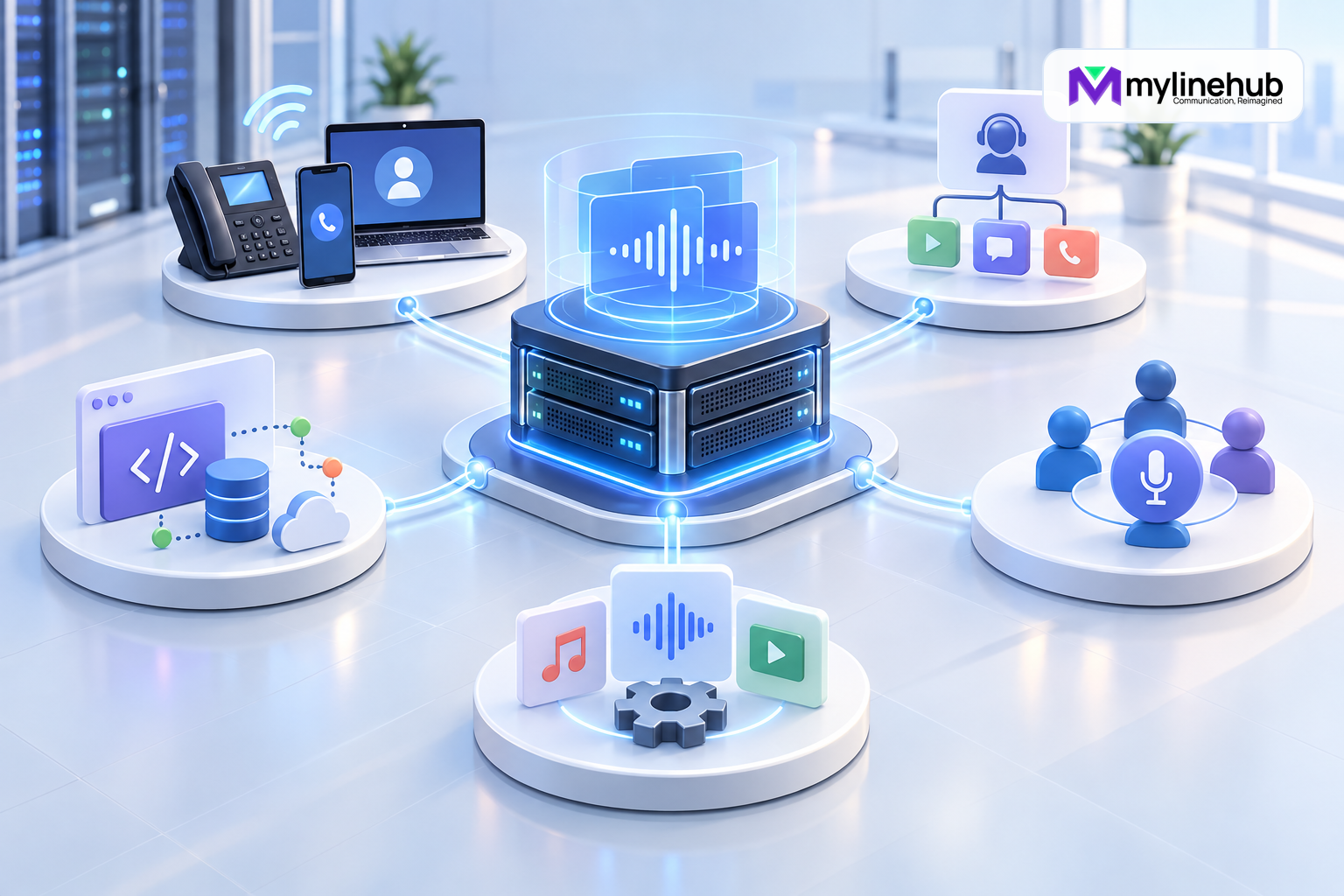
FreeSWITCH is an open-source communications platform designed to create and control real-time voice, video, and messaging sessions. It can operate as a PBX core, media server, conferencing platform, SIP application engine, gateway, or programmable component inside a larger communications product. It is not a telecom carrier, phone-number supplier, Internet connection, or finished operating model by itself.
The Core Works With Sessions and Channels
An endpoint originates or receives a call through a protocol module. One channel represents one leg and carries call state, media, and channel variables. A call can contain one or more channels; a bridge joins two channels so media can flow between parties. A session is the runtime container for a channel and the applications operating on it.
This leg-based model matters for reporting. One side can answer while another fails, and “completed” at the engine level may not equal a completed business conversation.
Modules Provide Most Capabilities
FreeSWITCH loads modules for endpoints, applications, codecs, file formats, dialplans, event handlers, loggers, languages, and speech functions. The official manual identifies mod_sofia as the primary SIP endpoint, mod_dptools for common dialplan applications, and mod_event_socket for external events and control.
A deployment should load the modules it intentionally uses and understand package and configuration dependencies. Adding every module increases operational and security surface without automatically improving the customer journey.
Configuration Has Three Main Domains
The directory answers who may connect and what properties apply. The dialplan answers where a call goes and what happens. Module and core configuration answers how the platform and each module behave. The default XML system assembles files from these areas into a runtime document.
Keeping these domains distinct makes troubleshooting clearer. A user can be correctly defined in the directory but sent to the wrong context; a dialplan can be correct while a SIP profile listens on the wrong interface.
SIP Profiles Define Independent Interfaces
The Sofia SIP module can run independent profiles, each bound to an address and port with its own transport, authentication policy, codec preferences, ACLs, and dialplan context. Deployments often separate internal endpoints from external carriers, but the exact design must match network and security requirements.
A profile being active does not prove provider service, correct number delivery, or RTP audio. Verify signalling and media through the real authorised path.
The Dialplan Runs Applications
The XML dialplan commonly uses contexts, extensions, conditions, and actions to match a call and execute applications. It can play prompts, collect digits, set variables, bridge endpoints, enter conferences, record where approved, or hand control to an external application.
Make routes explicit, bounded, and testable. Do not put credentials into dialplan files or let external input select arbitrary applications. Business campaign logic often belongs in a controlled application that uses documented interfaces and preserves state.
FreeSWITCH Is Strong in Media Workloads
It is used for conferencing, IVR, media playback, transcoding where codecs permit, WebRTC gateways, call routing, voicemail, and high-volume application-controlled communications. Architecture should still begin with traffic patterns, codecs, media path, recording, capacity, and failure requirements rather than assuming one server size or topology fits every workload.
Licensing and availability of particular codecs or commercial modules must be confirmed for the selected edition and installation source.
External Applications Use Events and Commands
The Event Socket is a TCP interface for commands, call control, and subscriptions to FreeSWITCH events. In inbound mode, an external client connects to FreeSWITCH; in outbound mode, FreeSWITCH connects a particular call leg to an external controller. The standard fs_cli tool uses inbound mode.
This interface is powerful and must be restricted with network controls, strong secrets, ACLs, least privilege where supported, and application validation. It should not be broadly exposed with default settings.
Events and CDRs Serve Different Needs
Events describe runtime transitions and can drive near-real-time applications. Call-detail record modules export per-leg records in formats such as CSV, XML, JSON, or database-backed forms depending on selected modules. Neither automatically creates the business relationship between campaign, customer, agent, and outcome.
An application must correlate stable identifiers, handle duplicate or delayed events, reconcile missed processing, define time zones, and protect phone numbers and recording references.
Why a Business Might Choose FreeSWITCH
It suits products and teams that need programmable session control, media handling, conferencing, gateway functions, or integration at scale. Its modular architecture supports focused deployments and different control models. Open source also permits inspection and adaptation.
The trade-off is engineering responsibility. The business needs people for Linux, networks, SIP, security, configuration, provider coordination, monitoring, testing, upgrades, data handling, and incident response. The software does not supply those roles.
Security and Operations Are Architectural
Bind services only where required, place management interfaces on controlled networks, change default secrets, apply ACLs, restrict SIP sources, protect configuration, and track supported software updates. Separate internal and external profiles where appropriate and validate the actual firewall and NAT path.
Back up configuration and application state, define restart and restore procedures, monitor resources and call journeys, and verify changes with real authorised calls. A running process is not proof that customers can reach the intended destination with two-way audio.
FreeSWITCH, Asterisk, and MYLO
FreeSWITCH and Asterisk overlap in many capabilities but differ in configuration concepts, modules, control interfaces, operational history, and team familiarity. Choose from requirements and ownership, not a claim that one is universally faster or better.
MYLO’s current prepared appliance architecture uses Asterisk as telephony truth. FreeSWITCH belongs in the wider architecture discussion or a separately engineered solution; it should not be presented as a hidden interchangeable MYLO component.
Evaluation Checklist
- Define call, media, conferencing, integration, and scale requirements.
- Choose supported edition, distribution, packages, modules, and upgrade ownership.
- Design directory, profiles, dialplan, configuration, and event control.
- Secure signalling, media, management, secrets, and recording access.
- Plan provider, network, power, monitoring, backup, and incident response.
- Build leg-aware reporting and reconciliation.
- Test realistic traffic, failures, restart, and end-to-end audio.
- Staff ongoing operations before committing production service.
FreeSWITCH is a capable communications foundation. Production value comes from a deliberate architecture around it.
Plan Scale From Sessions and Media
Estimate simultaneous channels, calls per second, codec negotiation, transcoding, conferences, recordings, prompts, event volume, and external-controller latency. A bridged call consumes multiple legs, and media-intensive features change CPU, network, and storage demand. Test the intended build and configuration with representative traffic.
Keep provider channel limits, agent capacity, and application throughput separate from FreeSWITCH capacity. A fast core cannot supply an unavailable agent or more carrier channels.
Configuration Changes Need Verification
FreeSWITCH assembles XML configuration and maintains live module and profile state. Editing a file does not prove the runtime accepted the intended value. Determine whether the change needs XML reload, profile rescan or restart, module reload, or a controlled service restart according to current documentation.
Protect active calls, back up, apply the smallest change, inspect loaded state, and test the affected journey. Preserve failure evidence and rollback outcome.
Choose a Supported Lifecycle
Select an edition, repository or build source, Linux release, modules, and update policy the team can sustain. Track security notices and compatibility, test upgrades, and retain reproducible package or build records. Exact defaults and module behaviour can change between releases.
Documentation should state the version it describes and link to the current official manual. Operational confidence comes from matching advice to the installed system, not from treating an old example as universal.
See the Platform Through a Practical Service Journey
Imagine an appointment-reminder service. An application requests a call through an authorised integration. FreeSWITCH creates an outbound session and channel, applies variables that identify the job, selects a dialplan route and originates a second leg through a SIP gateway. When the customer answers, an application can play a prompt, collect DTMF, transfer to a person, or end with a recorded result. Events describe runtime transitions while CDR output records per-leg facts for later reconciliation.
The same components can support an inbound service. A provider reaches an external Sofia profile, network and profile policy determine whether the source is accepted, and the selected context evaluates the called number. The route may enter an IVR, bridge to an internal user, connect to a conference or hand a leg to an external controller. Directory authentication, SIP-profile behaviour and dialplan routing solve different problems; a healthy registration therefore does not prove that the called number will reach the right destination.
This is why FreeSWITCH is better understood as a communications foundation than as a ready-made office product. A business still needs an application or managed layer that defines permissions, customer journeys, operating procedures, reports, data retention, alerts and safe change control.
Validate the Chosen FreeSWITCH Design
Begin a proof of concept with measurable outcomes rather than a generic load claim. Specify call direction, number of legs, codec set, expected concurrency and call-arrival rate, media features, event consumers, recording policy, network path and acceptable recovery time. Test normal calls as well as rejected authentication, no answer, busy, invalid digits, controller timeout, carrier loss, restart and one-way-audio conditions. Observe CPU, memory, network and storage with the intended modules and build.
The official FreeSWITCH core-concepts chapter defines channels, sessions, bridges, modules and the three configuration domains. The broader FreeSWITCH Users Manual covers SIP profiles, dialplan, media, applications and integration interfaces. Those current references should be matched to the deployed release because packages, defaults and available modules can change.
Before production, assign ownership for repositories or builds, module selection, configuration review, secrets, ACLs, certificates, monitoring, carrier coordination, backups, restore tests and security updates. FreeSWITCH can be an excellent fit when a capable team wants programmable media and session control. It is a poor fit when nobody owns the engineering and operational work that sits around the core.
Continue planning
Continue with MYLO Appliance vs MyLineHub Open Source: Which Path Fits?; What Is Asterisk, and Why Is It Used in Business Telephony?; How to Install FreeSWITCH on Debian or Ubuntu. For deeper implementation context, use MyLineHub technical architecture guidance.
For a requirement outside the prepared MYLO scope, discuss the exact outcome with MyLineHub.
Want to see API-driven CRM + Telecom workflows in action? Try the WhatsApp bot or explore the demos.
Comments (0)
Be the first to comment.