GSM Gateway vs SIP Trunk: Which Is Cheaper for Outbound Calling in India?
A practical comparison of SIM-based GSM gateways and SIP trunks, covering cost, scalability, reliability, and operational trade-offs for outbound calling in India.
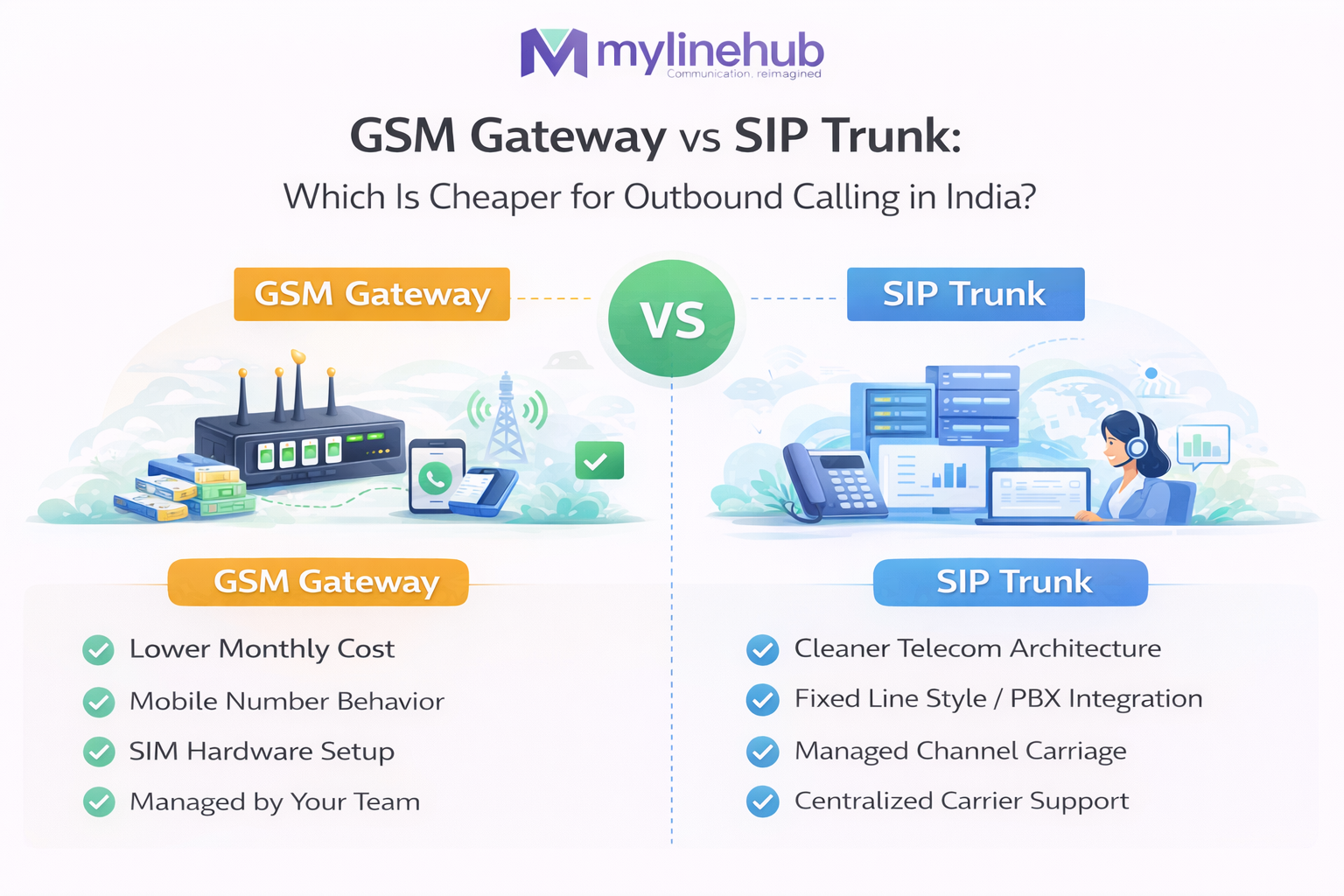
GSM Gateway vs SIP Trunk: Which Is Cheaper for Outbound Calling in India?
This is one of the most practical telecom questions businesses ask when they start planning serious outbound calling: Should we use a GSM gateway with SIM cards, or should we use SIP trunks?
The answer is not just technical. It is deeply financial. The wrong choice can lock a business into a recurring cost structure that feels fine in the beginning but becomes painful as call volume grows. The right choice can improve economics significantly, but only if the business understands what it is really buying.
In India especially, this question becomes more important because many teams want mobile-number based calling behavior, while enterprise telephony usually pushes businesses toward SIP-based, PBX-driven, landline-style telecom architecture. That difference changes cost, identity, operational behavior, and long-term planning.
- How GSM gateway and SIP trunk models differ economically
- Why monthly cost and one-time cost must be evaluated together
- How MyLineHub can reduce cost further in GSM-led architecture
- Why open-source software changes the economics materially
- When SIP trunks are cleaner and when GSM gateways can look cheaper
- How to think about break-even, scaling, and operational reality over time
Executive snapshot
Before going deep, here is the fastest serious summary: GSM gateway and SIP trunk are not just two calling tools. They are two different telecom operating models. One is more hardware-led and mobile-network-driven. The other is more carrier-led and IP-telephony-driven.
First, understand what each model really is
A GSM gateway connects physical SIM cards to an IP telephony environment. Each SIM behaves like a mobile line, and the gateway converts that connectivity into a form your PBX or telecom software can use.
- Mobile network based
- SIM-driven calling
- Commonly used where mobile-number behavior matters
- Needs hardware ports, antennas, SIM management, and gateway administration
A SIP trunk is an IP-based telecom connection provided by a telecom carrier. Instead of relying on physical SIM ports, it uses managed digital channels to carry voice through a PBX or calling platform.
- IP telephony based
- Channel-driven concurrency
- Cleaner fit for PBX, IVR, queues, reporting, and centralized telecom control
- Recurring carrier cost often becomes the main economic factor
What businesses are actually buying in each model
When a business buys GSM infrastructure, it is usually buying the ability to convert mobile-network connectivity into usable outbound voice capacity. When a business buys SIP, it is usually buying organized concurrent voice channels through a telecom-grade IP structure.
Ports, SIM slots, mobile network behavior, hardware routing, and a way to turn distributed mobile resources into outbound call capacity.
Concurrent digital call channels, carrier-managed connectivity, PBX integration, and a more standardized enterprise telephony framework.
Because the true cost is not only money. It is also architecture, control, scaling method, operational burden, and caller identity behavior.
Where MyLineHub changes the equation
This comparison becomes even more interesting when the GSM side is powered by MyLineHub. A major reason is simple: MyLineHub is open-source. That means businesses are not entering the usual software-license model where they keep paying recurring platform charges month after month.
Instead of a recurring software bill, the business mainly pays for deployment, setup, configuration, and feature-level customization. In practical terms, this changes the GSM economics materially because the ongoing software burden can remain very low compared to commercial dialer platforms or recurring telecom software subscriptions.
The power of MyLineHub in plain business terms
- No recurring software license in the usual commercial-platform sense
- Open-source foundation makes long-term software cost more controllable
- Businesses mainly pay for setup, deployment, integration, and feature requirements
- This can reduce total ownership cost further in GSM-led outbound operations
- Economics become especially attractive when the business wants cost control over time
The GSM gateway cost pattern
Based on the business-style approach discussed here, a GSM gateway setup can have a heavier one-time cost but a much lighter recurring monthly burden. When MyLineHub is used on the software side, the economics can improve further because software cost is primarily linked to setup and feature implementation rather than recurring license billing.
- 32-port GSM gateway: ₹85,000
- MyLineHub setup / customization / deployment: around ₹1 lakh to ₹1.5 lakh
- Actual setup depends on required features, integrations, workflow complexity, and implementation scope
- Infrastructure / installation / deployment support: as applicable
- SIM card recharge for 20 SIMs: ₹5,000
- Electricity: minimal / as applicable
- Maintenance burden: internal handling or support-led, depending on setup
- Software license: no recurring commercial software license in the typical paid-platform sense
From a business point of view, this means the GSM model can become not just capital-heavy but recurring-light, but in some cases also software-light over time. That is exactly where MyLineHub becomes strategically powerful.
Why open-source software changes the telecom cost story
In many outbound calling environments, buyers focus only on telecom channels, SIM costs, or hardware prices. But software cost is often where recurring pressure quietly accumulates. Monthly dialer subscriptions, user-based pricing, support contracts, and platform fees can become a long-term cost leak.
This is why MyLineHub deserves special attention in this comparison. Because it is open-source, the economics are different. The business does not keep paying a typical software license every month just to continue running the system. Instead, the business mainly invests in getting the environment set up correctly and enabling the features it actually needs.
| Software Cost Dimension | Typical Paid Platform Logic | MyLineHub Logic |
|---|---|---|
| License model | Recurring monthly or annual billing | Open-source base |
| Main software expense | Continuing subscription | Setup, deployment, customization |
| Long-term burden | Can accumulate month after month | Can remain lighter after setup |
| Control over cost | Vendor dependent | More implementation dependent |
| Best fit | Businesses comfortable with recurring software expense | Businesses prioritizing cost control and ownership-style economics |
The SIP trunk cost pattern
The SIP-based example shows the opposite shape. One-time entry can be more manageable, but the recurring cost becomes much heavier because channels, platforms, and support are purchased every month.
- SIP: 500 × 250 = ₹125,000
- Cloud autodialer / platform layer: ₹8,000
- Agency fees / support / operations: ₹15,000
- Total monthly cost: ₹148,000
- Total monthly calls: 3,150,000
- Effective cost around: 4.6 paisa per call
- Alternate variant reaches: below 5.2 paisa per call
This is what makes the comparison interesting. A SIP setup can look expensive every month, but if the system is driving extremely large outbound volume, the per-call math may still be efficient.
Side-by-side cost logic at a glance
| Cost Layer | GSM Gateway + MyLineHub | SIP Trunk + Paid Platform Pattern |
|---|---|---|
| What you buy first | Gateway hardware, setup, deployment, configuration | Channels, PBX routing structure, service platform |
| Software economics | Open-source base, setup-led expense | Usually recurring platform or service cost |
| Main burden at start | Higher setup and implementation | Lower physical setup burden |
| Main burden over time | SIM management and hardware operations | Monthly telecom and platform billing |
| Cost pain point | Front-loaded deployment effort | Recurring expense accumulation |
| Where MyLineHub helps | Reduces recurring software pressure | Not applicable in the same way |
So which one is cheaper?
The honest answer is: it depends on what “cheaper” means for your business.
SIP-led setups can feel easier to begin with when buyers want to avoid hardware-led deployment. But that first impression can become misleading if monthly platform and channel cost stays high.
GSM gateway setups can be dramatically cheaper on recurring monthly spend in the right use case, and MyLineHub can reduce the software side further by removing recurring paid-license pressure.
Over a longer operating window, the combination of lower telecom recurrence and open-source software economics can make GSM + MyLineHub especially attractive.
Break-even thinking: when does the upfront spend start making sense?
One of the most useful ways to evaluate the models is to ask a simple question: how many months of lower recurring spend does the GSM side need in order to recover its higher initial setup cost?
Using an illustrative business-style example with MyLineHub in the GSM stack:
| Illustrative Input | Value |
|---|---|
| GSM gateway hardware | ₹85,000 |
| MyLineHub setup / customization | ₹1,00,000 to ₹1,50,000 |
| Illustrative GSM recurring spend | Low, mostly SIM and operating cost |
| Illustrative SIP recurring spend | High, driven by channels + platform + support |
| Business takeaway | Break-even can arrive quickly when monthly savings are substantial |
Why mobile-number behavior changes the whole decision
In India, many businesses want outbound calls to appear from mobile-style numbers instead of landline-style enterprise telecom identifiers. This is one reason GSM gateway conversations happen so often.
That preference is not just branding. It affects pickup perception, routing preference, local behavior, and buyer psychology. Because of that, GSM and SIP are often not compared only on price. They are compared on identity + economics + operations.
Concurrency and scaling work very differently
A major reason this comparison gets misunderstood is that both systems can carry outbound calls, but they do not scale in the same way.
- Concurrency is tied to physical ports and active SIM resources
- Scaling may require more gateways, SIM groups, signal handling, and hardware planning
- Good planning can work well, but scaling is more infrastructure-led
- MyLineHub strengthens this model by avoiding recurring software lock-in
- Concurrency is tied to purchased channels
- Expansion is often cleaner in enterprise telephony environments
- PBX features, routing logic, IVR, and queues often integrate more naturally
- But recurring channel and platform cost can remain structurally heavier
| Scaling Dimension | GSM Gateway + MyLineHub | SIP Trunk |
|---|---|---|
| Concurrency unit | Port / SIM slot | Channel |
| Expansion method | Add hardware and SIM structure | Add carrier channels |
| Software cost pressure | Usually lighter after setup | Can remain recurring |
| Operational discipline needed | Higher | Usually cleaner |
| Telephony architecture cleanliness | Functional but hardware-led | More standardized and centralized |
Where GSM gateways powered by MyLineHub can look financially stronger
- When the business wants to reduce recurring telecom spend aggressively
- When SIM-based calling behavior is operationally desirable
- When the business wants to avoid recurring software license pressure
- When the team can handle hardware, ports, signal quality, and SIM administration properly
- When a one-time setup investment is acceptable in exchange for lower long-term operating cost
- When software cost control is strategically important
But GSM strength is not automatic
GSM gateway economics look attractive only when the environment is managed correctly. Port capacity, SIM lifecycle, signal quality, routing rules, local discipline, and operating consistency all influence whether the model remains efficient. MyLineHub improves the software-cost side, but the business still needs disciplined execution.
Where SIP trunks usually remain stronger
- When clean centralized PBX architecture matters
- When IVR, queues, reporting, conferencing, routing, and enterprise telecom logic are important
- When high concurrency must be handled in a more organized way
- When the business values standardized IP telephony over SIM-port infrastructure
- When operational simplicity and telecom cleanliness are more important than aggressive recurring-cost reduction
SIP trunking usually fits better into professional PBX ecosystems. It is cleaner from an IP telephony architecture perspective. The problem is not technical cleanliness. The problem is that recurring channel cost can grow heavily depending on scale, and that recurring burden may sit alongside ongoing platform or software expense as well.
Operational realities buyers often underestimate
SIM rotation, recharge discipline, port balancing, signal quality, antenna placement, and physical gateway management are all real work.
SIP is cleaner operationally, but it relies on provider quality, channel provisioning, IP stability, and overall PBX design discipline.
The cheaper monthly option is not automatically the easier option. Labor, monitoring, process consistency, and failure handling all matter.
A direct comparison table
| Dimension | GSM Gateway + MyLineHub | SIP Trunk |
|---|---|---|
| Initial setup cost | Hardware + setup + implementation, but software is open-source | Often easier or lighter to begin, depending on provider and platform model |
| Monthly cost structure | Can be much lower | Can become significantly higher due to recurring channel and platform costs |
| Software cost model | Setup-led, not recurring paid-license led | Often recurring platform or service expense |
| Mobile-number behavior | Strong reason businesses explore it | Usually more enterprise / fixed-line style |
| PBX integration cleanliness | Possible, but hardware-led | More natural and standardized |
| High concurrency architecture | Depends on ports, SIM groups, hardware planning | Cleaner channel-based scaling model |
| Operational burden | Higher due to SIM, signal, gateway, and hardware management | Usually cleaner from telecom operations viewpoint |
| Who often finds it attractive | Businesses optimizing recurring spend and software-cost control | Businesses prioritizing structured IP telephony and clean PBX logic |
12-month and 24-month thinking changes the answer
A short-term comparison often misleads buyers. Instead of comparing only first-month price, compare a real operating window such as 12 months or 24 months.
| Illustrative Window | GSM + MyLineHub Example | SIP Example |
|---|---|---|
| Upfront setup style | Gateway + deployment + feature setup | Lower physical deployment but recurring-heavy model |
| Software billing pattern | No typical recurring paid-license load | Recurring platform cost often remains |
| Month 12 perspective | Can become financially attractive faster | Recurring cost continues to accumulate |
| Month 24 perspective | Open-source software economics become more meaningful | Long-term recurring billing pressure becomes more visible |
Example thinking style
- If GSM costs more upfront but much less every month, its long-term economics may become attractive quickly.
- If the GSM stack uses MyLineHub, the software side can remain lighter because there is no typical recurring license burden.
- If SIP looks operationally cleaner but recurring cost remains heavy, the total spend over time may overtake the GSM model.
- If the business values flexibility, reporting, routing, IVR, and structured telecom integration above all else, SIP may still be the smarter architecture despite higher recurring cost.
What per-call economics can hide
Per-call cost is useful, but it can also hide important business realities. A low per-call figure does not automatically mean the system is better.
- Volume comparison at very large scale
- Benchmarking raw telecom efficiency
- Understanding how scale affects visible unit economics
- Hardware effort and SIM administration
- Routing quality and architecture limitations
- Downtime risk, maintenance work, and scaling friction
- Recurring software or platform burden on non-open systems
Hidden business factors that pricing sheets do not always show
GSM may need more hands-on management around hardware, signal, SIMs, and port planning.
SIP usually integrates more cleanly with IVR, queues, recording, analytics, and centralized telecom systems.
MyLineHub adds a major advantage because open-source deployment can reduce recurring software pressure and improve long-term ownership economics.
This is why the “cheaper” answer is never universal. Telecom cost is architecture-dependent, use-case dependent, scale dependent, and often software-structure dependent as well.
Decision matrix: which side usually wins under which priority?
| Business Priority | Likely Lean | Why |
|---|---|---|
| Lower recurring spend | GSM + MyLineHub | Monthly cost structure can be lighter and software cost pressure can also reduce |
| Structured PBX / IVR environment | SIP Trunk | Integration and routing are usually cleaner |
| Mobile-style number behavior | GSM + MyLineHub | SIM-led identity logic remains a major driver |
| High concurrency with centralized control | SIP Trunk | Channel-based scaling is generally more organized |
| Higher upfront okay, lower long-term cost wanted | GSM + MyLineHub | Front-loaded spend may improve long-term economics significantly |
| Lower operational complexity preferred | SIP Trunk | Usually less hardware and SIM management load |
| Software ownership-style economics matter | GSM + MyLineHub | Open-source base changes software cost logic materially |
So which businesses should lean toward MyLineHub-powered GSM?
- Businesses that strongly want mobile-number based calling behavior
- Teams that are highly sensitive to recurring monthly telecom cost
- Organizations that also want to reduce recurring software-platform cost
- Operations that can support hardware-led telecom discipline
- Organizations comfortable with a setup investment in exchange for lower long-term pressure
- Businesses that prefer open-source economics over recurring software lock-in
Which businesses should still lean toward SIP?
- Businesses building structured PBX and IVR-led operations
- Teams that want clean enterprise IP telephony architecture
- Operations needing well-managed channels, standardized routing, and deeper central telecom logic
- Businesses where architecture clarity matters more than aggressive recurring-cost cutting
- Organizations that prefer cleaner scaling over SIM-port-style infrastructure handling
Final strategic view
FAQ
How does MyLineHub reduce cost further?
MyLineHub changes the software side of the equation. Because it is open-source, businesses do not carry the same recurring software-license burden that many commercial platforms introduce. The main cost is setup, customization, and deployment based on required features.
Is MyLineHub software free?
The stronger way to describe it is this: MyLineHub is open-source, so businesses do not typically pay recurring commercial software license fees in the usual platform sense. They mainly invest in setup, implementation, integrations, and feature-level requirements.
What setup cost should businesses expect for MyLineHub?
A practical setup range can be around ₹1 lakh to ₹1.5 lakh, depending on the feature set, integrations, customization scope, and deployment complexity required by the business.
Is GSM always cheaper than SIP?
No. GSM often looks cheaper on recurring monthly spend, but the full decision depends on one-time cost, operational burden, scale, and architecture fit. MyLineHub can improve the GSM-side economics further, but the right choice still depends on the business model.
Why do businesses in India still consider GSM gateways?
A major reason is the desire for mobile-number based calling behavior and potentially lower recurring telecom cost. When paired with MyLineHub, the software-cost logic can also become more attractive.
Why do SIP trunks still remain attractive?
Because they fit more cleanly into organized IP telephony systems, PBX routing, IVR, queues, reporting, and centralized control.
Which one is better for long-term scale?
SIP often offers a cleaner structured scaling model, but GSM combined with MyLineHub can still be financially attractive for certain use cases if operationally managed well and if long-term recurring cost control matters.
What is the real hidden cost in GSM?
Usually not just money. The hidden cost is operational attention: SIM administration, signal quality, port usage discipline, and hardware maintenance.
What is the real hidden cost in SIP?
Usually recurring billing accumulation. The system may be cleaner, but the monthly cost stack can become large over time.
Conclusion
GSM gateway and SIP trunk models are not just two telecom options. They represent two different business cost philosophies. GSM often means higher upfront commitment and lower recurring pressure. SIP often means cleaner IP telephony structure with heavier monthly cost exposure.
But the comparison becomes even more powerful when the GSM side is built with MyLineHub. Because MyLineHub is open-source, the software layer does not keep adding the same recurring commercial-license burden that many paid platforms do. That means the business may only need to invest in setup, implementation, and the features it actually requires.
So which is cheaper for outbound calling in India? In many practical scenarios, GSM can look cheaper on monthly economics. And when MyLineHub is part of that stack, the economics can improve further because the software model itself is more ownership-oriented and less license-heavy.
The right question is not: “Which one is cheaper on paper?”
The better question is: “Which model gives my business the right combination of cost, identity, control, software ownership, and long-term telecom stability?”
Want to see API-driven CRM + Telecom workflows in action? Try the WhatsApp bot or explore the demos.
Comments (0)
Be the first to comment.