Real Cost of Running a Call Center in India: Cloud vs GSM vs On-Premise (With Actual Numbers)
A data-driven breakdown of actual call center costs in India using real deployment numbers, comparing cloud dialers, SIP infrastructure, and GSM gateway setups.
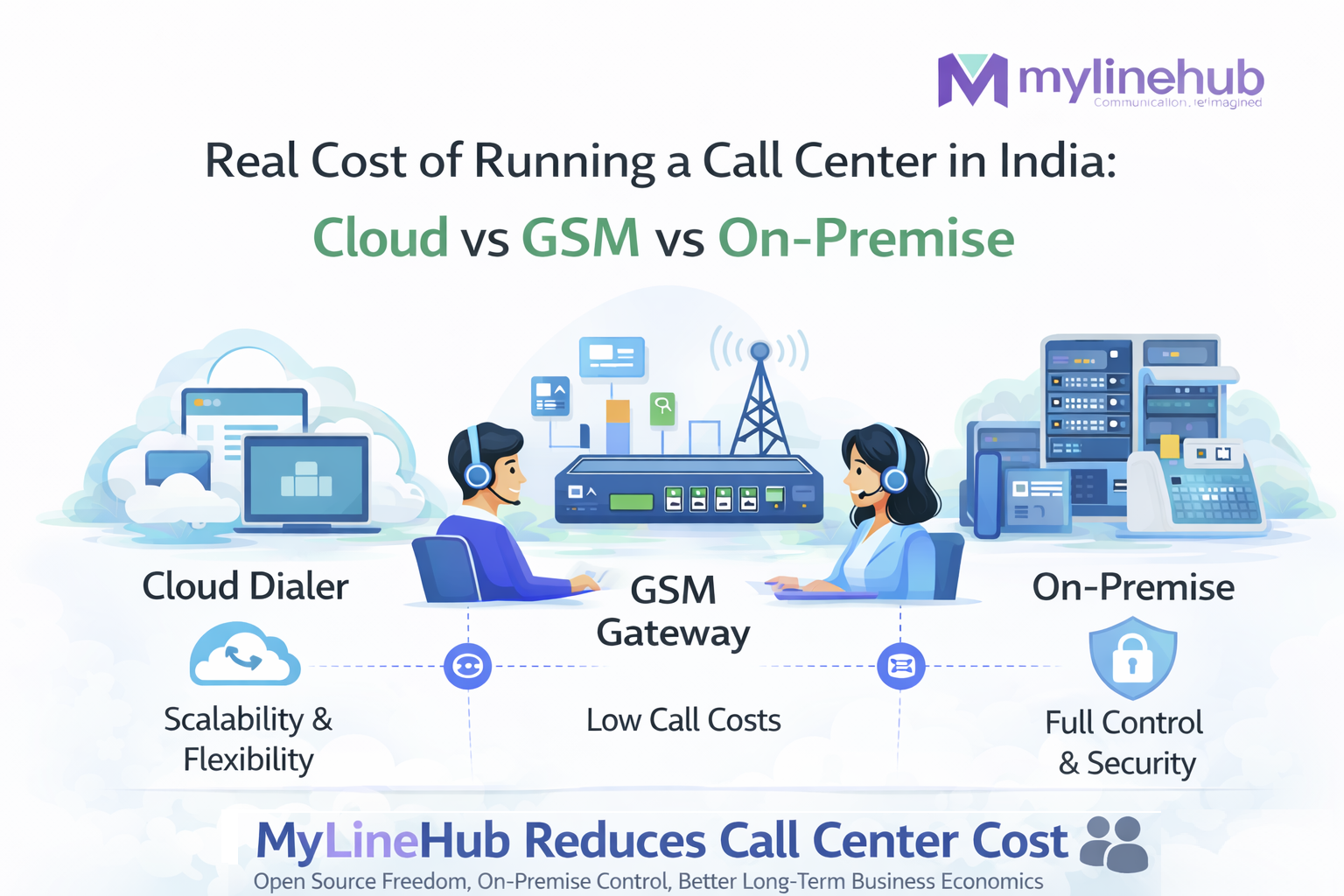
Cloud vs GSM vs On-Premise: What Comes Where, and Why MyLineHub Fits a Different Class of Business
Most telecom comparisons start in the wrong place. Before a business compares monthly cost, it needs to understand what each deployment model actually is, what belongs inside that model, and what kind of control the business keeps or gives up.
Read the architecture first. Then separate Cloud from GSM. Then see why On-Premise changes the picture for MyLineHub.
First Understand the Architecture
Before comparing pricing, compare the deployment model, routing logic, and control level.
Cloud
- Vendor-managed delivery
- SIP-based telephony path
- Hosted platform model
- Bounded by provider structure
GSM Gateway
- SIM-based routing model
- Physical hardware device
- Port and gateway setup
- Not the normal cloud pattern
On-Premise
- Business-controlled deployment
- More customization freedom
- Better integration control
- Stronger ownership and flexibility
MyLineHub belongs in the richer-control, on-premise class
MyLineHub fits best in open-source, on-premise, feature-rich environments where businesses want more control, deeper integrations, stronger workflow freedom, and long-term architecture flexibility.
- Cloud usually means SIP-led vendor delivery, not GSM gateway delivery.
- GSM gateway is hardware and SIM-led, not the normal cloud pattern.
- On-premise means the business controls more — deployment, integrations, workflows, and ownership.
- MyLineHub belongs naturally to the richer-control side of the market.
- Cost should come after architecture clarity, not before it.
What this page should make obvious
- Cloud is normally SIP-led.
- GSM is hardware + SIM-led.
- GSM cannot simply be treated as normal cloud architecture.
- MyLineHub is strongest in more open, more controlled deployments.
What “Cloud” actually means in this context
In telecom and call center buying, Cloud usually means the system is delivered through a vendor-managed platform. The infrastructure, platform logic, and telephony routing are largely defined by the cloud provider’s design.
In that model, what businesses usually get is SIP-based connectivity, cloud dialer behavior, hosted platform logic, and a workflow that depends materially on the cloud vendor.
- SIP line or SIP-based telephony path
- Vendor-managed dialer layer
- Hosted routing and control structure
- Dependency on cloud provider product boundaries
- Faster launch, but less infrastructure freedom
- A typical physical GSM gateway setup
- SIM-port-led routing inside the normal cloud product model
- Deep hardware-level telecom ownership by the customer
- Unlimited flexibility beyond what the cloud vendor exposes
Why GSM Gateway is not the same as Cloud
A GSM gateway is fundamentally different. It is a physical telecom layer that works with SIM cards and gateway hardware. It is not the normal architecture that comes bundled in a cloud dialer product.
That matters because many buyers accidentally compare cloud and GSM as if one is just a cheaper version of the other. It is not. They are different deployment worlds.
- Physical gateway hardware
- SIM-based telecom routing
- Port and signal considerations
- Different operational discipline
- Hosted platform logic
- SIP-led telecom path
- Vendor-controlled environment
- Less local telecom ownership
- Both can be used for outbound calling
- Both may sound like “call center systems”
- But their architecture, routing, and control model are different
What “On-Premise” really means — and why this is where MyLineHub becomes stronger
On-Premise means the business is not just renting a screen from a cloud vendor. It means the business has much more say over the deployment layer, infrastructure logic, internal control, workflow structure, and integration depth.
This is exactly where MyLineHub should be understood properly. MyLineHub is stronger because it sits naturally in the open-source, on-premise, feature-deep model. That matters far beyond pricing.
- On-premise deployment flexibility
- Open-source software logic
- Deeper customization possibilities
- Richer control over workflows and architecture
- More room than standard cloud products usually allow
- More control changes process design
- Process design changes output quality
- Output quality changes long-term economics
- Feature depth is not cosmetic — it changes the business result
Provider-Shaped Cloud vs Business-Controlled MyLineHub
A cloud system can be convenient, but it also means the business works inside the cloud vendor’s product shape. The SIP line, routing style, exposed features, workflow limitations, and scaling model are often influenced by what the provider supports.
MyLineHub changes that because it does not start from the same assumption. It starts from a model where the business can own more of the environment and shape more of the outcome.
| Question | Cloud-Led Pattern | MyLineHub-Led Pattern |
|---|---|---|
| What telephony path usually comes first? | SIP line via provider / hosted telecom pattern | Can be designed around broader on-premise architecture needs |
| Who shapes the workflow boundaries? | The cloud vendor product model | The business has more room to shape the environment |
| Can the business build deeper feature logic? | Often limited to what is exposed by the product | Usually much stronger in controlled deployments |
| What happens to software dependence? | Provider dependence stays higher | Ownership and control can improve materially |
| Where does MyLineHub stand out? | Not mainly in SaaS convenience comparison | In deeper control, richer capability, and long-term flexibility |
Why feature richness matters more than people think
Businesses often talk about features as if they are just a checklist for sales. That is too shallow. In real operations, feature depth affects process design, team behavior, efficiency, monitoring, integration quality, and eventually cost quality.
This is one of the reasons MyLineHub should be positioned strongly. It is not only about cost reduction. It is about enabling a stronger system with more room for serious business processes.
More control means the business is less trapped by a provider’s assumptions.
More process power means workflows can reflect real operating needs, not just generic vendor templates.
That is why MyLineHub should be understood as a stronger business layer, not just a calling interface.
Where cost comes into the picture
Cost still matters. But it should come after the deployment model is understood correctly. Once the business knows whether it wants a cloud SIP-led model, a GSM gateway-led model, or an on-premise ownership model, then cost comparison becomes much more meaningful.
This matters a lot for MyLineHub. If a buyer evaluates MyLineHub only against quick-launch cloud convenience, the comparison is incomplete. But if the buyer evaluates it against control, feature depth, ownership, flexibility, long-term software pressure, and strategic independence, then the picture becomes much clearer.
How to explain this properly in business terms
A simple way to explain the difference is this:
Cloud gives convenience, but usually through a SIP-led vendor model. It is useful where the business wants speed and hosted simplicity.
GSM gateway belongs to a different architecture class — hardware, SIM routing, and different telecom behavior.
MyLineHub stands out in richer, on-premise, open-source environments where the business wants stronger capabilities and more freedom.
What this means for small teams vs serious-scale teams
The right fit still depends on the stage of the business. Very small teams may still choose cloud because speed and lower deployment responsibility matter more than architecture depth. That does not weaken MyLineHub. It simply clarifies who benefits most from it.
As the business grows, and especially when workflows become more serious, integrations become more important, and ownership matters more, MyLineHub becomes a much stronger answer.
| Buyer Type | What They Usually Need | Where MyLineHub Looks Strongest |
|---|---|---|
| Very small, quick-launch team | Speed and convenience | Not always the primary advantage zone |
| Process-driven growing team | More control and better workflow power | Strong |
| Ownership-led serious operation | On-premise control, flexibility, depth, integration freedom | Very strong |
| Scale-conscious larger business | Long-term architecture quality and reduced dependence | Much stronger |
FAQ
Can a normal cloud model include GSM gateway the same way?
In normal business comparison language, cloud usually refers to a hosted SIP-led vendor model. GSM gateway belongs to a different architecture pattern built around physical telecom hardware and SIM routing.
What usually comes in cloud telephony?
Usually a SIP line, hosted platform logic, and workflow that depends to a meaningful extent on the cloud provider’s model and boundaries.
Why is MyLineHub positioned differently?
Because MyLineHub is stronger in open-source, on-premise, feature-rich environments where the business wants more ownership, more control, and more room to build serious workflows.
Is cost the main reason to choose MyLineHub?
Cost matters, but it is not the first reason. The first reason is usually architecture quality, feature depth, deployment control, and long-term flexibility. Cost becomes more meaningful after that.
What is the biggest MyLineHub advantage beyond pricing?
It gives the business a stronger operating layer: more deployment control, more feature freedom, more process power, and better ownership of the environment.
Conclusion
Cloud, GSM Gateway, and On-Premise should not be treated as three simple price columns. They are three different deployment models, with different routing logic, different operating assumptions, and different business implications.
Cloud usually means a SIP-led, vendor-shaped, hosted model. GSM gateway usually means a physical SIM and hardware-led model. On-premise means the business moves into a more controlled, more flexible, more ownership-oriented environment.
That is why MyLineHub should be understood differently. Its strength is not only that it can reduce pressure on long-term cost. Its strength is that it gives serious businesses more capability, more control, more feature depth, and more freedom to shape the system properly.
Want to see API-driven CRM + Telecom workflows in action? Try the WhatsApp bot or explore the demos.
Comments (0)
Be the first to comment.