Manual Calling vs Automated Calling: Real Cost Comparison
See the real math behind manual calling versus automated dialing, including productivity, cost per lead, and long-term scalability.
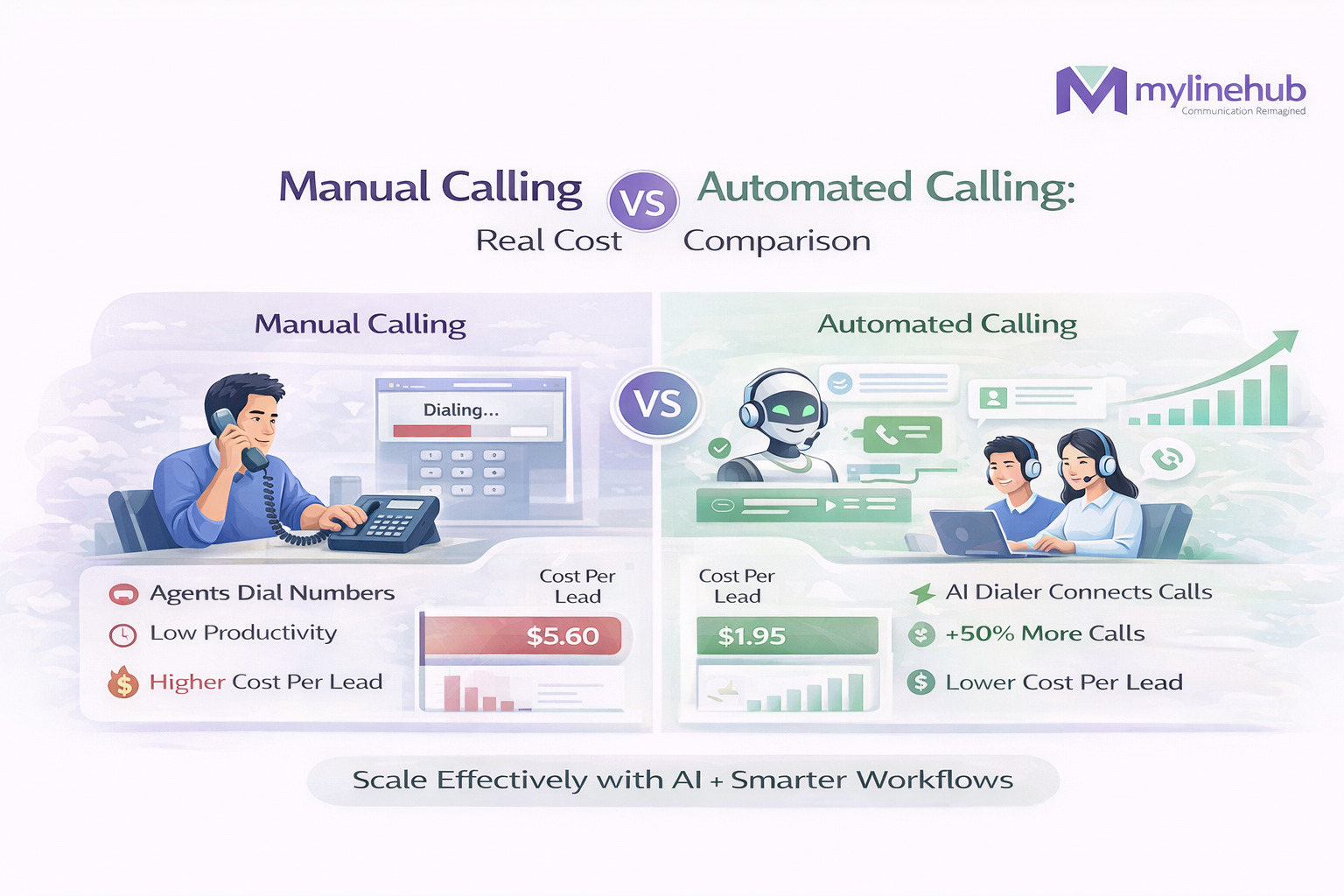
Most businesses underestimate how expensive “manual calling” really is. They only count salary and phone bill. They don’t count the silent costs: idle time between attempts, wrong follow-ups, missed callbacks, inconsistent lead notes, quality leakage, and the management overhead needed to keep the team productive. Automated calling is not just “a dialer that presses numbers faster” — it is a system that converts wasted minutes into productive conversations by using telecom events, scheduling, workflows, and (now) AI voice to handle repetitive tasks.
This article compares manual calling vs automated calling in a way that matches how costs show up in real businesses: cost per connected conversation, cost per qualified lead, cost per conversion, and cost per month of operations. The goal is not to “sell automation.” The goal is to help you see where money is leaking and what a durable fix looks like when you want scale without permanently increasing payroll.
MYLINEHUB is an open-source omnichannel CRM + telecom control layer that helps businesses move from manual calling to automated calling without vendor lock-in and without per-agent license pressure. Codebase: https://github.com/mylinehub/omnichannel-crm. It also includes an open-source AI calling bridge (VoiceBridge) that connects Asterisk/FreePBX call legs to external AI bots: https://github.com/mylinehub/omnichannel-crm/tree/main/mylinehub-voicebridge. This matters because “automation” is no longer only about dialing speed — it’s about routing, outcomes, follow-ups, and AI calling that reduces human workload safely.
Before the comparison, define two terms clearly. Manual calling means: the agent decides who to call, dials, waits for ring, handles drops, writes notes, and remembers follow-ups with minimal system enforcement. Automated calling means: the system decides the next best number to call (based on rules), dials using dialer strategies, detects call outcomes via PBX events, logs automatically, schedules follow-ups, and routes work to agents with consistent next actions.
The first cost category is agent idle time. In manual calling, idle time comes from: searching records, copying numbers, waiting for ringing, re-dialing after failures, switching tools, and doing admin work. Even strong agents lose a surprising amount of time here. Automated calling reduces idle time by controlling the calling loop: list selection, dialing, retry rules, logging, and disposition discipline. If you want the underlying reasons why telecalling teams become expensive over time, read: https://mylinehub.com/articles/why-your-telecalling-team-is-expensive.
Think of it like this: you pay for 8 hours of agent time, but only 3–5 hours might be real “talk time” if the operation is manual and loosely managed. Automated calling aims to increase “talk time per paid hour” without turning your floor into a chaotic pressure cooker. That is why dialer strategy matters: progressive/power/predictive are not the same thing, and the correct choice depends on compliance, lead quality, and campaign intent. See: https://mylinehub.com/articles/types-of-autodialer-strategies-explained.
The second cost category is connect rate and wasted attempts. Manual calling treats all failed attempts similarly: call again later. Automated calling uses call outcomes to decide what to do next. For example, a “busy” outcome may trigger a short retry window; “no answer” may trigger a longer window; “call rejected” may reduce attempt frequency; “invalid number” may mark the record for cleaning. These are not fancy features — they are cost controls. Every wrong retry wastes telecom minutes and agent time.
MYLINEHUB’s calling automation is built to integrate with Asterisk/FreePBX so that call outcomes are not guessed — they are captured from PBX events and controlled systematically. In particular, modern event control via ARI enables better understanding of call state transitions (ringing, answered, hangup causes, early media, etc.), which helps improve campaign logic and connect rate workflows. For the connect-rate and event-driven dialer logic perspective, read: https://mylinehub.com/articles/increase-call-connect-rate-outbound-campaigns.
The third cost category is callbacks and follow-up timing. A large percentage of conversions happen on a follow-up, not the first call. Manual teams often lose money here because follow-ups are remembered, not enforced. Agents forget. Supervisors cannot see what’s missing until it is too late. The system becomes dependent on individual discipline. Automated calling changes the model: callbacks become scheduled objects, campaigns run in legal time windows, and missed calls trigger an automatic next action. This reduces missed revenue and reduces the stress of supervision. See: https://mylinehub.com/articles/call-center-scheduling-campaigns-callbacks.
The fourth cost category is quality leakage. Manual calling often produces inconsistent scripts, inconsistent lead qualification, and inconsistent notes. That inconsistency forces more calls later because the earlier call didn’t capture the right information. Automated systems don’t remove humans from conversations — they standardize the workflow around the conversation so data and next actions don’t depend on memory. This also improves reporting accuracy because outcomes are not “free text” chaos.
The fifth cost category is management overhead. Manual operations require heavy supervision to maintain minimum productivity: managers track lists, chase attendance, monitor random calls, push agents to complete follow-ups, and fight data inconsistency. Automated operations reduce the “manual policing” component by making activity visible and workflow-driven. That does not mean “no supervision.” It means supervisors can focus on coaching and funnel improvement rather than chasing basics. For the monitoring angle without harming productivity, see: https://mylinehub.com/articles/how-to-track-call-center-employees-effectively.
Now let’s talk about the numbers in a realistic way. Even if you do not know your exact metrics, you can model the comparison using a simple structure: (1) paid agent hours per month, (2) average talk time ratio, (3) connects per hour, (4) qualification rate, (5) conversion rate, (6) average revenue per conversion. Manual calling typically underperforms on (2) and (3) because the loop is slower and the retry logic is human-driven. Automation typically improves (2) and (3), and then the improvement cascades into (4) and (5) because follow-ups become consistent.
Example reasoning (without pretending your business is identical): if an agent is paid for 8 hours but only 4 hours becomes real talk time, you effectively pay double for every minute of conversation. If automation raises talk time to 5.5 hours without changing salary, you just improved output by 37.5% for the same payroll. This is why “automation ROI” is often larger than telecom savings. Telecom minutes are real, but the biggest number in most calling teams is payroll.
A common trap is buying a closed platform that charges per agent license. That model eats your savings as you scale: every new agent increases software rent. MYLINEHUB avoids that pressure because it is open source. You can deploy it in your own environment and keep using it long-term without per-seat licensing. This is especially important for seasonal businesses or fast-growing teams where head count changes month to month. If data ownership and long-term control is a priority, read: https://mylinehub.com/articles/how-to-make-sure-your-business-data-remains-yours.
Another trap is assuming “automation = cloud CPaaS.” CPaaS is useful for APIs, but contact-center automation often needs deeper control: predictable event handling, custom dialer logic, stable data retention, and integration that doesn’t break when business rules get complex. MYLINEHUB can work alongside Asterisk/FreePBX so you keep telecom control where it belongs and add automation at the control layer. For CPaaS context, see: https://mylinehub.com/articles/what-is-cpaas.
Where AI calling fits into the comparison is simple: manual calling uses expensive humans for repetitive interactions. Automated calling reduces wasted minutes. AI calling goes further by handling entire categories of calls that don’t need a human at all: initial qualification, confirming intent, collecting basic data, appointment scheduling, and routine reminders. The best model is not “replace agents.” It is “route humans only when it matters.” MYLINEHUB VoiceBridge enables AI calling while keeping your telecom infrastructure and your data ownership intact. For broader AI calling use-cases, see: https://mylinehub.com/articles/ai-calling-for-interviews-and-business-growth.
This is where architecture matters. Many AI calling demos fail in real operations because audio becomes one-way, latency grows, or concurrent calls break the system. VoiceBridge exists because real duplex voice and production telecom behavior require disciplined RTP handling, event control, and safe integration to Asterisk/FreePBX. If you want the deep architecture layer, see: https://mylinehub.com/articles/open-source-full-duplex-asterisk-ai-voice-bot-bridge-voicebridge and https://mylinehub.com/articles/mylinehub-voicebridge-architecture.
So what’s the final comparison in one sentence? Manual calling costs more because it depends on humans to run the calling system. Automated calling costs less because the system runs the calling loop and humans only execute the high-value part. When you add open source into the equation, the cost advantage becomes durable: you are not paying forever for the right to keep using your own operational process.
If your business is already using FreePBX, Asterisk, or a telecom stack you don’t want to replace, MYLINEHUB’s approach is deliberately clean: keep telephony stable, add a control layer for dialer + CRM workflows, and add VoiceBridge for AI calling where it creates the biggest reduction in human workload. See integration references: https://mylinehub.com/articles/freepbx-mylinehub-integration-flow and https://mylinehub.com/articles/autodialer-for-freepbx-mylinehub.
The moment you treat calling as an engineered pipeline instead of an “agent activity,” the economics change. You stop scaling cost linearly with lead volume. You can handle more leads without hiring more agents, and you can keep software ownership inside your business rather than renting it forever. If you want the “scale without hiring” angle in depth, read: https://mylinehub.com/articles/handle-more-leads-without-hiring-more-agents.
Want to see API-driven CRM + Telecom workflows in action? Try the WhatsApp bot or explore the demos.
Comments (0)
Be the first to comment.