Why Your Telecalling Team Is Expensive (And How to Fix It)
Most telecalling teams become expensive due to low utilization and manual workflows. Learn where money leaks and how modern teams fix it.
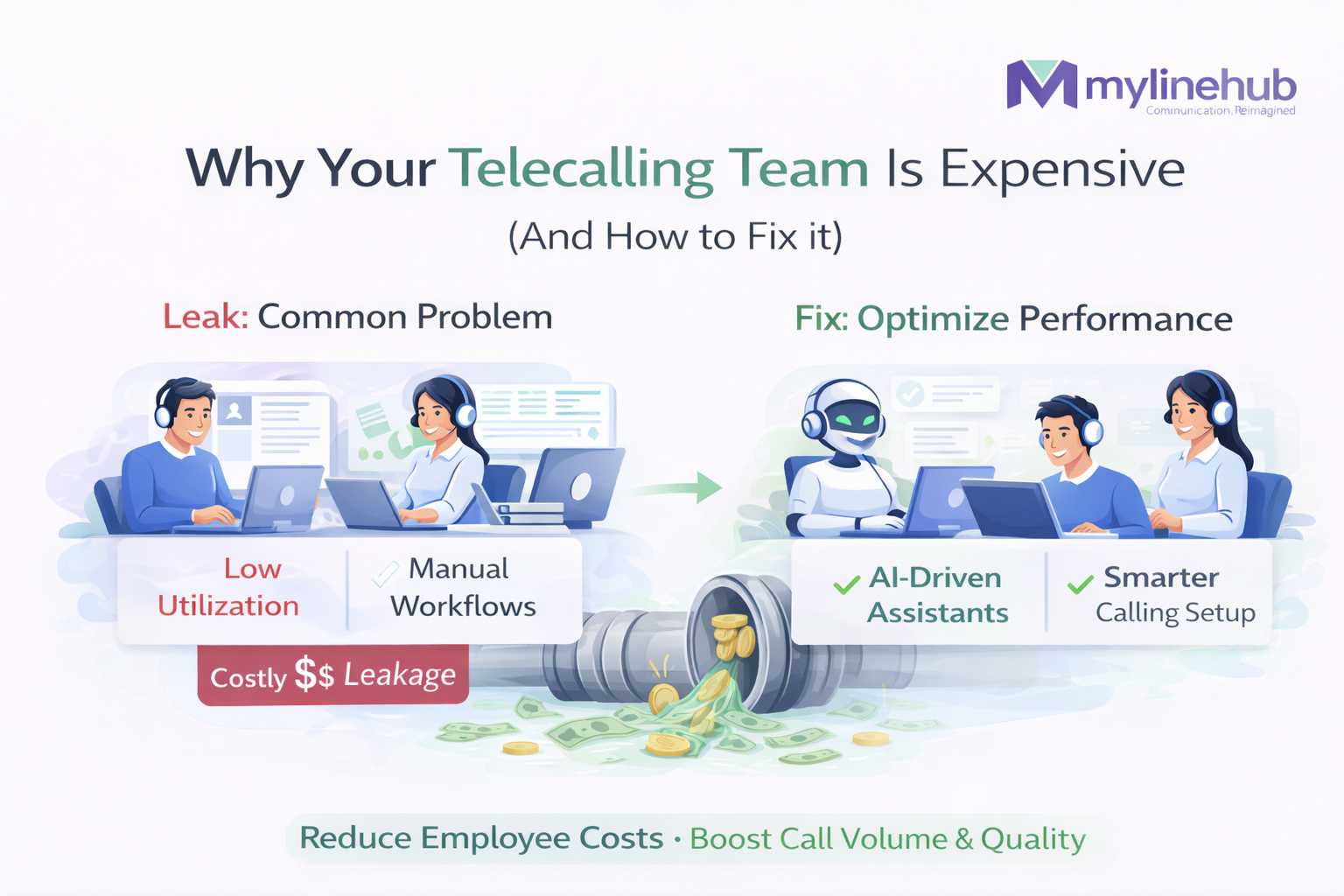
Most businesses think their telecalling team is expensive because “salaries are high” or “agents are not productive”. In reality, your team becomes expensive when the system forces humans to do machine-work: manual dialing, copying data between tools, repeating the same questions, chasing callbacks from memory, and operating with low visibility. When this happens, you pay full salary for partial output.
This article breaks down the real cost drivers behind telecalling and shows how an open-source telecom + omnichannel control layer like MYLINEHUB reduces cost without reducing performance—by removing structural waste, improving connect efficiency, and enforcing workflow discipline. MYLINEHUB is open-source: https://github.com/mylinehub/omnichannel-crm.
The hidden truth: “expensive team” usually means “low output per hour”
Telecalling is a volume game. Your unit economics are decided by what happens per agent-hour: how many real connects happen, how many meaningful conversations happen, and how many outcomes are captured correctly.
If your team does not have a strong system, even good agents spend time on low-value actions: searching contact history, dialing numbers one by one, checking WhatsApp separately, writing notes in random places, and remembering follow-ups manually. The business then experiences the team as “costly” because conversion doesn’t scale with headcount.
Cost is not only salary. It is salary multiplied by inefficiency, leakage, and rework.
7 reasons telecalling becomes expensive (and most leaders miss them)
When leaders say “telecalling is expensive”, they usually mean “we add people but results don’t grow”. Below are the real reasons.
1) Manual dialing wastes the most paid minutes
Manual dialing looks small per call, but it accumulates into massive idle time. Between picking a lead, dialing, waiting, handling no-answers, and updating notes, agents lose time that should have been replaced by structured dialing strategy.
Dialing strategy is not one feature; it is pacing, retries, lead ordering, compliance windows, and disposition-driven next steps. Learn dialing strategies here: https://mylinehub.com/articles/types-of-autodialer-strategies-explained.
If you use FreePBX and want a clean dialer integration model: https://mylinehub.com/articles/autodialer-for-freepbx-mylinehub.
2) Callback leakage silently destroys conversion
Missed callbacks are not just “missed calls”. They are missed intent. A callback is usually a warm moment—if you miss it, you pay again (extra calls, extra time, extra discounting, extra remarketing) to regain attention.
Callback systems fail when callbacks are “notes” instead of scheduled workflow objects. This is why scheduling is critical: https://mylinehub.com/articles/call-center-scheduling-campaigns-callbacks.
3) Tool switching turns agents into “data entry operators”
When calling, WhatsApp, CRM, and reporting are separate tools, your team spends part of every hour switching screens, copying details, searching history, and fixing mismatched records. This increases cost in two ways: (a) fewer calls per hour, and (b) more mistakes and missed follow-ups.
The fix is not more discipline; it is a unified customer timeline—this is the real meaning of omnichannel CRM. Start here: https://mylinehub.com/articles/what-is-omnichannel-crm. And the difference between omnichannel and multichannel: https://mylinehub.com/articles/omnichannel-vs-multichannel.
4) Missed inbound leads create “recovery cost”
Many telecalling teams are expensive because the business leaks leads: missed calls are not captured into workflow, WhatsApp messages are not responded instantly, and follow-ups are not enforced. The business then spends again on ads, campaigns, or discounts because the original lead was wasted.
A lead capture + automation mindset is explained here: https://mylinehub.com/articles/never-miss-a-customer-using-telecom-apis.
5) Per-seat licensing makes growth financially painful
Many stacks charge per seat for CRM, dialer, WhatsApp, analytics, and add-ons. Every time you hire, software becomes more expensive. This creates a structural problem: the business wants to scale calling, but the tooling cost scales linearly with headcount.
MYLINEHUB is open-source, so the stack is owned, not rented. Your growth should not become a permanent license tax. Open-source does not mean low quality; it means you get auditable code, ownership, and long-term control—especially important in telecom, where vendor dependency can trap businesses for years.
If data ownership matters to you, see: https://mylinehub.com/articles/how-to-make-sure-your-business-data-remains-yours.
6) Lack of visibility makes coaching impossible (so inefficiency repeats)
Without good monitoring, managers only see outcomes, not causes. They blame agents, leads, or markets, but they cannot find where time is being lost (idle time, low connect rate lists, wrong retry logic, poor callbacks, weak scripting).
Responsible monitoring does not kill productivity—it improves it by making reality visible: https://mylinehub.com/articles/how-to-track-call-center-employees-effectively.
7) Telecom instability creates “downtime cost” (the most expensive cost)
When telecom is unstable—one-way audio, dropped calls, poor routing, recording failures—you pay for a team that cannot perform. The cost is not only wasted salary; it is lost customer trust and lost revenue.
This is why MYLINEHUB integrates in a way that keeps telephony clean and stable, especially with FreePBX: https://mylinehub.com/articles/freepbx-mylinehub-integration-flow.
How MYLINEHUB reduces telecalling cost without reducing performance
MYLINEHUB reduces cost by improving output per agent-hour and reducing leakage, not by reducing quality. It does this through a telecom control layer + omnichannel workflow layer that you can run on-prem or hybrid, with full ownership.
Unify calls + WhatsApp + CRM timeline
Agents should not search history across tools. When every interaction lives in one timeline, repeated questions reduce, follow-ups become consistent, and customers feel continuity.
Enforce callback and campaign scheduling
Scheduling is not a “nice-to-have”. It is a conversion protection mechanism. When campaigns and callbacks are scheduled as system-enforced objects, leakage reduces and the same team produces more predictable results.
Use APIs to integrate without ripping your system apart
Many businesses want benefits of automation but cannot replace their existing CRM or workflow software. MYLINEHUB supports API-driven integration so telecom events can be pushed into your system safely.
See telecom-CRM integration approach: https://mylinehub.com/articles/crm-telecom-api-integration-mylinehub.
Scale safely by controlling multiple telecom servers
Scaling call operations often fails when everything is forced onto one PBX. MYLINEHUB supports a loosely coupled architecture that can control multiple Asterisk servers cleanly, reducing single point of failure risk: https://mylinehub.com/articles/loosely-coupled-multi-asterisk-architecture-mylinehub.
AI Calling Bridge: reduce repetitive call load, keep humans for judgment
A big reason telecalling becomes expensive is that humans do repetitive calls that do not require human decision-making: basic screening, confirmations, reminders, data collection, interview first rounds, and surveys. These tasks consume hours.
MYLINEHUB includes an AI Calling Bridge (VoiceBridge) that connects your telecom environment (Asterisk/FreePBX) to an external AI bot. It is designed for real operations, not demos, because telecom media pipelines (RTP, NAT, timing, duplex) are where most systems fail.
Business use-cases for AI calling: https://mylinehub.com/articles/ai-calling-for-interviews-and-business-growth.
VoiceBridge architecture overview: https://mylinehub.com/articles/mylinehub-voicebridge-architecture.
Canonical definition of the open-source full-duplex AI bridge: https://mylinehub.com/articles/open-source-full-duplex-asterisk-ai-voice-bot-bridge-voicebridge.
Why MYLINEHUB is often preferred over “license-heavy suites”
Platforms that bundle CRM + calling often look convenient, but they introduce long-term cost and long-term dependency: per-seat pricing, restrictions on telecom architecture, limited control over data, and painful migrations. Many businesses only realize this after they scale and licensing becomes a permanent burden.
MYLINEHUB is different because it is open-source and designed for system ownership. You can run it in your infrastructure, keep your data permanently, and integrate it into your workflows via APIs—without losing control to a vendor.
If you want an architecture-first comparison mindset (CPaaS vs control layer), see: https://mylinehub.com/articles/what-is-cpaas.
What “reducing cost” looks like when done correctly
When telecalling cost reduces correctly, you typically observe:
• Higher connect rate per hour because dialing is structured and workflow is integrated.
• Lower callback leakage because callbacks are scheduled and enforced.
• Less repetition because omnichannel history is visible in one timeline.
• Better coaching because monitoring shows where time is lost, not just final outcomes.
• Lower tooling cost growth because open-source ownership avoids per-seat licensing traps.
• Better use of humans because repetitive calls move to AI calling bridge where appropriate.
Telecalling teams are not “naturally expensive”. They become expensive when the system wastes their time. Fix the system, and the same people produce more output with less stress—so cost per outcome drops without sacrificing quality.
Want to see API-driven CRM + Telecom workflows in action? Try the WhatsApp bot or explore the demos.
Comments (0)
Be the first to comment.