Common Mistakes That Make Call Centers Inefficient
Many call centers lose money due to hidden process mistakes. Learn the most common inefficiencies and how modern teams fix them.
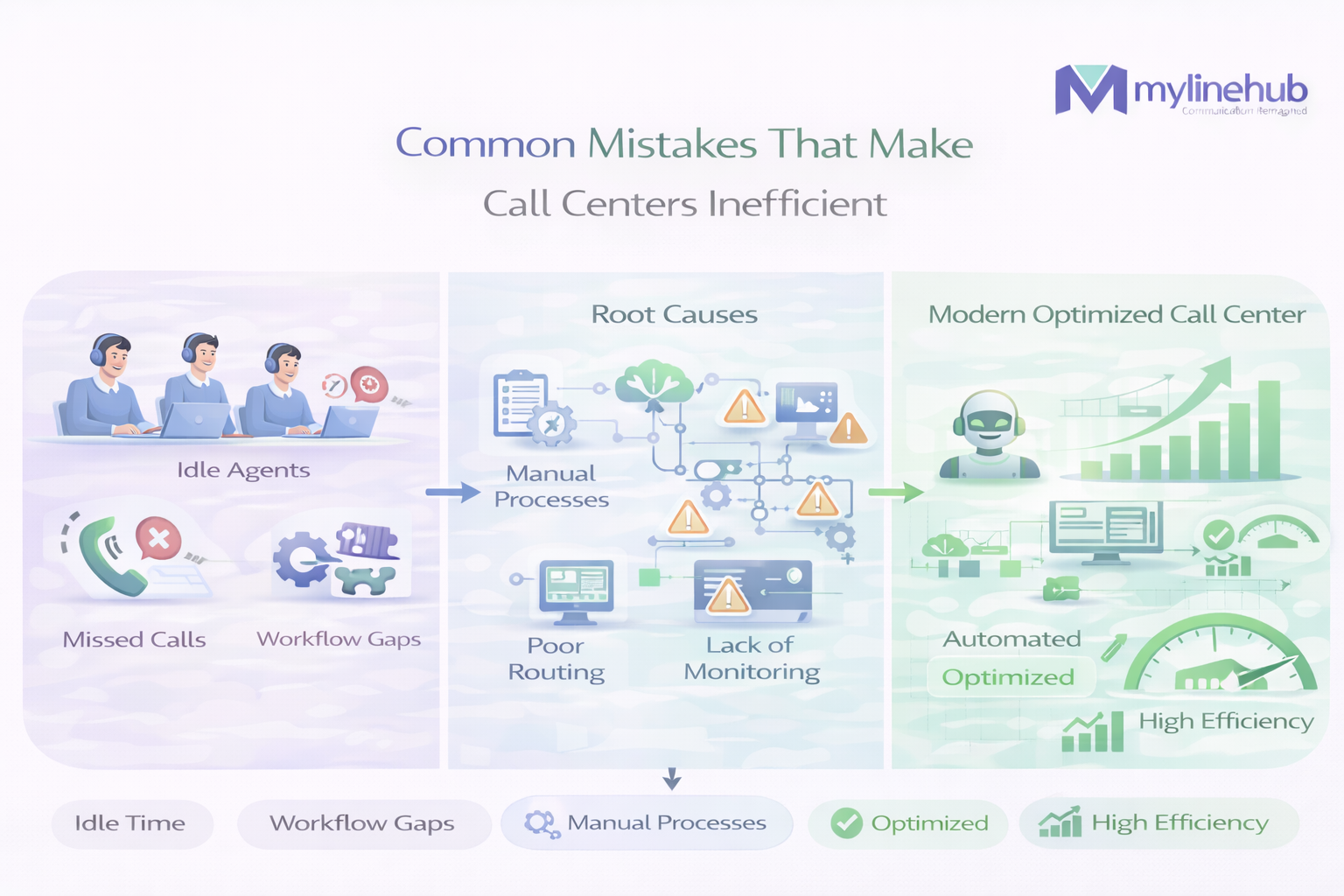
Most call centers don’t fail because people are lazy — they fail because the operating system of the call center is broken. Inefficiency is usually not “one big problem”. It is many small leaks: weak routing, manual follow-ups, wrong dialer choice, missing context, poor monitoring, and software pricing traps that force bad decisions later.
This article covers the most common call center inefficiency mistakes, how they show up in real operations, and how to fix them with an architecture-first approach using open-source telecom + CRM control layers like MYLINEHUB. MYLINEHUB is open source (core repo: https://github.com/mylinehub/omnichannel-crm) and includes an open-source AI calling bridge (VoiceBridge: https://github.com/mylinehub/omnichannel-crm/tree/main/mylinehub-voicebridge) that can connect your telecom system to external AI bots without locking you into per-seat pricing or proprietary call flows.
The goal is simple: reduce wasted agent minutes, increase connect and conversion rates, and make performance predictable as you scale.
Mistake 1: Measuring “dials” instead of outcomes
Many teams optimize for the easiest number to count: total calls made. But high performance is not “how many times you pressed call”. It is outcomes: qualified leads, meetings booked, collections recovered, tickets resolved, or customers retained.
When “dials” become the KPI, the system encourages low-quality behavior: rushed conversations, wrong dispositions, weak follow-ups, and repeated calls to the same lead without learning. This creates more work, not more results.
Fix: design the workflow around outcomes and enforce it with your CRM + dialer. Make every call end with structured next steps (callback scheduled, follow-up task, WhatsApp message, email, or closure) so the system becomes self-driving rather than memory-driven.
Related reading: /articles/improve-telecalling-team-productivity-proven-methods.
Mistake 2: Manual follow-ups and “remember to call later” culture
Follow-up failures are one of the biggest invisible losses in any call center. It usually looks like this: agent spoke to a prospect, prospect asked to call back tomorrow, agent noted it somewhere (or didn’t), tomorrow got busy, and the lead went cold or moved to a competitor.
The problem is not the agent. The problem is that the system treats follow-up as optional. In real operations, optional tasks get dropped.
Fix: callback scheduling must be enforced as a first-class feature. Your dialer and CRM should push due callbacks to the top, apply time-window rules, and prevent “random calling” that ignores customer intent. This is a systems discipline problem.
Deep guide: /articles/call-center-scheduling-campaigns-callbacks.
Mistake 3: Slow lead response time (speed-to-lead is not engineered)
Many sales call centers lose deals before they even speak. The lead arrives from ads, website, WhatsApp, or missed call — and the first call happens hours later. By that time, buyer interest has cooled or the lead has already talked to someone else.
Fast lead response is not a “motivation issue”. It is a pipeline issue. If you don’t have automated assignment, routing, immediate dialing, and omnichannel fallback, you are depending on humans to behave perfectly under load — which does not happen.
Fix: treat inbound leads like emergency signals. The system should instantly capture the lead, assign it, trigger the first attempt, and if the human queue is overloaded, automatically fall back to AI calling or WhatsApp/SMS confirmation, and then schedule a human callback.
More detail: /articles/why-fast-lead-response-increases-sales and /articles/never-miss-a-customer-using-telecom-apis.
Mistake 4: Wrong dialer strategy (or no dialer discipline at all)
Some teams do “manual calling” with spreadsheets. Others buy the wrong dialer and then blame the agents. The dialer strategy defines agent talk time, idle time, connect rate, compliance risk, and customer experience.
Common failure patterns include:
• using manual calling for high volume, causing massive idle time and missed follow-ups
• using predictive dialing without maturity, creating abandoned calls and customer anger
• using a cheap dialer that cannot accurately detect call outcomes, forcing agents to manually classify every attempt
• mixing inbound and outbound incorrectly, creating agent confusion and queue instability
Fix: choose power/progressive/predictive based on your campaign reality, and use telecom-level call events (not guesses) to drive retry logic. MYLINEHUB uses Asterisk ARI to understand what actually happened: answered, busy, no-answer, network drop, early hangup, voicemail patterns, and more — so the system can retry intelligently and keep agents productive.
Dialer strategy deep dive: /articles/types-of-autodialer-strategies-explained and connect-rate engineering: /articles/increase-call-connect-rate-outbound-campaigns.
Mistake 5: Agents don’t see the full customer context (fragmented systems)
A huge source of inefficiency is repeated questioning. The customer already shared details on WhatsApp, email, a previous call, or a form — but the agent cannot see it. The call becomes longer, the customer gets annoyed, and the agent spends extra minutes doing “information recovery” instead of closing.
Fix: unify communication channels into one customer timeline. Calls, WhatsApp, notes, dispositions, callbacks, and recordings should live in the same operational system. This is exactly what omnichannel CRM is supposed to do, but many tools treat channels as separate modules rather than one shared customer context.
Omnichannel fundamentals: /articles/what-is-omnichannel-crm and /articles/omnichannel-vs-multichannel.
Mistake 6: Weak telecom integration (CRM and telephony are disconnected)
Many organizations run CRM on one side and telephony on another. This creates a constant tax: agents copy numbers, paste notes, manually mark outcomes, and lose time after every call. Supervisors cannot trust reports because the telephony truth and CRM truth are different.
Fix: connect CRM and telecom through APIs so call events update CRM automatically and CRM actions trigger telecom workflows. MYLINEHUB is built as a telecom control layer that integrates with Asterisk/FreePBX cleanly and exposes the right hooks for automation, reporting, and omnichannel flow.
Integration guide: /articles/crm-telecom-api-integration-mylinehub and architecture view: /articles/mylinehub-architecture-and-technology-stack.
Mistake 7: Treating “open source” as “low quality” (and overpaying forever)
Many decision-makers assume “paid software equals quality” and “free software equals risk”. In reality, the biggest long-term risk is being trapped in a vendor model that punishes scale. Per-agent licensing, per-channel pricing, and locked workflows force you to keep paying even after you’ve built maturity.
Open source does not mean “no support” or “no discipline”. It means your system can be owned permanently, deployed in your environment, audited, improved, and integrated deeply. You control your data. You control your roadmap. You can customize small parts of code when needed rather than waiting months for vendor approvals.
MYLINEHUB is open source for exactly this reason: call operations are strategic infrastructure. The CRM + telecom layer should not become a tax that grows linearly with every new agent.
Read: /articles/why-per-agent-pricing-expensive-at-scale and long-term cost thinking: /articles/how-to-reduce-call-center-costs-long-term.
Mistake 8: Using AI as a gimmick instead of an operational layer
AI calling only helps when it is integrated into the real telecom flow: call routing, recordings, retries, barge-in behavior, queue strategy, compliance windows, and customer context. When AI is deployed as a separate “tool”, it creates new inefficiency: duplicated databases, inconsistent outcomes, manual handoffs, and broken reporting.
Fix: connect AI to the same system that runs your calls. MYLINEHUB VoiceBridge is an open-source bridge that connects Asterisk/FreePBX calling to external AI bots. This is important because it avoids “cloud lock-in” and enables AI calling without losing telecom control. It also allows businesses to evolve the AI logic gradually: start with simple qualification, move to appointment setting, then expand to verification or support — without rebuilding your entire stack.
Business reality: /articles/ai-calling-vs-human-telecallers-business-reality and technical definition: /articles/open-source-full-duplex-asterisk-ai-voice-bot-bridge-voicebridge.
Mistake 9: Monitoring focused only on control, not improvement
Monitoring becomes inefficient when it turns into fear-based policing. Agents start gaming metrics, supervisors spend time chasing people, and the real root causes stay hidden: lead quality, dialer strategy, routing mistakes, and broken follow-up discipline.
Fix: monitoring should answer operational questions:
• where is idle time coming from?
• are callbacks being completed on time?
• which lead sources are wasting the most agent minutes?
• which campaigns have poor connect rates and need different retry logic?
• which scripts fail at objection handling?
When monitoring is designed correctly, it becomes a coaching engine and a systems improvement loop.
Practical guide: /articles/how-to-track-call-center-employees-effectively.
Mistake 10: Scaling headcount before scaling the system
The most expensive mistake is hiring more agents to compensate for inefficiency. This increases wage cost and supervision cost, but does not fix the underlying leaks. The result is a large, stressed team with low predictability.
Fix: scale the system first. That means:
• faster lead response with automation and AI-first touch where appropriate
• correct dialer strategy and accurate call outcome detection
• enforced callbacks and campaign scheduling
• unified customer context (omnichannel timeline)
• telecom + CRM integration via APIs
• open-source ownership so cost doesn’t explode with headcount
If you need to handle higher volume without hiring at the same pace: /articles/handle-more-leads-without-hiring-more-agents.
Why MYLINEHUB reduces inefficiency better than “generic suites”
Many suites try to be everything for everyone. They often look good on paper but fail in real call center operations because telecom integration is shallow, dialing is limited, and pricing increases aggressively as you scale.
MYLINEHUB is different because it is built around a telecom-first architecture:
• deep Asterisk/FreePBX integration (ARI/AMI-driven control)
• power/progressive/predictive dialing approach with real call event intelligence
• omnichannel CRM timeline as the operational center (not separate modules)
• open-source ownership for long-term cost control and customization
• VoiceBridge for AI calling integrated into real telecom flows
If you want the architectural reasoning behind scaling safely: /articles/how-to-build-scalable-telecom-solution.
Inefficiency is not a people problem first — it is a system design problem. Once the system is correct, people become productive naturally.
Want to see API-driven CRM + Telecom workflows in action? Try the WhatsApp bot or explore the demos.
Comments (0)
Be the first to comment.