How to Improve Telecalling Team Productivity (Proven Methods)
Simple but powerful methods to increase talk time, reduce idle time, and improve real telecalling output without burning teams.
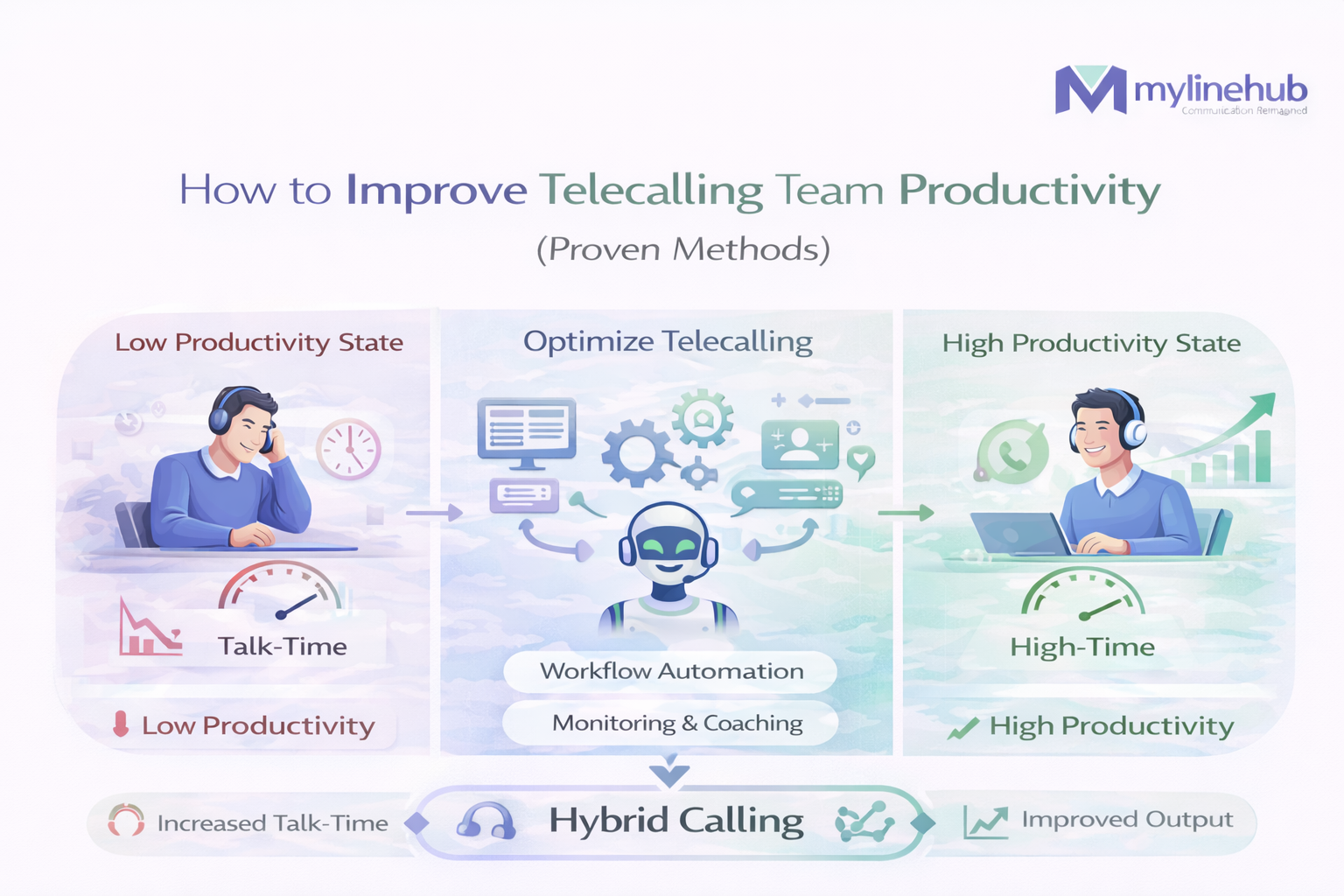
“Productivity” in a telecalling team is often misunderstood. Most managers measure productivity as “calls per day”, then pressure agents to dial faster. That usually backfires: quality drops, customers get irritated, compliance risk increases, and attrition rises. Real productivity is not speed. Real productivity is useful outcomes per paid hour: qualified conversations, booked appointments, payments collected, issues resolved, and follow-ups completed on time.
This article gives proven, practical methods to improve telecalling productivity without turning your operation into a stressful, low-quality factory. The key idea is simple: productivity is a system problem — not a “motivation problem”. If your system wastes time, even your best agents will look average.
MYLINEHUB improves productivity by fixing the system layer: dialing automation, call-state intelligence using ARI, omnichannel CRM context, missed-call capture, scheduling, and AI calling where it makes sense — all while staying open source so your business owns the stack permanently: https://github.com/mylinehub/omnichannel-crm and the AI calling bridge (VoiceBridge): https://github.com/mylinehub/omnichannel-crm/tree/main/mylinehub-voicebridge.
First: measure the right productivity (otherwise you optimize the wrong thing)
If you only measure “dials”, agents will maximize dials. That creates superficial activity and poor outcomes. Instead, split productivity into three layers:
1) Activity efficiency: How many minutes are lost to manual work (dialing, notes, searching contact history, re-trying numbers)?
2) Conversation efficiency: When connected, how effective is the conversation at reaching the next step?
3) Pipeline efficiency: Do follow-ups happen on time, or do leads decay because of delays?
Many call centers think they have a “people problem” when the real issue is activity inefficiency: agents spend huge time on non-talking tasks — dialing, waiting for ringing, hearing tones, switching tabs, writing notes twice.
If your team cost feels high for the output, read: /articles/why-your-telecalling-team-is-expensive
Method 1: Remove manual dialing time (power dialer and intelligent retry)
Manual calling wastes time in three places: selecting the next lead, dialing, and waiting through ringing/tones. A proper power dialer eliminates that waste. But not all dialers are equal.
Most cheap dialers only “dial numbers”. The important part is what happens after the dial: busy, no-answer, switched off, call rejected, network failure, voicemail, human answer, agent not available, customer requests callback, customer says “call me later”, wrong number, etc.
MYLINEHUB improves this using deep Asterisk integration (ARI-based call events). This means the system can detect drop reasons and call-state transitions reliably, then apply the right automation:
• Auto-skip invalid states (busy/congestion) without wasting agent time
• Intelligent retry windows (not immediately, not randomly — scheduled correctly)
• Callback scheduling when customer asks for a better time
• Lead status updates tied to real call events (not manual “agent says it happened”)
For connect-rate improvement through dialing strategy, see: /articles/increase-call-connect-rate-outbound-campaigns
Method 2: Increase connect rate (better lists, better timing, better routing)
Productivity jumps when connect rate increases, because the same agent hours produce more real conversations. The fastest way to improve connect rate is not “dial more”. It is to dial smarter.
Practical connect-rate levers:
List hygiene: Remove known bad numbers, duplicates, and stale leads.
Time-of-day targeting: Different customer segments answer at different times.
Callback discipline: Most teams forget callbacks; that destroys connect rate and trust.
Local presence / caller ID strategy: If applicable, configure appropriately through your telecom setup.
Distribution logic: Route the right leads to the right agents (language, product, region, skill).
MYLINEHUB enables this by combining telecom event truth (Asterisk/FreePBX) with CRM segmentation. When call outcomes are captured automatically, your data becomes clean enough to drive better dialing decisions.
Also read: /articles/call-center-scheduling-campaigns-callbacks because callback scheduling is one of the most underused productivity multipliers.
Method 3: Reduce “after-call work” using a single customer timeline
A common productivity killer is tab-switching and duplicate note writing: one place for call logs, another for CRM, another for WhatsApp, another spreadsheet for follow-ups. Agents lose minutes per lead, and those minutes compound.
The fix is an omnichannel customer timeline: calls, WhatsApp, SMS/email actions, dispositions, recordings, and tasks attached to the same customer record. When agents see the full context instantly, conversations start faster and end with clearer next steps.
If you are aligning channels, read: /articles/what-is-omnichannel-crm and /articles/omnichannel-vs-multichannel.
Method 4: Build a disciplined follow-up engine (not “agent memory”)
In telecalling, the money is in follow-up. Most deals close after multiple touches. Yet many teams rely on memory: “I will call tomorrow.” That fails in real life — leads cool down, customers go to competitors, and managers cannot see what is slipping.
A productivity system enforces follow-up discipline:
• every conversation ends with a scheduled next action
• missed callbacks are highlighted and escalated
• follow-up attempts are timed (not spammy, not delayed)
• lead owners are clear (no “everyone thought someone else called”)
This is where MYLINEHUB’s scheduling + telecom automation combination matters. If you care about response speed, read: /articles/why-fast-lead-response-increases-sales.
Method 5: Use call monitoring in a way that improves skills (not fear)
Monitoring improves productivity only when it is used for coaching and pattern detection, not constant policing. If monitoring feels like surveillance, good agents leave, stress rises, and performance drops.
A healthy monitoring approach:
• record calls for quality review and training examples
• track outcomes and conversion, not just talk time
• identify repeat objections and build scripts/answers
• review a small sample of calls regularly (not every call as punishment)
Read: /articles/how-to-track-call-center-employees-effectively for a balanced monitoring model.
Method 6: Automate the low-value calls using AI calling (VoiceBridge)
A major productivity shift happens when humans stop spending time on repetitive calls that do not require human skill. Examples: basic qualification, appointment confirmation, payment reminders, survey questions, first-touch lead response.
This is where AI calling becomes a real productivity tool — but only if the voice experience is good and the call system is reliable. Many AI calling setups fail because they are turn-based or have poor audio handling.
MYLINEHUB’s open-source VoiceBridge enables real-time AI voice bridging inside Asterisk/FreePBX environments. It can connect your calls to external AI bots (OpenAI/Google/others) while preserving telecom control and event accuracy. That means:
• AI can handle first touch instantly, even outside working hours
• AI can collect structured information and push it to CRM fields
• Humans only receive leads that are warmed/qualified or need human judgment
• The system tracks call results using ARI events rather than “agent typed it”
Deep technical background (for teams that want to understand quality): /articles/open-source-full-duplex-asterisk-ai-voice-bot-bridge-voicebridge and /articles/how-voicebridge-achieves-true-full-duplex-audio-in-production.
For the business reality of AI vs humans: /articles/ai-calling-vs-human-telecallers-business-reality
Method 7: Reduce burnout and attrition (productivity is fragile)
Productivity improvements collapse if attrition stays high. New agents require training time, ramp time, supervision, and they make more mistakes. If your environment forces constant manual work, pressure, and unclear success metrics, churn becomes inevitable.
Practical attrition reducers that also improve productivity:
• automate repetitive tasks (dialing, logging, callbacks)
• provide clean scripts and objection-handling playbooks
• coach using real call examples (good and bad)
• align incentives to quality outcomes, not raw call counts
• keep workload stable with smart scheduling
Also read: /articles/reduce-telecaller-attrition-growing-teams
Method 8: Own your system (open source reduces long-term cost and friction)
Many teams attempt productivity improvements but get blocked by licensing costs, per-seat pricing, or vendor limits. They cannot customize workflows, cannot integrate deeply, and cannot keep data ownership clean. Productivity becomes “what the tool allows” rather than “what the business needs”.
MYLINEHUB is open source, which changes the economics:
• no per-agent license lock-in for core platform ownership
• you can customize small workflow rules instead of buying add-ons
• you can integrate telephony the way your business actually runs
• your data and call history remain inside your system permanently
For data ownership strategy: /articles/how-to-make-sure-your-business-data-remains-yours
For cost reduction foundations: /articles/how-to-reduce-call-center-costs-long-term and /articles/reduce-call-center-cost-without-losing-performance
A simple productivity checklist (what to fix first)
If you want results fast, focus on the highest-leverage sequence:
Step 1: Implement power dialing + reliable call outcome capture (ARI events).
Step 2: Enforce callback scheduling and follow-up discipline.
Step 3: Centralize context in an omnichannel customer timeline.
Step 4: Coach using call samples and objection patterns.
Step 5: Automate repetitive calls using AI calling (VoiceBridge) where it fits.
Productivity is not one magic trick. It is the compound effect of removing friction, improving connect rate, and ensuring every lead gets the right follow-up at the right time — with humans doing the work that needs humans, and automation doing the work that does not.
Want to see API-driven CRM + Telecom workflows in action? Try the WhatsApp bot or explore the demos.
Comments (0)
Be the first to comment.