How to Reduce Telecaller Attrition in Growing Teams
High telecaller attrition increases costs and disrupts performance. Learn the operational and technology fixes that actually work.
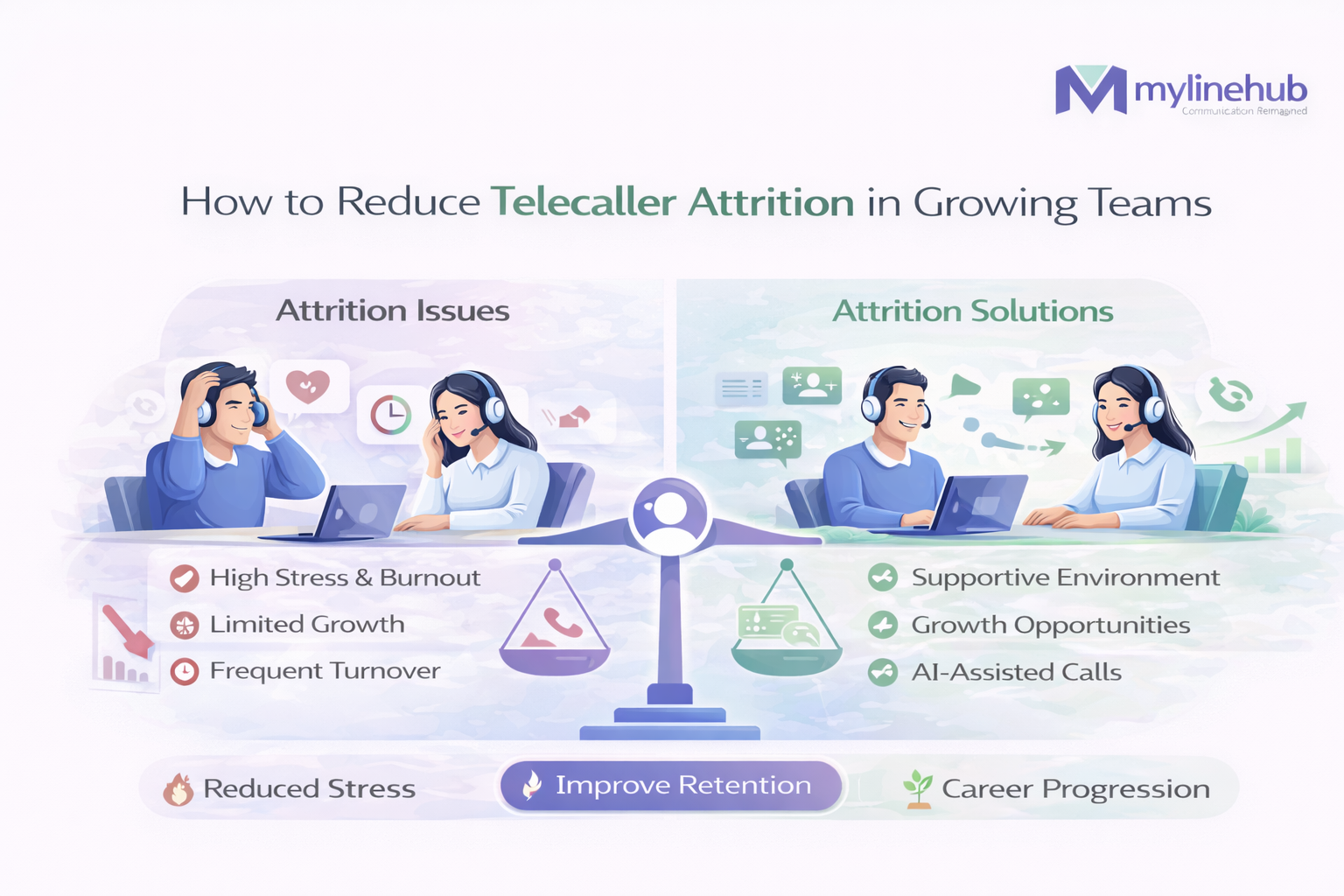
Telecaller attrition is one of the most expensive hidden problems in growing call centers. Many businesses focus heavily on lead generation, dialing technology, and campaign strategy — but overlook the human reality inside their calling teams. When attrition rises, productivity falls, training costs increase, customer experience becomes inconsistent, and managers spend more time hiring than scaling.
The truth is simple: high attrition is rarely just an HR problem. In most cases, it is a systems and workflow problem. Poor dialing efficiency, repetitive manual work, lack of real-time feedback, and low connect success rates create agent frustration. Over time, good agents leave — and the business keeps restarting the same expensive cycle.
Modern high-performance teams reduce attrition not by pushing agents harder, but by building smarter calling infrastructure. This is where open architecture platforms like MYLINEHUB fundamentally change the equation.
Why Telecaller Attrition Increases as Teams Grow
In early stages, small teams often perform well because supervision is tight and workflows are manageable. But as volume grows, several structural problems begin to appear:
Agents spend large portions of their day hearing ring tones, busy signals, and disconnected numbers. Manual dialing slows them down. Lead lists are not prioritized intelligently. Follow-ups are missed. Managers struggle to monitor performance in real time.
Over weeks and months, this creates a predictable pattern:
Low connect rate → Agent frustration → Lower morale → Higher attrition → Higher hiring cost.
Many organizations mistakenly respond by increasing incentives or hiring more supervisors. But unless the calling workflow itself improves, the attrition cycle continues.
If you have already reviewed common call center inefficiency mistakes, you will notice that most attrition drivers originate from operational friction, not compensation.
The Hidden Cost of High Telecaller Attrition
Attrition is not just about recruitment expense. Its real impact spreads across the entire revenue engine:
• Training time resets repeatedly
• Lead handling quality becomes inconsistent
• Experienced agents leave with process knowledge
• Managers spend time hiring instead of optimizing
• Customer experience becomes unpredictable
When attrition crosses certain thresholds, cost per lead rises sharply. This is why many businesses struggle even when their lead volume is strong. If you are analyzing unit economics, it is useful to also review how to reduce cost per lead in telecalling.
Why Traditional Dialing Environments Burn Out Agents
Many legacy setups unintentionally create poor working conditions for telecallers. Common issues include:
• Too much manual dialing
• No intelligent call progress detection
• Slow lead distribution
• No real-time visibility into outcomes
• Repetitive low-value work
When agents feel they are working hard but not achieving meaningful connects, motivation drops quickly. This is one of the biggest reasons manual environments underperform compared to automated workflows. The difference becomes very clear when comparing manual calling vs automated calling cost comparison.
How MYLINEHUB Reduces Telecaller Attrition Structurally
MYLINEHUB approaches attrition as a systems engineering problem. Instead of treating agents as the bottleneck, the platform focuses on removing operational friction so agents spend more time in meaningful conversations.
Key structural advantages include:
Power and progressive dialing: Agents are automatically connected only when calls are actually answered. This dramatically reduces idle time and improves morale.
ARI-based call intelligence: The platform listens to real-time Asterisk events using ARI to detect busy, failed, or dropped calls instantly, improving campaign flow efficiency.
AI calling support: Routine or first-level interactions can be handled by AI VoiceBridge, reducing repetitive workload on human agents.
Open architecture flexibility: Teams can modify dialing logic, lead routing, and workflows because the system is open source.
The MYLINEHUB codebase is publicly available:
👉 https://github.com/mylinehub/omnichannel-crm
The AI media layer (VoiceBridge) that enables real-time voice automation is also open:
👉 VoiceBridge open-source module
This openness is important. Many businesses assume free software compromises quality. In reality, mature open-source telecom stacks often provide more control, more transparency, and lower long-term cost than closed per-seat platforms.
AI Calling Reduces Burnout on Human Teams
One of the biggest shifts in modern contact centers is the use of AI-assisted calling layers. MYLINEHUB’s VoiceBridge enables real-time duplex voice integration with external AI bots. This allows businesses to:
• Handle first-touch outreach automatically
• Qualify leads before human involvement
• Manage after-hours conversations
• Reduce repetitive agent workload
When AI absorbs repetitive interactions, human agents focus on high-value conversations. This improves both productivity and job satisfaction. The broader business impact is explained in AI calling vs human telecallers business reality.
Operational Visibility Keeps Teams Stable
Another major contributor to attrition is lack of feedback. Agents perform better — and stay longer — when they understand outcomes clearly.
MYLINEHUB provides deep operational visibility across:
• Call outcomes
• Connect ratios
• Agent activity
• Campaign performance
• Real-time call states
This transparency allows supervisors to coach effectively instead of reacting blindly. It also helps identify process gaps early, before frustration builds inside the team.
Why Open Source Matters for Long-Term Team Stability
Many fast-growing businesses eventually discover a painful truth: per-agent licensing models scale linearly with headcount. As teams grow, software costs rise, flexibility drops, and experimentation becomes harder.
MYLINEHUB’s open-source foundation changes this dynamic. Because the platform is deployable on your own infrastructure:
• There is no per-seat lock-in
• Workflows can be customized
• AI integrations can evolve freely
• Long-term costs remain predictable
This architectural freedom allows organizations to optimize continuously instead of being constrained by vendor pricing models — a key factor in maintaining healthy, stable teams at scale.
Building a Low-Attrition, High-Performance Calling Operation
Reducing telecaller attrition is not about quick fixes. It requires aligning technology, workflow design, and team experience. Businesses that succeed typically follow a clear pattern:
• Automate low-value dialing work
• Improve connect efficiency
• Introduce AI where repetitive load is high
• Provide real-time visibility to supervisors
• Keep infrastructure flexible and scalable
When these pieces come together, the effect is powerful: agents stay longer, productivity rises, and cost per lead falls naturally — without constant hiring pressure.
For organizations planning serious scale, the question is no longer whether to hire more agents. The real question is whether the calling architecture itself is designed to support sustainable growth.
Want to see API-driven CRM + Telecom workflows in action? Try the WhatsApp bot or explore the demos.
Comments (0)
Be the first to comment.