AI Calling vs Human Telecallers: What Actually Works for Businesses
AI will not replace every agent—but it changes the cost structure dramatically. Learn where AI wins and where humans still matter.
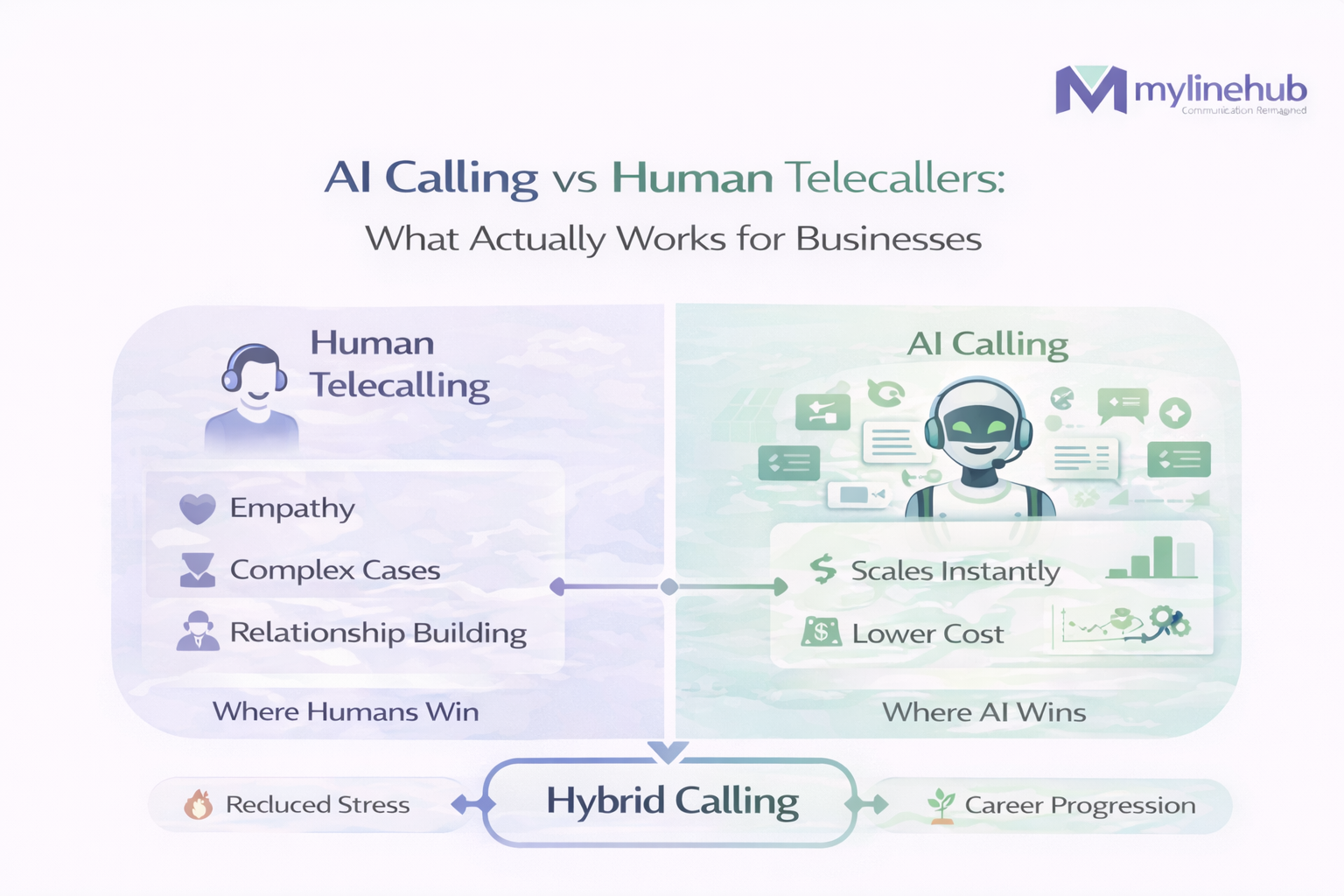
The debate between AI calling and human telecallers is often framed incorrectly. Many businesses assume AI will fully replace humans, while others dismiss AI as low-quality automation that cannot match real conversations. The business reality is more nuanced. The real winners are not choosing one over the other — they are building systems where AI and humans work together to maximize productivity, coverage, and cost efficiency.
As lead volumes increase and response expectations shrink to minutes, traditional calling teams alone struggle to keep up. Hiring more agents increases cost linearly, while customer expectations grow exponentially. This gap is exactly where modern AI calling infrastructure becomes strategically important.
MYLINEHUB addresses this challenge through an open-source telecom and CRM control layer combined with the VoiceBridge AI calling engine. Core platform: https://github.com/mylinehub/omnichannel-crm VoiceBridge (AI calling bridge): https://github.com/mylinehub/omnichannel-crm/tree/main/mylinehub-voicebridge
Where human telecallers still outperform AI
Despite rapid advances in conversational AI, human agents remain superior in several high-complexity scenarios. Businesses that ignore this reality often deploy AI incorrectly and see disappointing results.
Humans still excel at:
• complex negotiations • high-value enterprise sales • emotional customer handling • objection-heavy conversations • relationship building • nuanced decision making
In these cases, empathy, improvisation, and contextual judgment matter more than speed. Replacing experienced agents completely is rarely the right first move.
However, the important operational insight is this: most call center workload is not high-complexity work.
Where human-only teams become inefficient
When we analyze real call center workloads, a large percentage of calls fall into repetitive, structured categories:
• first response calls • lead qualification • appointment confirmations • payment reminders • survey collection • basic support triage • follow-up attempts
Using fully manual teams for these tasks creates structural inefficiencies:
Linear cost growth — more leads require more agents.
Limited working hours — humans cannot cover 24×7 economically.
Response delays — queues build during peak times.
Attrition pressure — repetitive work increases churn.
Inconsistent quality — performance varies by agent.
This is why many growing teams see costs rise faster than revenue.
If you are seeing cost pressure already, read: /articles/why-your-telecalling-team-is-expensive
Where AI calling creates immediate leverage
AI calling is most powerful when used to remove repetitive load from human teams and to guarantee instant first touch. When deployed correctly, AI becomes a force multiplier rather than a replacement.
High-impact AI calling use cases include:
• instant lead response • first-level qualification • bulk follow-ups • missed call automation • off-hours coverage • high-volume outreach • data collection workflows
In these scenarios, the key advantage is not just cost — it is response consistency at scale.
Why most AI calling implementations fail
Many businesses experiment with AI calling but fail to see meaningful results. The problem is rarely the AI model itself. It is usually the surrounding telecom architecture.
Common failure points include:
• turn-based IVR-style bots • high audio latency • poor duplex handling • weak call state tracking • no intelligent retry logic • disconnected CRM workflows • vendor lock-in limitations
Traditional AGI-based or basic ExternalMedia approaches often feel robotic because they are not built for true full-duplex conversation.
Technical deep dive: /articles/why-agi-cannot-provide-real-time-duplex-voice-technical-limits
The MYLINEHUB VoiceBridge advantage
MYLINEHUB VoiceBridge was designed specifically to solve the real-time AI calling gap inside Asterisk and FreePBX environments. Instead of batch or turn-based audio, VoiceBridge enables true streaming duplex voice between the caller and external AI engines.
Architecturally, VoiceBridge:
• streams RTP in both directions • maintains timing discipline • supports real barge-in • tracks call state via ARI • integrates with CRM workflows • works with external AI providers • remains fully open source
This allows businesses to deploy AI calling without sacrificing call quality or telecom control.
Architecture deep dive: /articles/voicebridge-architecture-deep-dive-asterisk-rtp-ai-rtp-asterisk
The hybrid model: AI first, humans where it matters
The most effective organizations are not choosing AI or humans. They are designing layered calling flows:
Layer 1: AI handles instant response and basic qualification
Layer 2: warm leads are routed to human agents
Layer 3: humans focus on high-value conversations
Layer 4: AI continues follow-ups and reminders
This model produces several structural advantages:
• faster first response • lower cost per lead • better agent utilization • reduced idle time • improved coverage • more consistent pipelines
If your goal is scaling without headcount explosion, also read: /articles/handle-more-leads-without-hiring-more-agents
Open source vs closed AI calling platforms
Another critical business decision is platform ownership. Many AI calling vendors operate as closed CPaaS systems with per-minute or per-agent pricing. While quick to start, these platforms often create long-term constraints.
Common limitations include:
• rising usage costs • limited telecom control • restricted customization • data residency concerns • difficult AI model switching • dependency on vendor roadmap
MYLINEHUB takes a fundamentally different approach. Because the platform is open source and telecom-native, businesses retain architectural control while still enabling advanced AI workflows.
This becomes increasingly important as call volumes grow and AI usage expands.
The cost reality businesses must understand
AI calling is not primarily about replacing people. It is about changing the economics of responsiveness and coverage. When deployed correctly, organizations typically observe:
• reduced cost per first contact • higher connect rates • improved lead utilization • lower agent fatigue • better off-hours coverage • more predictable pipelines
The businesses that struggle are usually the ones trying to use humans for every touchpoint or AI for every conversation. The balanced architecture consistently wins.
The business reality going forward
Over the next few years, the competitive gap between AI-augmented teams and fully manual call centers will continue to widen. Customer expectations for immediate response are already here, and the economics of large human-only teams are becoming harder to sustain.
The organizations that will scale efficiently are those that:
• automate first touch • preserve human expertise where it matters • maintain telecom ownership • avoid per-seat lock-in • build for real-time responsiveness
MYLINEHUB and VoiceBridge are built specifically for this hybrid future — combining open-source control, deep telecom integration, and production-grade AI calling so businesses can scale without losing flexibility or margin.
Want to see API-driven CRM + Telecom workflows in action? Try the WhatsApp bot or explore the demos.
Comments (0)
Be the first to comment.