Cost Per Lead in Telecalling: How to Bring It Down
If your cost per lead is rising, your calling strategy needs attention. Learn the exact levers that reduce CPL in outbound teams.
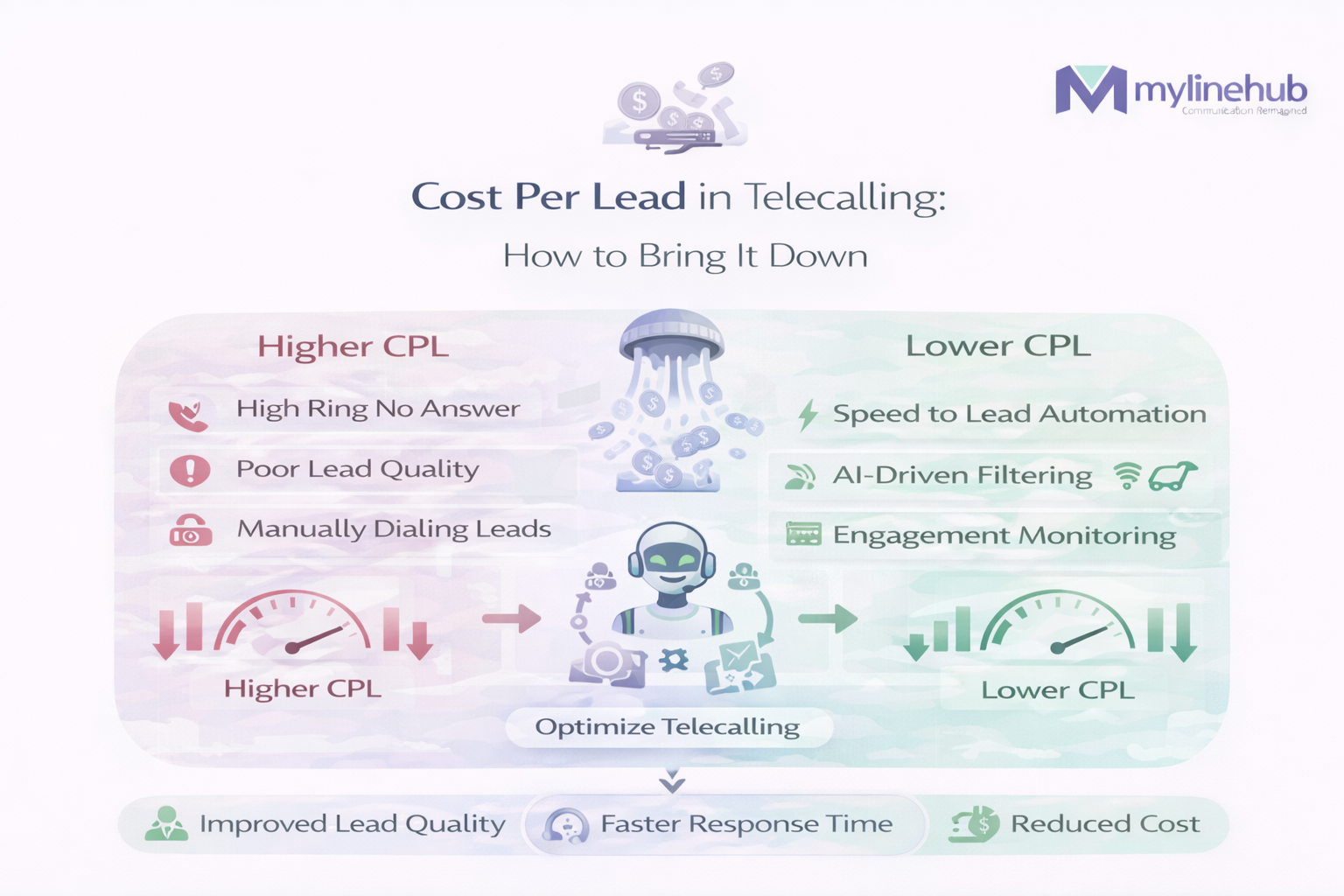
If your telecalling cost per lead feels “out of control”, the problem is usually not salary alone. Cost per lead increases when your operation wastes paid hours on low-value actions: manual dialing, poor connect rate, slow follow-ups, repeated work across tools, and weak lead prioritization. You can cut cost per lead dramatically without “pushing agents harder” by fixing the system that surrounds agents.
MYLINEHUB is built for this exact goal: reduce cost per lead by combining an omnichannel CRM + telecom control layer (Asterisk/FreePBX), automation, scheduling, and an open-source AI calling bridge (VoiceBridge) that can connect calls to external AI bots. Because MYLINEHUB is open source, you keep the system permanently and avoid per-seat license lock-in: https://github.com/mylinehub/omnichannel-crm and VoiceBridge: https://github.com/mylinehub/omnichannel-crm/tree/main/mylinehub-voicebridge.
This guide breaks down cost-per-lead like a real operator would: what drives it up, what fixes it fastest, and why an open-source telecom + CRM stack improves cost per lead more reliably than “just another cloud tool”.
What “cost per lead” really means in telecalling
Cost per lead is not just the cost of a lead list. In telecalling operations, “cost per lead” is the total cost required to touch a lead enough times to achieve an outcome (qualification, appointment, payment, conversion, or closure).
A practical formula most teams can use:
Cost per lead (CPL) = (Total team cost for the period + telecom cost + tooling cost + supervision cost) / Leads meaningfully processed
The hidden trap is the last part: “meaningfully processed”. If you count “dial attempts” as processed leads, CPL looks low, but revenue stays low. If you only count “success outcomes”, CPL may look high but you see reality. The right KPI depends on your business: qualification CPL, appointment CPL, and conversion CPL are different numbers — and they improve with different tactics.
If your team feels expensive even though call counts are high, read: /articles/why-your-telecalling-team-is-expensive
The 7 biggest drivers that increase cost per lead
Most operations suffer from the same cost leaks. Fixing even 2–3 can drop CPL sharply:
1) Low connect rate: paid hours are consumed by ringing, busy tones, “switched off”, and unreachable numbers.
2) Manual dialing and list handling: agents waste minutes selecting leads, dialing, copying numbers, switching tabs.
3) Slow response time: leads go cold; your attempts take more calls and more time to get the same outcome.
4) Weak callback discipline: missed callbacks force repeat work and reduce trust; conversion drops, CPL rises.
5) No lead prioritization: agents spend prime hours on low-intent leads while high-intent leads decay.
6) Tool fragmentation: CRM in one place, calling in another, WhatsApp elsewhere — repeated notes, broken context.
7) High attrition: training costs and ramp time are huge; team “output per salary” declines.
Notice what’s missing: “agent laziness”. Most CPL problems are structural, not personal.
Fix #1: Raise connect rate before you try to “increase productivity”
Connect rate is one of the strongest CPL multipliers. If connect rate improves, you get more real conversations per hour. More conversations per hour means fewer paid hours per processed lead — and CPL drops.
Connect rate improves through a combination of list hygiene, time windows, retries, and dialing strategy. The best systems do not just dial; they understand what happened and what should happen next.
MYLINEHUB leverages Asterisk/FreePBX call events (ARI) to capture real outcomes and automate next actions. When the system can reliably distinguish “no answer” vs “busy” vs “network failure” vs “call rejected”, you can build retry rules that increase connect rate without annoying customers.
Deep guide: /articles/increase-call-connect-rate-outbound-campaigns
Fix #2: Use power dialing + event-based automation to remove wasted minutes
Manual dialing is one of the biggest hidden costs per lead. Even if an agent “dials fast”, the process includes: selecting next lead, dialing, waiting, marking notes, setting reminders, updating status, and switching channels. Those minutes are paid minutes — and they compound across thousands of calls.
A power dialer reduces wasted time by automatically progressing through leads. But the real productivity lift happens when the dialer is tied to call-state intelligence and CRM actions:
• auto-disposition suggestions based on call events (reduces after-call work)
• automated retry windows based on outcome type (raises connect rate without over-dialing)
• automatic callback creation when customer requests “call later” (prevents lead decay)
• scheduled calling hours enforcement (reduces compliance and reputation risk)
This is why telecom integration depth matters. When your dialer is loosely attached to a telephony stack, it cannot reliably detect reasons, drops, and state transitions. MYLINEHUB’s approach is to integrate cleanly with Asterisk/FreePBX while keeping telephony stable: /articles/freepbx-mylinehub-integration-flow and /articles/autodialer-for-freepbx-mylinehub.
Fix #3: Speed up lead response to reduce “attempts per conversion”
Fast response reduces CPL because it reduces the number of attempts required to get an outcome. When you call a lead quickly, intent is higher, memory is fresh, and the conversation is shorter and more decisive. When response is slow, you need more follow-ups, more persuasion, more time, and sometimes a different agent — which increases total cost.
Many businesses attempt “fast response” manually and fail because leads arrive outside shifts or agents are busy. A system-driven approach solves this: instant first-touch (AI or automation), structured follow-ups, and prioritization queues.
Detailed reasoning: /articles/why-fast-lead-response-increases-sales
Fix #4: Turn callbacks into a controlled pipeline (not a memory game)
Missed callbacks silently destroy productivity. When a callback is missed, the agent must call again later, the customer feels ignored, and the conversation gets harder. Your team spends more minutes for the same outcome — CPL rises.
A disciplined callback pipeline reduces CPL by preventing rework:
• every call ends with a next action (call back / WhatsApp / email / close / escalate)
• callbacks are scheduled automatically, not written on paper or “remembered”
• missed callbacks are surfaced immediately to supervisors
• calling windows and compliance are enforced by the system
Fix #5: Reduce “context switching” using omnichannel CRM timeline
A classic CPL leak is tool fragmentation. When the agent must jump between telephony UI, CRM, WhatsApp, and spreadsheets, the lead handling time increases. Even worse, context gets lost, so conversations repeat the same questions, causing customer frustration.
Omnichannel CRM reduces lead handling time by giving agents one timeline: calls + WhatsApp + follow-ups + notes + tasks in one place. This reduces after-call work and makes each conversation more effective.
Read: /articles/what-is-omnichannel-crm and /articles/omnichannel-vs-multichannel.
Fix #6: Use AI calling to cut cost per lead where humans are not required
The fastest structural CPL reduction comes when humans stop doing repetitive calls that don’t require human judgment. Examples include initial qualification, appointment confirmation, reminders, simple surveys, and “first touch” outside working hours.
But AI calling only helps CPL if the telecom side is production-grade. Many “AI voice bots” fail in real call center conditions: one-way audio issues, poor interruption handling, turn-based delays, and fragile integrations. If AI creates customer frustration, it increases CPL by damaging trust and forcing human rework.
MYLINEHUB includes an open-source AI calling bridge (VoiceBridge) designed for real telecom environments. It connects Asterisk/FreePBX calls to external AI bots while preserving telecom control, call recording, and event truth: https://github.com/mylinehub/omnichannel-crm/tree/main/mylinehub-voicebridge.
This creates a strong CPL advantage:
• AI handles first-touch instantly, reducing lead decay and attempts per outcome
• AI collects structured info and writes it to CRM fields (less agent questioning time)
• humans receive fewer low-quality calls and more “ready” conversations
• the system measures results using real call events (ARI), not manual reporting
Deep reference for how production duplex AI voice is achieved: /articles/open-source-full-duplex-asterisk-ai-voice-bot-bridge-voicebridge and /articles/how-voicebridge-achieves-true-full-duplex-audio-in-production.
If you want the business reality view: /articles/ai-calling-vs-human-telecallers-business-reality.
Why open source directly improves cost per lead over time
Many teams try to reduce CPL by switching tools, then discover a new problem: per-seat pricing and feature paywalls. The moment you scale agents, costs rise again. Or you need a small customization and the vendor says “not possible”, so your process stays inefficient and CPL remains high.
Open source changes that curve. With MYLINEHUB:
• you avoid per-license lock-in for owning the platform
• you can customize workflow logic (even small changes) to match your business
• you can run on-premise or hybrid for telecom reliability and data control
• you keep your data permanently in your system (no forced migrations)
For data ownership and long-term control: /articles/how-to-make-sure-your-business-data-remains-yours
Practical “CPL reduction plan” you can execute
If your goal is to reduce cost per lead quickly and sustainably, implement in this order:
Step 1: Improve connect rate (list hygiene + correct dialing strategy + event-driven retries).
Step 2: Remove manual dialing and reduce after-call work using power dialer + CRM automation.
Step 3: Enforce callback scheduling and follow-up discipline to prevent rework.
Step 4: Centralize context (calls + WhatsApp + tasks) into a single customer timeline.
Step 5: Add AI calling for repetitive call types to reduce human hours per processed lead.
For a broader cost strategy (beyond CPL), see: /articles/how-to-reduce-call-center-costs-long-term and /articles/reduce-call-center-cost-without-losing-performance.
When you treat cost per lead as a system design problem, not a “pressure the team” problem, your CPL drops while your customer experience improves — which is the only kind of cost reduction that scales.
Want to see API-driven CRM + Telecom workflows in action? Try the WhatsApp bot or explore the demos.
Comments (0)
Be the first to comment.