Why Fast Lead Response Increases Sales (And How to Achieve It at Scale)
Speed to lead directly impacts conversions. Learn how modern teams respond instantly using AI, workflows, and structured follow-ups.
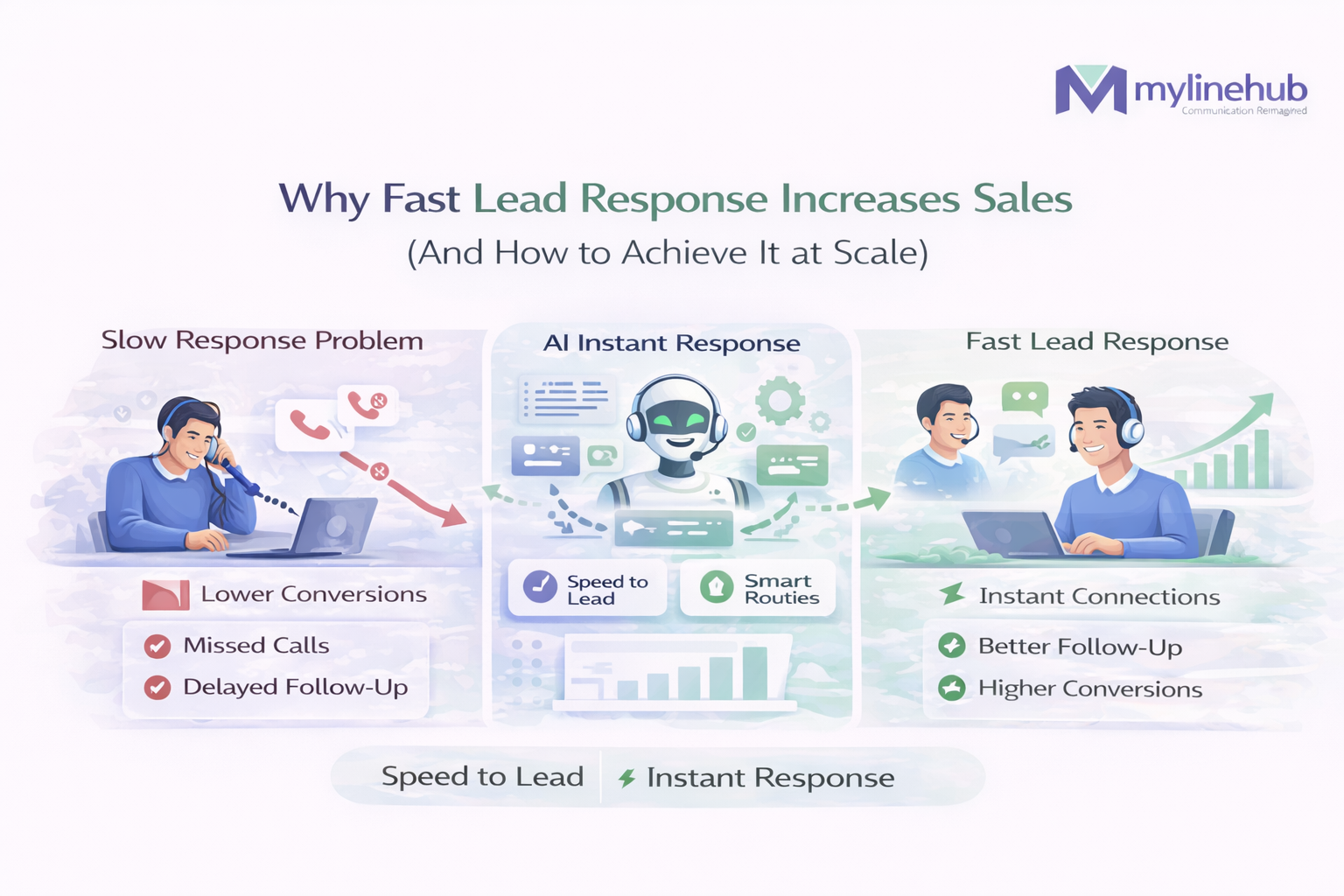
Speed to lead is one of the most underestimated growth levers in modern sales operations. Companies spend heavily on marketing, ads, landing pages, and lead generation — but lose revenue in the first few minutes after a prospect shows interest. The uncomfortable truth is simple: most sales are lost before the first real conversation even begins.
Research consistently shows that responding within five minutes can increase conversion probability dramatically — in some studies by up to 100× compared to waiting 30 minutes. :contentReference[oaicite:0]{index=0} Yet the average business still responds hours (or even days) later, creating a massive performance gap between fast and slow teams.
This is exactly the gap MYLINEHUB is designed to close. MYLINEHUB is an open-source omnichannel CRM + telecom control layer that helps businesses respond instantly across calls, WhatsApp, and AI calling workflows — without per-agent license lock-in. Core platform: https://github.com/mylinehub/omnichannel-crm. AI calling bridge (VoiceBridge): https://github.com/mylinehub/omnichannel-crm/tree/main/mylinehub-voicebridge.
The psychology of fast lead response (why minutes matter)
When a prospect fills a form, clicks an ad, or gives a missed call, they are at peak intent. Their problem is fresh, their curiosity is high, and they are actively evaluating options. This window is extremely short.
Studies show the odds of qualifying a lead drop sharply with every minute of delay, and many buyers ultimately choose the first company that responds. :contentReference[oaicite:1]{index=1} In fact, 78% of customers buy from the first responder in many B2B scenarios. :contentReference[oaicite:2]{index=2}
What this means operationally is brutal: by the time your team calls back “later today,” the buyer may have already:
• spoken to a competitor • lost urgency • forgotten the context • moved to another solution • become harder to qualify
Fast response is not just about customer experience — it directly changes revenue math.
The math behind speed-to-lead and revenue
Multiple large-scale studies show the same pattern:
• responding within 5 minutes can make leads up to 21× more likely to convert :contentReference[oaicite:3]{index=3} • a 1-minute response can increase conversions by ~391% :contentReference[oaicite:4]{index=4} • conversion probability drops steeply after the first hour :contentReference[oaicite:5]{index=5} • the average business still responds after ~40–47 hours :contentReference[oaicite:6]{index=6}
The implication is powerful: most businesses are not losing because of poor marketing — they are losing because of slow response infrastructure.
This is why improving speed-to-lead often produces faster ROI than increasing ad spend. When response improves, the same leads generate more revenue.
Why most teams fail at fast lead response
Very few organizations are slow by choice. They are slow because their systems are not built for real-time engagement. The common structural blockers are:
Manual lead routing — leads sit in queues waiting for assignment.
Disconnected tools — CRM, dialer, and WhatsApp are separate.
No off-hours coverage — but ~44% of leads arrive outside business hours. :contentReference[oaicite:7]{index=7}
Agent availability mismatch — leads arrive in bursts.
No automatic first touch — everything waits for humans.
Weak callback discipline — follow-ups depend on memory.
This is why even motivated teams struggle. The funnel simply isn’t engineered for speed.
If you want the operational cost impact of these gaps, read: /articles/why-your-telecalling-team-is-expensive
The modern solution: response automation + intelligent routing
High-performing teams treat speed-to-lead as an engineering problem, not a people problem. The winning architecture usually includes:
• real-time lead capture • automatic routing • dialer-triggered first call • WhatsApp/SMS fallback • scheduled callbacks • AI-assisted first touch • unified customer timeline
MYLINEHUB is designed exactly for this layered response model. It sits between your PBX (Asterisk/FreePBX) and your business workflows, ensuring that inbound signals immediately trigger the correct next action.
Where power dialing improves speed-to-lead
In outbound and blended teams, one of the fastest ways to improve response speed is to remove manual dialing delays. MYLINEHUB supports power and progressive dialing strategies that keep agents continuously connected to the next best lead.
More importantly, the system understands call outcomes using Asterisk ARI events. This means it knows whether a call:
• rang but was not answered • failed due to network • was busy • dropped mid-call • was rejected
Because retry logic becomes intelligent, the system reaches prospects faster without wasting attempts. For dialing deep dive: /articles/increase-call-connect-rate-outbound-campaigns
The real breakthrough: AI calling for instant first response
Even the best human teams cannot guarantee sub-minute response 24×7. This is where AI calling becomes strategically important.
MYLINEHUB VoiceBridge enables real-time AI calls triggered directly from your telecom stack. Instead of waiting for an agent to become free, the system can:
• instantly call new leads • perform first-level qualification • confirm intent • collect key data • schedule human follow-up • route hot prospects to agents
This dramatically reduces the “first response gap” — the most dangerous leak in most funnels.
VoiceBridge architecture: /articles/mylinehub-voicebridge-architecture
Full duplex AI bridge deep dive: /articles/open-source-full-duplex-asterisk-ai-voice-bot-bridge-voicebridge
Why open source matters for response infrastructure
Many businesses try to fix speed-to-lead using closed SaaS tools. Initially it works — but over time new problems appear:
• per-agent pricing grows with the team • data becomes locked • telecom flexibility reduces • customization becomes limited • AI integration becomes constrained
MYLINEHUB takes a different approach. Because it is open source, you can:
• deploy on-prem or hybrid • keep customer history permanently • customize routing logic • tune dialer behavior • integrate your own AI models • avoid per-seat licensing pressure
This makes speed-to-lead improvements durable — not temporary hacks that break at scale.
If data ownership is critical in your environment, read: /articles/how-to-make-sure-your-business-data-remains-yours
Operational playbook: achieving sub-5-minute response
Teams that consistently win on speed-to-lead typically implement the following stack:
Step 1: Real-time lead capture from web, ads, missed calls, and WhatsApp
Step 2: Automatic routing to the correct campaign
Step 3: Instant AI call or power dial attempt
Step 4: Omnichannel fallback (WhatsApp/SMS/email)
Step 5: Scheduled human follow-up
Step 6: Continuous monitoring and tuning
When this pipeline runs correctly, businesses often see improvements without increasing headcount.
For the scale-without-hiring angle, see: /articles/handle-more-leads-without-hiring-more-agents
The bottom line: speed is now a structural advantage
In today’s market, product quality alone rarely wins the first conversation. Response speed does. Buyers expect near-instant engagement, and the companies that build for it consistently outperform slower competitors.
Fast lead response increases sales because it:
• captures buyers at peak intent • beats competitors to first contact • increases connect probability • improves qualification rates • reduces marketing waste • lowers cost per acquisition • stabilizes pipeline predictability
MYLINEHUB combines open-source ownership, power dialing intelligence, omnichannel workflows, and VoiceBridge AI calling to help organizations achieve true real-time response — not just faster callbacks.
Businesses that treat speed-to-lead as infrastructure, not a KPI, are the ones that scale efficiently.
Want to see API-driven CRM + Telecom workflows in action? Try the WhatsApp bot or explore the demos.
Comments (0)
Be the first to comment.