How to Increase Call Connect Rate in Outbound Campaigns
Low connect rates waste agent time and increase costs. Learn proven methods to improve outbound call pickup and campaign performance.
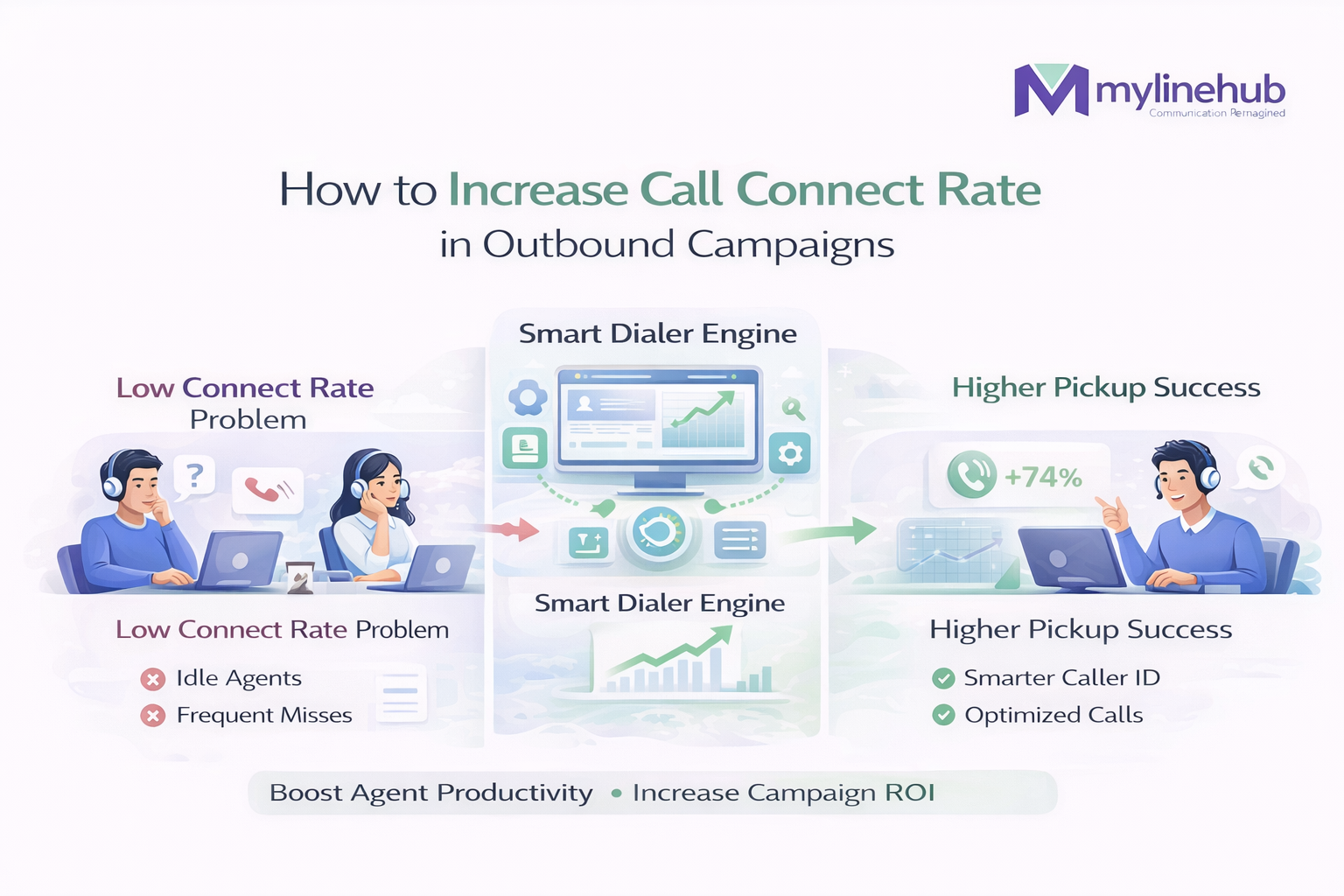
Low connect rate is one of the fastest ways to make an outbound team look expensive. When agents spend most of their hour waiting on ringing calls, dialing manually, or chasing poor-quality retries, productivity drops and the business starts adding headcount just to maintain output.
The reality is simple: connect rate is an engineering + strategy problem, not just an agent performance problem. With the right dialing model, event awareness, and telecom control, the same team can produce significantly more meaningful conversations per hour.
MYLINEHUB addresses this using an open-source dialing control layer, ARI-driven call intelligence, and structured campaign logic. The platform is fully open-source: https://github.com/mylinehub/omnichannel-crm.
What “connect rate” actually measures (and why most teams misread it)
Connect rate is not just how many calls are answered. It reflects the efficiency of your entire outbound system: list quality, dialing strategy, retry logic, time-window compliance, carrier behavior, and agent readiness.
Many teams try to fix connect rate by pushing agents to “call faster”. That rarely works. If the system does not understand call outcomes in real time, it cannot adapt pacing, retries, or agent allocation.
The real goal is higher meaningful connects per agent-hour, not just more dial attempts.
Why outbound connect rates usually stay low
Across industries (sales, collections, verification, education, real estate), the same structural issues appear:
• Manual dialing or semi-automation creates idle time.
• No clear retry intelligence causes repeated waste calls.
• Call drop events are not understood properly, so pacing becomes blind.
• Agents wait on ringing calls instead of speaking to customers.
• Poor time-window discipline leads to unanswered attempts.
• Disconnected tools prevent campaign learning.
Fixing connect rate requires both the right dialer strategy and real-time telecom awareness.
Understanding dialing strategies: predictive vs progressive vs power dialer
Many teams choose the wrong dialer type for their campaign and then blame the team for poor results. Each strategy exists for a reason.
Predictive Dialer
Predictive dialing places multiple calls ahead of agent availability based on statistical models. It maximizes agent talk time but must be used carefully due to compliance and abandoned call risks.
Best suited for: high-volume, lower-sensitivity campaigns where aggressive pacing is acceptable.
Progressive Dialer
Progressive dialing is more controlled. The system dials the next number only when an agent is about to become free. It balances efficiency and customer experience better than predictive in many regulated environments.
Best suited for: quality-focused outbound programs and moderate-volume campaigns.
Power Dialer (MYLINEHUB’s most widely used mode)
Power dialing keeps agents continuously connected to the next call in sequence with tight pacing and strong visibility into call outcomes. It avoids the regulatory risk of aggressive predictive dialing while dramatically reducing manual idle time.
When implemented correctly, power dialing often delivers the best real-world balance between: connect rate, agent control, and compliance safety.
Detailed strategy comparison: https://mylinehub.com/articles/types-of-autodialer-strategies-explained.
How MYLINEHUB Power Dialer improves connect productivity
MYLINEHUB’s power dialer is not just an auto-call loop. It is tightly integrated with Asterisk through ARI (Asterisk REST Interface) so the system understands what is actually happening to each call in real time.
This matters because dialing efficiency depends on correctly interpreting events such as:
• Ringing but not answered
• Busy tone
• Network failure
• Call dropped mid-flow
• Agent unavailable
• Customer disconnected
Using ARI event streams, MYLINEHUB classifies these outcomes accurately and immediately feeds that intelligence back into campaign logic. This is one of the biggest reasons connect productivity improves.
Why ARI-based event intelligence matters
Many dialers treat every failed call the same. In reality, different outcomes require different next actions. For example:
Busy signal → retry sooner
No answer → retry later in window
Call dropped → adjust pacing or carrier routing
Agent missed → workflow or staffing issue
MYLINEHUB listens to Asterisk ARI events and AI-derived call states to distinguish these cases. Because the system knows why a call failed, it can schedule smarter retries and maintain agent flow.
This is especially important at scale where blind redialing wastes thousands of attempts per day.
For deeper telecom control concepts: https://mylinehub.com/articles/how-to-build-scalable-telecom-solution.
Open-source advantage: tailor dialing logic to your business
Every outbound program is different: sales, collections, verification, admissions, real estate, insurance. Closed dialers force you into fixed retry rules and pacing models.
Because MYLINEHUB is open-source, teams can:
• Adjust retry strategies
• Tune pacing behavior
• Modify disposition logic
• Integrate custom CRM triggers
• Build campaign-specific workflows
Even small code adjustments can align the dialer perfectly with your business model. Source code is available here: https://github.com/mylinehub/omnichannel-crm.
AI-assisted call understanding (beyond basic dial status)
Traditional dialers rely only on SIP outcomes. MYLINEHUB can also incorporate AI-assisted interpretation layers (when enabled) to better classify real-world call behavior. This becomes powerful in noisy environments where carrier signals alone are insufficient.
Combined with ARI telemetry, this helps maintain clean campaign flow and reduces false retries.
Where AI Calling Bridge fits into outbound productivity
Even with the best dialer, some outbound workloads are repetitive: verification calls, reminders, first-pass screening, surveys, and basic qualification.
MYLINEHUB includes the VoiceBridge AI Calling Bridge, which connects your telecom environment to external AI bots while preserving PBX-grade media control.
This allows businesses to:
• Offload repetitive calls to AI
• Keep humans for high-value conversations
• Maintain telecom ownership
• Scale outreach without linear hiring
Business use cases: https://mylinehub.com/articles/ai-calling-for-interviews-and-business-growth.
VoiceBridge architecture: https://mylinehub.com/articles/mylinehub-voicebridge-architecture.
Operational best practices to maximize connect rate
Technology alone is not enough. High-performing outbound teams combine system discipline with data hygiene:
• Clean lead lists regularly
• Respect time-window compliance
• Segment campaigns by geography and intent
• Monitor connect trends daily
• Tune retry gaps based on real outcomes
MYLINEHUB’s monitoring and reporting layers help supervisors identify where connects are being lost: https://mylinehub.com/articles/how-to-track-call-center-employees-effectively.
The measurable impact of fixing connect rate
When connect rate improves through structured dialing and ARI-aware campaign logic, teams typically observe:
• Higher talk time per agent
• Lower idle dialing time
• Better list utilization
• More predictable daily output
• Reduced need for rapid headcount growth
Outbound performance does not improve by pushing agents harder. It improves when the dialing engine becomes intelligent, event-aware, and adaptable to real telecom behavior.
With an open-source, ARI-integrated power dialer and optional AI calling bridge, MYLINEHUB enables teams to systematically increase connect productivity while retaining full control over their telecom stack.
Want to see API-driven CRM + Telecom workflows in action? Try the WhatsApp bot or explore the demos.
Comments (0)
Be the first to comment.