Why Per-Agent Pricing Becomes Expensive as You Scale
Per-agent pricing looks simple early on—but becomes costly at scale. Understand the math and the alternatives.
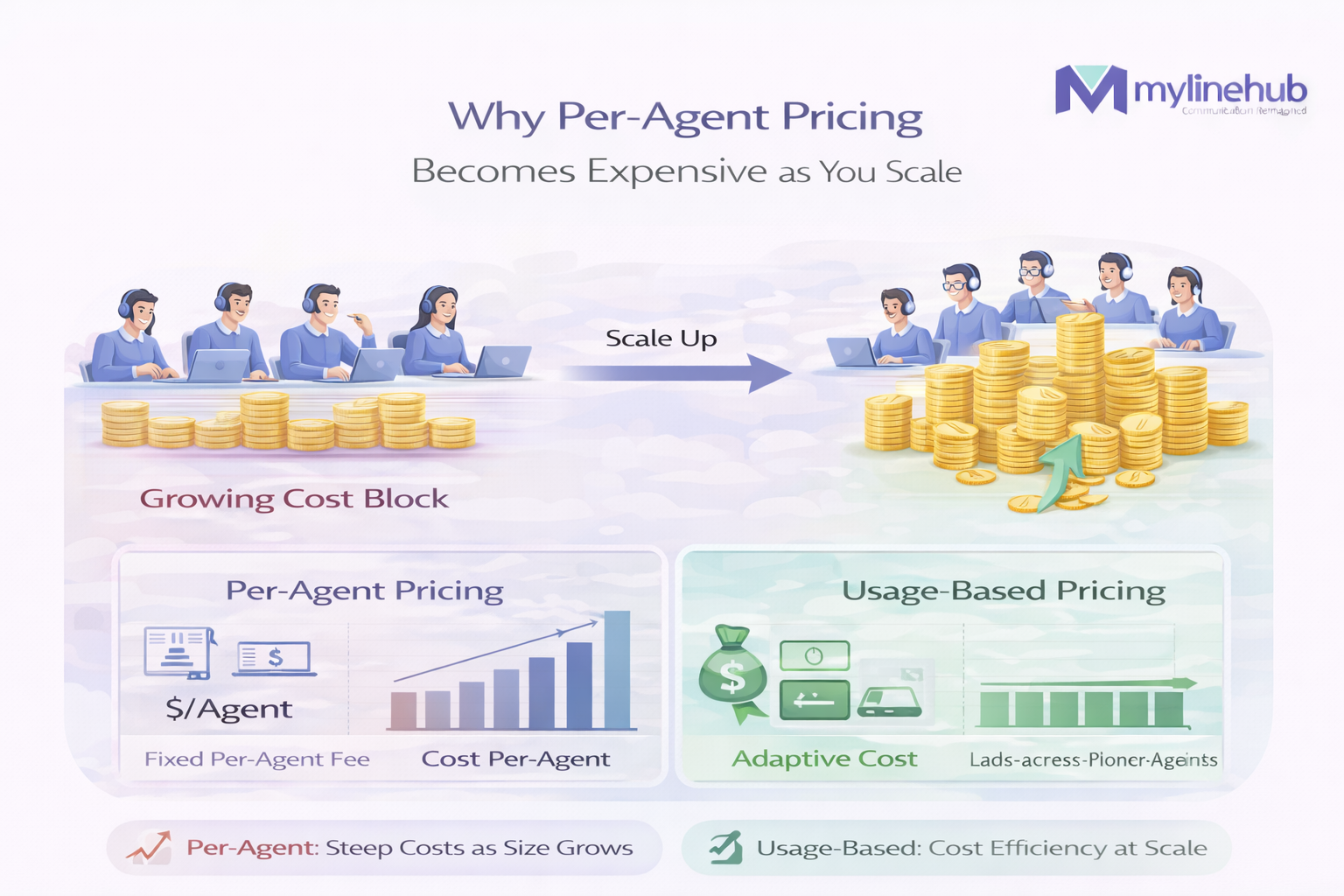
Per-agent pricing looks simple when teams are small. Many businesses adopt SaaS calling platforms, CRMs, or contact center tools because the entry cost feels manageable — pay per user, start fast, and scale later. The real problem appears only when the operation begins to grow. What looked affordable at 5 agents often becomes structurally expensive at 25, 50, or 200 agents.
The issue is not that per-agent pricing is “wrong.” The issue is that it creates a linear cost curve in a business that is trying to achieve non-linear growth. Every time you hire to handle more leads, your software cost rises automatically — even if your underlying infrastructure could have supported the scale more efficiently.
MYLINEHUB was designed to break this pattern. It is an open-source omnichannel CRM and telecom control layer that can be deployed in your own environment, allowing you to scale operations without being locked into per-seat licensing for the core platform: https://github.com/mylinehub/omnichannel-crm. It also includes VoiceBridge, an open-source AI calling bridge for Asterisk/FreePBX environments: https://github.com/mylinehub/omnichannel-crm/tree/main/mylinehub-voicebridge.
Why per-agent pricing feels attractive at the beginning
Early-stage teams often choose per-user SaaS tools for good reasons. They offer:
• fast onboarding
• low upfront commitment
• predictable monthly billing
• bundled features
• minimal infrastructure setup
At small scale, these benefits are real. If you have 3–5 agents and you are validating a process, per-agent pricing can be perfectly reasonable.
The mistake happens when businesses assume the same model will remain efficient as they scale.
The scaling trap: software cost grows faster than productivity
In most telecalling environments, productivity improvements come from better systems: improved connect rate, better routing, faster follow-ups, and automation of repetitive work. But per-agent pricing ignores these efficiencies.
Under a per-seat model:
• hiring 20% more agents → software cost rises ~20% immediately
• seasonal hiring → software bill spikes instantly
• experimentation → becomes expensive
• temporary teams → still incur full license cost
Meanwhile, your infrastructure (PBX capacity, servers, network) often has unused headroom that could have supported more activity without proportional cost increases.
This is why many teams feel their cost per lead stops improving beyond a certain size.
If you are already seeing rising unit costs, read: /articles/reduce-cost-per-lead-telecalling.
The hidden compounding effect at mid-scale
The real pain of per-agent pricing appears between roughly 25 and 150 agents. At this stage:
• you add supervisors → more paid seats
• QA teams grow → more paid seats
• managers need dashboards → more paid seats
• support teams need access → more paid seats
What started as “agent pricing” quietly becomes “everyone pricing.” Your software cost base expands across the entire organization, even though only part of the team is directly generating revenue.
At the same time, your operational complexity increases:
• callback discipline becomes harder
• lead routing must become smarter
• monitoring needs deeper visibility
• automation becomes essential
Ironically, the moment you most need system flexibility is the moment per-seat tools become most expensive.
Why this directly impacts cost per lead
Cost per lead is heavily influenced by fixed overhead divided by productive outcomes. When software cost scales linearly with headcount, your fixed overhead rises faster than your efficiency improvements.
This creates a ceiling effect:
• you improve dialing efficiency
• you improve connect rate
• you improve follow-up discipline
• but software cost keeps rising anyway
Over time, the financial gains from operational improvements get partially cancelled by licensing growth.
For a deeper breakdown of manual vs automated economics: /articles/manual-calling-vs-automated-calling-cost-comparison.
The architecture mismatch most teams miss
Telecom infrastructure does not naturally scale per human. A properly designed Asterisk/FreePBX environment can handle large call volumes with relatively predictable infrastructure costs. The expensive part of many operations is human time — not the underlying switching capacity.
Per-agent SaaS pricing ignores this reality. It prices software based on headcount rather than on actual resource consumption or call throughput.
MYLINEHUB takes a different approach by acting as a telecom control layer integrated with Asterisk/FreePBX rather than a purely seat-based cloud wrapper. This allows businesses to align software economics more closely with actual usage and infrastructure capacity.
Integration reference: /articles/freepbx-mylinehub-integration-flow
Where AI calling makes per-seat pricing even more inefficient
The rise of AI calling further exposes the limitations of per-agent models. When AI begins handling first-touch, qualification, reminders, and bulk follow-ups, the relationship between “number of humans” and “number of calls” changes dramatically.
In a hybrid AI + human model:
• call volume can increase significantly
• human headcount may grow slowly or even stabilize
• automation handles repetitive workload
• agents focus on high-value conversations
Seat-based pricing does not adapt well to this shift. You either overpay for human seats or struggle to integrate AI cleanly into closed platforms.
MYLINEHUB VoiceBridge enables AI calling directly within your telecom environment, allowing automation to scale without forcing your entire cost structure to follow a per-seat model.
Business reality of AI vs humans: /articles/ai-calling-vs-human-telecallers-business-reality
The flexibility advantage of open-source ownership
Open-source does not mean “free forever” in the simplistic sense. You still invest in infrastructure, telecom minutes, and operational discipline. The advantage is structural: you are not forced into perpetual per-user rent for core platform ownership.
With MYLINEHUB, businesses can:
• deploy on-prem or hybrid
• customize workflows as needed
• scale teams without automatic license multiplication
• integrate deeply with existing Asterisk/FreePBX setups
• retain full ownership of customer interaction data
For long-term data control: /articles/how-to-make-sure-your-business-data-remains-yours
When per-agent pricing still makes sense
To be clear, per-seat tools are not always wrong. They can be appropriate when:
• your team is very small and unlikely to scale soon
• you need a rapid proof of concept
• your calling volume is low and stable
• deep telecom control is not important
• customization requirements are minimal
The risk comes when businesses build their long-term growth engine on a pricing model optimized only for early-stage simplicity.
A practical way to evaluate your current cost curve
Ask these questions:
1) If we double our agents next year, does our software cost nearly double?
2) Are we paying licenses for supervisors, QA, and managers separately?
3) Does our platform limit dialer logic or telecom control?
4) Will AI calling be difficult or expensive to integrate?
5) Do we truly own our customer interaction history?
If most answers raise concern, your pricing model — not your team — may be the real bottleneck.
Per-agent pricing solves the onboarding problem but often creates a scaling problem. As outbound operations become more automated, more AI-assisted, and more tightly integrated with telecom infrastructure, businesses that retain architectural control and avoid linear license growth gain a structural advantage.
MYLINEHUB is built for teams that have moved beyond the “just start quickly” phase and are now optimizing for long-term efficiency, ownership, and scalable economics.
Want to see API-driven CRM + Telecom workflows in action? Try the WhatsApp bot or explore the demos.
Comments (0)
Be the first to comment.