How to Build a Telecom Incident-Response Process
A telecom incident is any unplanned condition that materially affects customer calling, staff calling, routing, audio, recording, reporting, or the security of the phone system.
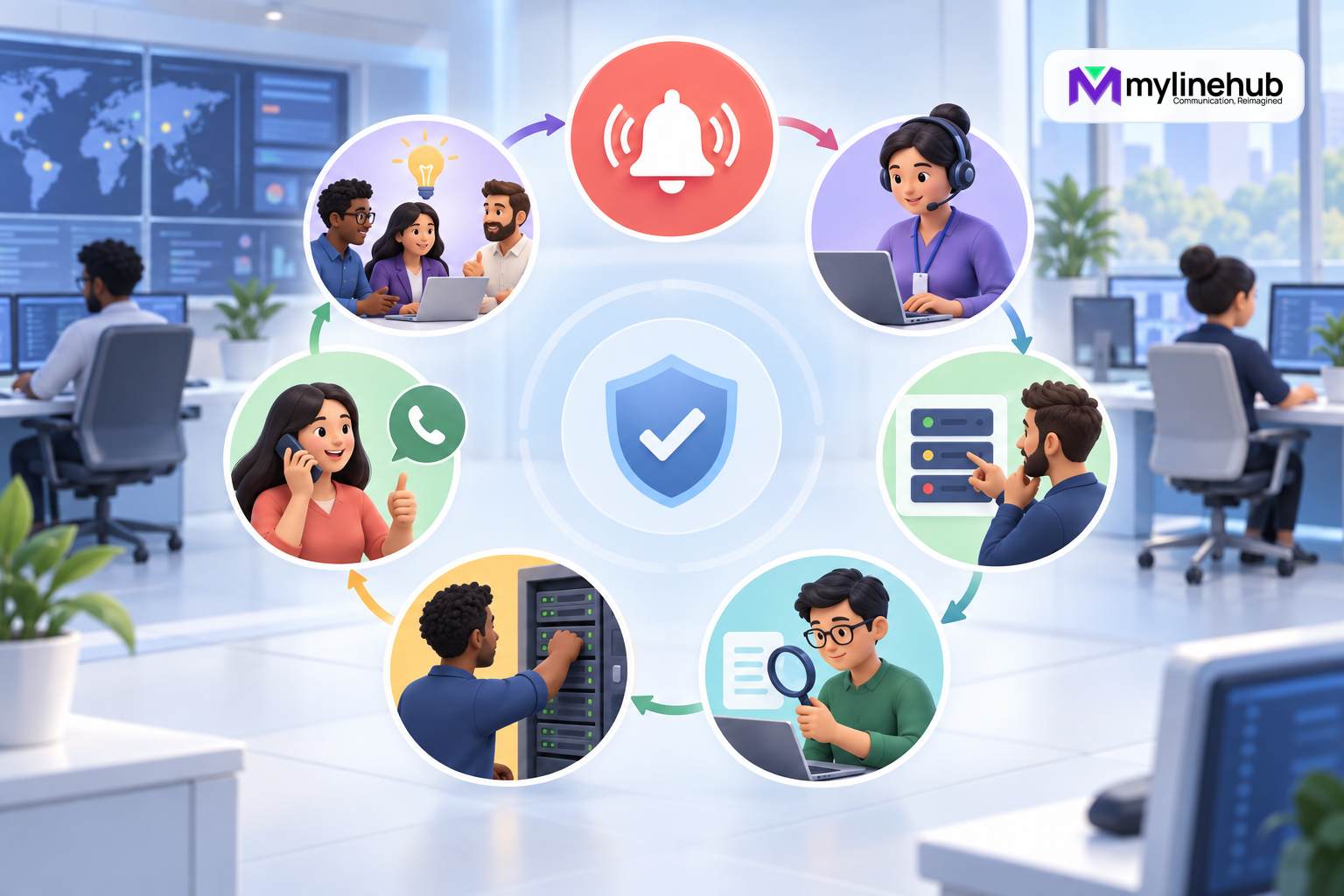
A telecom incident is any unplanned condition that materially affects customer calling, staff calling, routing, audio, recording, reporting, or the security of the phone system. A useful response process helps a small team protect customers, identify the responsible layer, restore service safely, and learn from evidence. It does not treat every failed call as a crisis or let urgency become permission for uncontrolled configuration changes.
Define Incidents in Business Language
List the journeys the business depends on: customers reaching the main number, urgent calls reaching an on-call person, agents making outbound calls, transfers, IVR choices, recordings, campaign activity, and emergency calling where applicable. Define impact levels using those journeys. One extension failing is different from every inbound call failing; delayed reporting is different from silent or one-way audio.
For each level, name who coordinates, who may make technical changes, who communicates internally, and who contacts providers. Include a clear threshold for declaring and closing an incident. The process should work outside normal hours without assuming one unavailable expert holds every password and relationship.
Prepare an Ownership Map
Record who owns the PBX or telephony engine, Linux host, LAN, firewall, Internet access, SIP trunk, DIDs, endpoints, CRM integration, campaign application, recordings, and power. MYLO can explain and coordinate supported work, but it does not become the provider, network, Asterisk, or business-policy authority. Escalate each failure to the layer that can actually observe and correct it.
Keep provider account references, support channels, approved contacts, service commitments, and maintenance windows accessible to authorised staff. Store credentials in an approved secret system, never in the incident checklist or chat transcript.
Create a Simple Intake Record
Capture who reported the problem, first observed time and time zone, affected numbers or extensions, direction, expected journey, actual symptom, approximate scope, and one or more call examples. For a call example, keep the bounded timestamp, originating and destination identifiers with appropriate redaction, MYLO call ID or Asterisk identifier, and audio result.
Do not begin with an unbounded log dump. A precise example lets the team distinguish signalling, routing, endpoint, media, application, and provider problems. Preserve reports from users, but label them as observations rather than verified causes.
Triage Safety and Customer Impact
First determine whether emergency calling, urgent healthcare or safety contact, security, or widespread customer access is affected. Follow the organisation’s dedicated continuity procedure for those cases. Pause campaigns or automation that could create duplicate calls, expose customers to broken audio, or worsen provider load.
Choose only pre-approved fallbacks. Provider diversion, alternate trunks, mobiles, or manual callbacks may change caller identity, privacy, recording, queueing, reporting, and cost. State those limitations to the business owner and record who authorised activation.
Separate the Failure Domains
Check power and physical links; local network reachability; Linux interfaces, addresses, routes, DNS, time, storage, and resource pressure; Asterisk or FreeSWITCH process and loaded state; endpoint registrations; trunk authentication or reachability; dialplan execution; RTP media; MYLO application state; and provider evidence. A green status at one layer does not prove the whole journey.
Use the correct source of truth. Linux owns current host networking. Asterisk or FreeSWITCH owns loaded telephony state and live channels. The provider owns service on its network. MYLO owns its permissions, proposals, campaign state, and reporting relationships. Preserve contradictions rather than asking AI to select a plausible story.
Collect Bounded Evidence
Use a narrow time window and stable call identifiers. Correlate customer and agent legs, SIP responses, routes, channel results, media observations, application events, and provider ticket references. State when evidence was collected because volatile state can change during investigation. Redact tokens, SIP passwords, private keys, and unrelated customer information.
Keep facts separate from hypotheses. “Asterisk received the call at 10:32” is an observation; “the carrier had an outage” needs carrier evidence. Store exported diagnostics securely and apply retention rules to tickets, email attachments, and support bundles.
Control Changes During the Incident
Prefer the smallest reversible correction. Before a consequential change, capture current state, describe the expected effect, identify affected journeys, create or verify a backup, obtain the required approval, and define the acceptance test. Do not combine unrelated upgrades, cleanup, or design changes with urgent restoration.
Use an incident log with immutable entries for proposal, approval, execution result, and verification. If a change fails, record it rather than overwriting the attempt. When evidence is incomplete, restoring a known approved configuration may be safer than inventing a new one, but restore scope must be understood.
Communicate on a Predictable Rhythm
Updates should state impact, start time, current evidence, mitigation, owner, next decision, and next update time. Avoid technical speculation presented as fact. Customer-facing messages should explain affected service and practical alternatives without exposing security details or promising a recovery time the responsible provider has not confirmed.
Use one coordinator to maintain the shared record and prevent parallel teams from changing the same route. If responsibility moves between network, telecom, application, and provider teams, record the handoff and the evidence each receives.
Verify the Real Journey
Process health, registration, reload success, and a provider portal are supporting evidence. Restoration requires an authorised real inbound or outbound test through the affected path. Confirm number delivery, caller identity, route, ringing, answer, transfer or IVR behaviour, two-way audio, hangup, event history, and recording only where approved.
Repeat the original failed scenario after correction. Record expected and observed results, timestamps, identifiers, and tester. Reconcile calls or campaigns affected during the incident before releasing paused automation.
Close and Learn
Close only after the business owner accepts service, temporary fallbacks are removed or documented, monitoring is stable, and unresolved customer work has an owner. Summarise impact, timeline, evidence-backed cause, contributing conditions, mitigation, permanent correction, verification, and follow-up deadlines.
A review should improve monitoring, ownership, capacity, change control, documentation, and fallback testing—not merely assign blame. Track actions to completion. Keep the report accessible to authorised operators while protecting customer and infrastructure data.
Incident Response Checklist
- Declare scope and impact in business terms.
- Name the coordinator and technical owners.
- Protect urgent journeys and pause harmful automation.
- Capture bounded call examples and live evidence.
- Identify the responsible network, telephony, provider, or application layer.
- Approve, back up, and apply the smallest correction.
- Verify the original journey with a real authorised call.
- Reconcile affected records, communicate recovery, and complete follow-up actions.
A mature process turns pressure into a sequence the team can repeat: protect, observe, contain, correct, verify, communicate, and learn.
Build an Evidence Toolkit Before Failure
Prepare approved commands and views for Linux networking, Asterisk or FreeSWITCH runtime, MYLO operation history, provider status, packet capture where authorised, and call retrieval. Define who may use each tool and where outputs are stored. Test that timestamps align and that staff can find a call using a bounded time, direction, number, and stable identifier.
Automate collection only with strict scope and redaction. A support bundle should not casually include all customers, secrets, configuration, or recordings. Record the tool version and collection time so later reviewers understand what the evidence represents.
Practise With Tabletop Scenarios
Run short exercises for an Internet outage, failed SIP trunk, one-way audio, compromised API token, unavailable administrator, full storage, and a campaign that stopped after restart. Ask the actual on-call person to declare impact, find ownership, choose a fallback, collect evidence, request approval, and state the acceptance test.
Exercises reveal missing access and unclear authority more safely than a live outage. Update the runbook and contact list immediately afterward, then assign any technical correction an owner and due date.
Measure Response Quality
Track time to detection, declaration, containment, responsible-owner engagement, verified restoration, customer reconciliation, and follow-up completion. Also track unsafe retries, unauthorised changes, missing call examples, and repeated documentation gaps. Do not reward fast closure that lacks end-to-end verification.
Use trends to improve design and staffing. A recurring trunk incident may require provider action; repeated routing mistakes may require simpler change review; slow recovery may reflect absent access rather than weak technical skill.
Use Decision Gates Instead of Open-Ended Troubleshooting
Define explicit decision points that stop investigation from becoming an uncontrolled sequence of guesses. After initial triage, the coordinator should decide whether the team has enough evidence to continue diagnosis, activate a continuity route, involve the carrier, or move directly to restoration from a known state. Each gate should have an owner, a time limit, the evidence required, and the risk of waiting. A widespread inbound failure with a healthy PBX but no calls arriving, for example, should move quickly to provider escalation rather than repeated dialplan edits.
Set stop conditions for technical work. Stop when a proposed action could widen customer impact, when two operators are changing the same layer, when the approved maintenance boundary is exceeded, or when the current backup and rollback path are unclear. Escalation is a controlled response, not an admission of failure. The goal is to place the problem with the authority that can verify it while protecting the service from speculative changes.
Preserve a Minimum Incident Evidence Pack
For every material incident, retain the declaration, impact statement, bounded call examples, aligned timestamps, relevant runtime observations, provider references, approved actions, backup reference, verification calls, customer reconciliation, and closure decision. Include enough context to explain why an action was taken, not only what command or button was used. Where packet captures, recordings, or logs contain customer information, store them separately with restricted access and documented retention.
Before closing, ask whether an independent authorised operator could reconstruct the event from the record. If not, capture the missing decision or evidence while it is still available. This compact evidence pack supports provider disputes, recurring-fault analysis, training, and safer future changes without turning the incident record into an unrestricted archive of customer communications.
Continue planning
Continue with MYLO Appliance vs MyLineHub Open Source: Which Path Fits?; Why Telecom Changes Need Approval, Backup and Verification; What Must Be Documented in a Business Phone System?. For deeper implementation context, use MyLineHub technical architecture guidance.
For a requirement outside the prepared MYLO scope, discuss the exact outcome with MyLineHub.
Want to see API-driven CRM + Telecom workflows in action? Try the WhatsApp bot or explore the demos.
Comments (0)
Be the first to comment.