Why Telecom Changes Need Approval, Backup and Verification
A telecom change can be technically small and commercially large. One incorrect route can make a public number unreachable. One caller-ID mistake can cause outbound rejection.
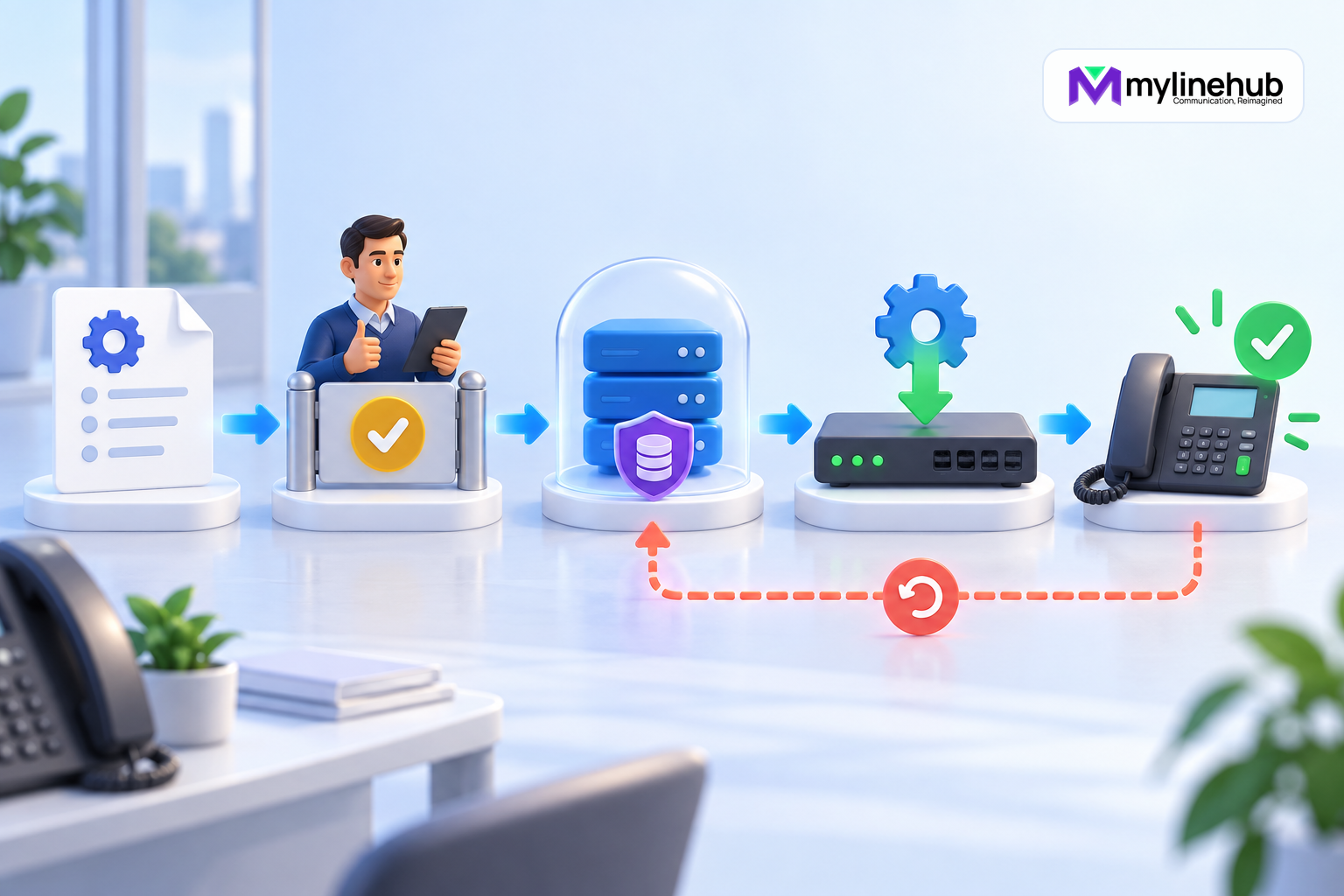
A telecom change can be technically small and commercially large. One incorrect route can make a public number unreachable. One caller-ID mistake can cause outbound rejection. One network edit can remove both voice traffic and administrative access. Approval, backup and verification are therefore not bureaucracy around the work; they are three different controls for three different risks.
Approval confirms that the intended effect is authorised. Backup preserves a defined pre-change state. Verification proves that the required customer journey works after execution. None can substitute for the others.
Why a successful command is not enough
Telephony spans providers, networks, PBX configuration, endpoints, applications and people. A configuration file can be syntactically valid while the provider sends a different number format. A service can reload while RTP audio is blocked. A campaign can start while the authorised caller ID is rejected. The system needs evidence from the layer that owns each fact.
In the MYLO model, Asterisk is the authority for loaded telephony configuration and live call execution. Linux is the authority for machine and network state. The provider owns its external service. MYLO owns application approvals and workflows. Verification correlates these authorities rather than trusting a single green status.
Approval answers “should this happen?”
Before a consequential change, an accountable person should see the intended outcome, affected service, meaningful before-and-after values, protected inputs, dependencies, maintenance window, possible customer impact, backup scope and acceptance test. Approval should attach to that exact proposal.
A casual conversation is not always authorization. An operator may agree that a proposed IVR design looks correct without approving production execution. An AI model may confidently recommend an action but cannot grant the business’s authority. Role and permission checks apply independently of how persuasive the request sounds.
Approval also prevents ownership confusion. The carrier owner confirms provider details, the network owner accepts connectivity changes, the service owner accepts customer impact and the system administrator applies supported operations. High-risk changes may require more than one role.
Backups answer “how can defined state be recovered?”
A useful backup is scoped and identifiable. It records when it was created, for which proposed operation, which files or records it contains, integrity information and the method required to restore it. It is created before mutation, not after failure.
Scope matters. A telephony configuration snapshot does not back up the SIP provider account, office router, CRM database, recordings or entire machine unless explicitly designed to do so. Calling every archive “the backup” creates false confidence.
Protect backup access because it may contain credentials, numbers or customer information. Apply retention and encryption policy. Test restoration under controlled conditions. A backup that has never been read or restored is only an assumption.
Verification answers “did the business outcome work?”
Verification has layers. First validate inputs and generated configuration. Then confirm the affected service loaded the intended state. Finally perform a functional test through the real path. The strength of the evidence should match the change.
For an inbound route, place an external call to the public number and verify provider delivery, number matching, prompt, DTMF, destination, ring behaviour, two-way audio, hang-up and recording choice. For an outbound route or campaign, verify authorized caller ID, call-leg order, agent availability, bridge, audio, result and channel use.
Record expected and observed results with time and safe identifiers. “The reload succeeded” proves only that a reload command completed. It does not prove that a customer can reach the business.
The controls form one chain
- Request: describe the business outcome.
- Observe: read current state from the correct authorities.
- Clarify: collect missing provider, route, user and policy information.
- Propose: show the narrow change and expected impact.
- Approve: an authorised human accepts the proposal.
- Back up: capture the exact recoverable pre-change scope.
- Apply: use deterministic, bounded operations.
- Validate: check syntax, loading and system evidence.
- Verify: run the real acceptance journey.
- Record: preserve result, evidence and unresolved risks.
If volatile state changes between proposal and execution, return to observation. Approval for one difference should not silently authorize another.
Protect scope and secrets
A safe operation names what it may change and what it must preserve. Provider credentials, unrelated routes, endpoints and manual customizations should not be rewritten simply because a broad template is convenient. Use atomic writes or transactional mechanisms where appropriate and validate before activating.
Never put SIP passwords, API keys or private customer data into an approval description. Show masked or semantic references. AI assistance can interpret intent and explain evidence, but deterministic services must enforce authorization, file or API scope, validation and secret handling.
When the requested scope is unsupported by the prepared MYLO appliance, stop and classify it. The wider MyLineHub open-source platform or a custom project may offer a path, but neither is automatically included in the appliance change.
Failure should stop expansion
When validation or verification fails, do not continue applying the change to more numbers, users or campaigns. Preserve current evidence, identify which authority disagrees and decide whether a bounded correction or restore is safer.
An automated retry is not always appropriate. If a provider rejects authentication, repeated attempts do not solve the credential. If a real call reaches an IVR but DTMF fails, reloading the same route does not test the media path. Diagnose the failed boundary.
Keep the failed operation record. Do not overwrite history to make the change appear successful. A clear failure record improves later review and prevents the same unsafe assumption.
Restore is another change
Restoring a snapshot can remove valid work completed after that snapshot. It therefore needs an identified restore point, difference review, authority, supported application process and verification. “Undo” is not automatically harmless.
After restore, validate loaded configuration and repeat the affected call journey. If the original fault came from the carrier, network, endpoint or external application, restoring PBX files may not help. Assign external failures to their owners rather than cycling configuration.
For severe incidents, the service owner may authorize an emergency process, but it should still preserve scope, evidence and retrospective review.
Examples of the three controls
Changing business hours
Approval confirms the new schedule and timezone. Backup captures the existing time condition and related route. Verification calls through the real public number in representative open and closed conditions.
Updating a SIP trunk
Approval covers provider-supplied endpoint, transport and expected impact without exposing credentials. Backup captures affected telephony configuration. Verification checks loading, registration where applicable, inbound and outbound signalling, number formats and two-way audio.
Starting an outbound campaign
Approval covers audience, schedule, caller ID, connection type, capacity and lawful purpose. Backup may not be the central control because campaign creation is application state, but recoverable configuration and immutable approval remain important. A mandatory functional test proves the exact call-leg pattern before production launch.
Right-size the process
Not every read-only question needs formal approval. Observing a trunk, explaining a log or listing routes may be allowed within role permissions. Creating users, changing routes, starting a live campaign, altering network state or restoring a snapshot has consequences and should follow the control chain.
Use standard change templates for routine work. Predefine required inputs, risk, backup scope and tests, but never turn the template into automatic approval. Emergency changes can shorten waiting time while retaining a named decision-maker and mandatory follow-up.
A small team benefits from clarity more than ceremony. A concise proposal and a five-minute real test may prevent hours of outage.
Build an evidence record
Record request, current observation, proposal, approver, backup identifier, execution result, technical validation, functional verification and follow-up. Include timestamps and safe correlation identifiers. Keep secrets and unnecessary customer data out.
Separate administrative audit from high-volume telemetry. Important user, role, provider or security changes may need durable tamper-evident history. Routine call events and diagnostic logs belong in their appropriate operational stores and retention policies. More records do not automatically mean better accountability.
A production checklist
- Is the business outcome and affected scope precise?
- Was current state read from its authoritative source?
- Are dependencies and protected values identified?
- Can the approver understand meaningful before and after?
- Is approval current and role-authorised?
- Was a scoped backup created and checked before mutation?
- Did deterministic validation pass?
- Did the running system load the intended state?
- Did a real end-to-end test pass?
- Were failure, restore and escalation paths confirmed?
- Was the outcome recorded without exposing secrets?
The bottom line
Approval protects intent and accountability. Backup protects recoverable state. Verification protects the customer outcome. Removing any one leaves a different risk unmanaged.
Use the chain for every consequential telecom change, scale it to the impact and keep each step evidence-based. The result is not merely safer configuration; it is a phone service the business can explain, operate and recover.
Continue planning
Continue with MYLO Appliance vs MyLineHub Open Source: Which Path Fits?; How to Write Telecom Operating Procedures for a Small Team; How to Build a Telecom Incident-Response Process. For deeper implementation context, use MyLineHub technical architecture guidance.
For a requirement outside the prepared MYLO scope, discuss the exact outcome with MyLineHub.
Want to see API-driven CRM + Telecom workflows in action? Try the WhatsApp bot or explore the demos.
Comments (0)
Be the first to comment.