How to Write Telecom Operating Procedures for a Small Team
A telecom operating procedure turns knowledge held by one person into a repeatable business process. For a small team, the best procedure is not a huge manual.
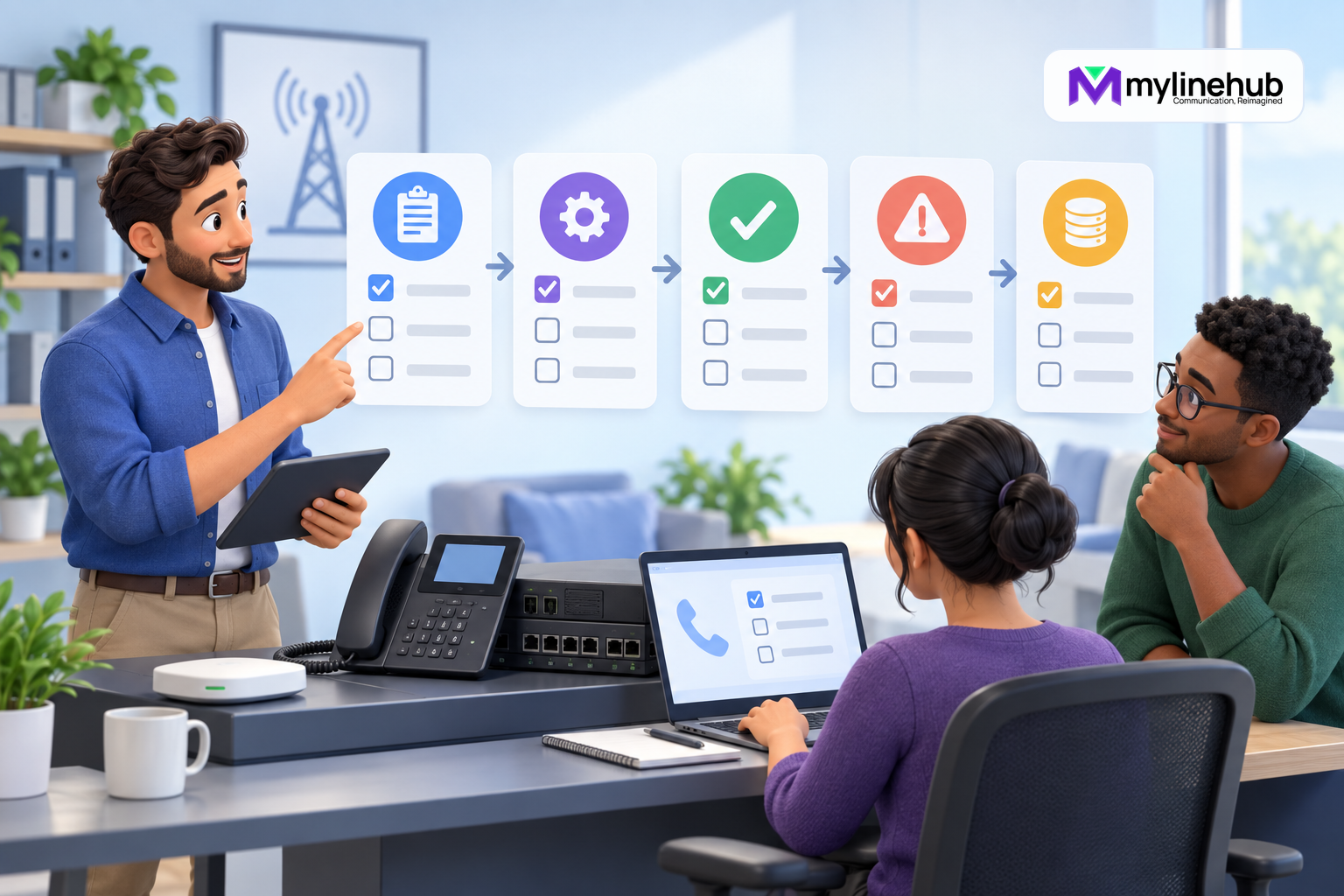
A telecom operating procedure turns knowledge held by one person into a repeatable business process. For a small team, the best procedure is not a huge manual. It is a short, accurate guide that tells an authorised person what outcome is being protected, what evidence to collect, which system owns the truth, what actions are allowed, when approval is required and how to verify the result.
Good procedures reduce guesswork without encouraging blind button-clicking. They help a prepared MYLO appliance, a MyLineHub open-source deployment or a custom telephony environment remain supportable when staff, providers and technology change.
Begin with the service, not the interface
Write down the customer journey in ordinary language. A caller reaches the support number, hears an opening-hours message, selects a menu option, reaches an available agent and can speak in both directions. An outbound agent starts an approved campaign, the expected call legs connect, and the result is recorded correctly.
This statement gives the procedure a purpose. Screens and command names can change, while the outcome remains understandable. Add scope: which office, number, department, provider, campaign type or user population the procedure covers. State exclusions so a general operator does not apply it to a custom deployment or unsupported integration.
Name roles and authority
Every procedure should identify who may perform it, who approves consequential effects and who owns dependent systems. At minimum, name the service owner, telephony administrator, carrier contact, network owner and escalation route. For CRM or dialer work, include the application or campaign owner.
Use role names rather than only personal names, then maintain a separate contact list. Define what each role may see and change. A dialer operator should not automatically receive system-administrator access. A person who can explain a proposed route does not necessarily have authority to apply it.
Distinguish conversational agreement from formal approval. Approval should reference the exact proposed change, scope, time and expected impact.
Document sources of truth
A procedure should tell the operator where current facts come from. Asterisk is the authority for loaded telephony configuration and live call evidence in the MYLO appliance model. Linux is the authority for machine and network state. The SIP provider is authoritative for its account, number activation and external routing. MYLO owns its application users, permissions, approvals, campaigns and operational records. A CRM owns its business records.
Do not instruct staff to trust a screenshot, remembered value or database copy when the running authority is available. Documentation and historical examples help interpretation, but are not proof of current state. Include the date or version for any reference that can become stale.
Use one compact procedure structure
- Purpose: the business outcome protected.
- Scope: systems, sites, numbers and users covered.
- Prerequisites: access, information, maintenance window and dependencies.
- Roles: operator, approver, owners and escalation.
- Safety: secrets, customer data and actions that must stop.
- Observation: evidence to collect before changing anything.
- Procedure: ordered, bounded actions.
- Verification: technical checks and real acceptance call.
- Failure path: stop, preserve evidence, restore or escalate.
- Record: what must be documented afterwards.
Keep stable principles in the main procedure and put fast-changing provider contacts or screenshots in controlled appendices.
Write prerequisites that prevent unsafe starts
List required information precisely. A trunk change may need provider, hostname or address, port, transport, authentication method, authorised caller IDs, number representation, codecs and channel capacity. An IVR change may need the incoming number, business hours, prompt files, DTMF choices, destinations, invalid-input behaviour and recording decision.
Specify required access without embedding secrets. Say “authorised provider credential available through the protected secret process,” not the credential itself. Confirm the backup location has capacity, the operator has recovery access and affected staff know the maintenance window.
Add stop conditions: missing owner, incomplete provider information, conflicting current state, failed backup, unapproved impact or unavailable test participant. A procedure is safer when it tells people when not to continue.
Separate observation, proposal and execution
Observation is read-only evidence gathering. Proposal translates the desired outcome and current state into an exact change. Execution applies the approved bounded change. Keeping these phases separate helps reviewers see what will happen and prevents a diagnostic question from becoming an accidental mutation.
The proposal should name affected objects, meaningful before-and-after values, protected values that remain unchanged, expected service impact, backup scope and acceptance tests. It should not expose SIP passwords or API keys.
Execution should use the supported deterministic path. AI assistance may explain terminology or evidence, but it should not invent commands, bypass permissions or alter arbitrary files. If the proposal no longer matches live state, stop and re-observe.
Make each step observable
A useful step contains an action, expected evidence and a failure branch. For example: “Place an external call to the support DID. Confirm the PBX records the expected called number and route. If the call does not reach the PBX, preserve the time and source number and escalate to the provider owner.”
Avoid vague instructions such as “check the trunk” or “restart if needed.” Say which state to inspect, what healthy means and when restart is authorised. Avoid copying long commands without explaining scope. For high-risk operations, use a reviewed tool or automation rather than manual transcription.
Protect credentials and customer data
Mark sensitive inputs and their approved handling path. Never ask staff to paste SIP credentials, API keys, private recordings or bulk phone numbers into general chat or tickets. Redact evidence according to policy and grant access by purpose.
State where call records, campaign files and recordings are stored, who may access them and how long they remain. Procedures should follow the organisation’s privacy and legal decisions; they should not invent policy. If external AI processing is used, identify approved providers and the categories of data permitted.
Define verification beyond “saved”
Technical validation may include syntax, service state, loaded endpoint or trunk, route visibility and relevant logs. Functional validation proves the business journey. For inbound service, call through the real provider and check number matching, prompt audio, DTMF, destination, two-way media, hang-up and recording choice. For outbound service, check caller ID, both call legs, bridge, audio, outcome and channel use.
Record test time, source, destination, tester, expected result and observed result without unnecessarily exposing personal data. Where a change affects several paths, use a small acceptance matrix. A green dashboard alone does not prove customers can communicate.
Write a bounded recovery path
Before change, create a scoped snapshot and manifest through the supported mechanism. Record what it contains and what it does not. A PBX backup cannot restore a carrier account, router, CRM or failed handset.
If validation fails, stop expansion, preserve evidence and decide whether to correct forward or restore. Restoration is itself a consequential change: select an identified snapshot, review its difference from current state, obtain approval, apply only supported contents, reload required services and verify again.
Do not write “restore the backup” without a selection rule and acceptance test. Do not overwrite the failed operation record; it is valuable evidence.
Include incident quick guides
Create short decision guides for common symptoms: all calls failing, one number failing, one endpoint failing, one-way audio, poor quality, provider rejection, Internet outage, full storage and integration delay. Each guide should begin with impact and a precise example, then direct evidence collection to the correct authority.
Specify escalation packages. A provider case may need account, public number, time with timezone, direction, source and destination, SIP response and a safe trace reference. A network case may need interfaces, routes and packet observations. Protect secrets and customer information.
Control and review the procedure
Give each document an owner, version, approval date and review trigger. Triggers include provider change, network redesign, software upgrade, new call flow, security incident and failed use during an actual event. Keep superseded procedures for history where policy requires, but clearly mark the current approved version.
Test procedures with someone other than the author. If a trained colleague cannot follow the steps, identify missing assumptions. Run tabletop exercises and occasional controlled restore tests. A procedure that has never been rehearsed is a hypothesis.
Do not place MYLO appliance instructions and broader MyLineHub open-source administration in one ambiguous runbook. State the delivery model and supported boundary.
Example: changing after-hours routing
The purpose is to route calls after closing time to an approved message and voicemail destination. Scope is one public support number. Prerequisites include confirmed schedule and timezone, approved audio, destination capacity, recording policy, administrator access, maintenance window and a test caller.
The operator observes the live inbound route and time condition, prepares a proposal showing current and desired hours, protects unrelated trunk values, obtains approval and creates a scoped backup. The supported operation applies and validates the change. Tests occur once inside and once outside the schedule or through a controlled time-condition test, followed by a real provider call. The record includes evidence and follow-up owner.
If the provider does not deliver the call, changing the schedule again is not the response. Escalate to the carrier owner with time-correlated evidence.
A release checklist for every procedure
- Does it state purpose, scope and exclusions?
- Are operator, approver and dependency owners named?
- Are current-state authorities correct?
- Are prerequisites and stop conditions complete?
- Are secrets and customer data protected?
- Does every risky step have expected evidence?
- Is the backup scope explicit?
- Does verification test the real customer journey?
- Is failure and restore handling bounded?
- Has another trained person rehearsed it?
- Are version, owner and review triggers recorded?
The bottom line
Small teams need procedures that are concise enough to use and precise enough to prevent improvisation. Build them around outcomes, owners, authoritative evidence, bounded changes and real verification. Keep credentials out, name stop conditions and make recovery testable.
That discipline allows a small team to operate business calling confidently without pretending every operator is a telecom engineer—and without making the system dependent on one person’s memory.
Continue planning
Continue with MYLO Appliance vs MyLineHub Open Source: Which Path Fits?; Who Owns the Trunk, PBX, Network, CRM and Dialer?; Why Telecom Changes Need Approval, Backup and Verification. For deeper implementation context, use MyLineHub technical architecture guidance.
For a requirement outside the prepared MYLO scope, discuss the exact outcome with MyLineHub.
Want to see API-driven CRM + Telecom workflows in action? Try the WhatsApp bot or explore the demos.
Comments (0)
Be the first to comment.