Legal Battle for Telecom in India: What Businesses Must Know
Understand why telecom is legally complex in India, why cloud PRI is restricted, when licenses are required, and why on-premise telecom remains the safest choice for businesses.
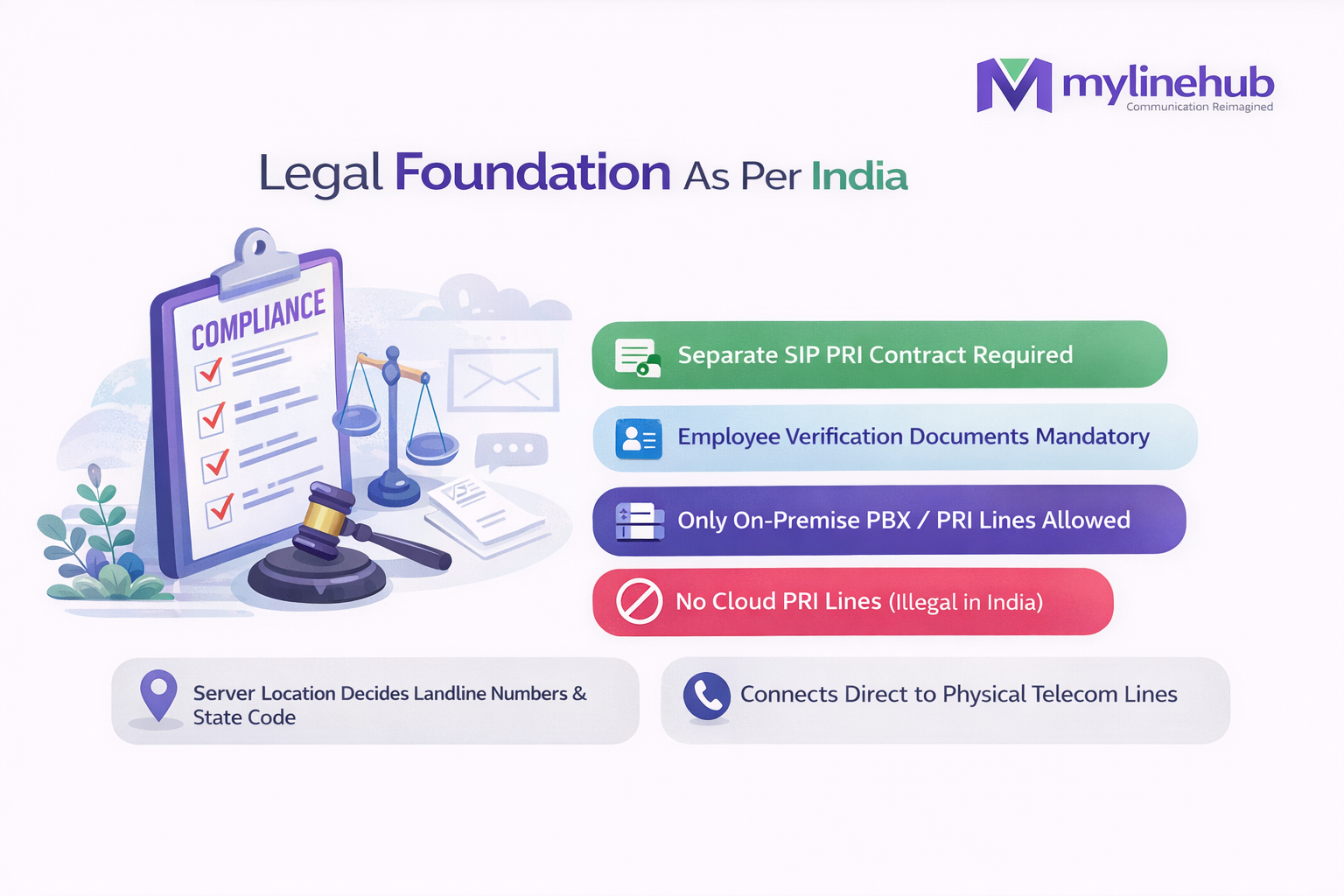
Telecom in India is not just a technical domain — it is a tightly regulated space. Many businesses struggle with call setups not because of technology, but because they unknowingly violate telecom regulations.
This article explains why telecom is legally complex in India, what is allowed, what is restricted, and why on-premise telecom remains the safest architecture for Indian businesses.
Why Telecom Is Difficult in India
Unlike many countries, India does not freely allow telecom servers to operate from public cloud infrastructure.
Landline numbers, PRI lines, and SIP trunks are all governed by strict location, licensing, and identity rules.
This is the core reason why telecom platforms in India cannot be treated like normal cloud software.
The Reality Behind “Cloud Telephony” in India
Many providers advertise cloud telephony, but in reality their telecom servers are physically hosted in Indian cities such as Ahmedabad, Bengaluru, or Mumbai.
You may notice numbers starting with:
- 079 (Ahmedabad)
- 080 (Bengaluru)
- 022 (Mumbai)
These numbers appear mobile-like and are easily picked up by users, but they are still tied to specific geographic exchanges.
Why Licensing Matters
To legally sell telecom services at scale, a company must hold appropriate licenses.
For example:
- VNO (Virtual Network Operator) license
- UL (Unified License) from DoT
- Interconnect agreements with carriers
Large operators such as Tata Communications or Airtel obtain national-level licenses and then distribute services under multiple regulatory categories.
When a Business Does NOT Need a Telecom License
This is where most confusion exists.
A business does not need a telecom license when:
- It is using telecom lines for its own internal operations
- It is not reselling numbers or minutes
- It is not distributing telecom services to third parties
Using on-premise PBX software with legally procured PRI or SIP lines does not make a business a telecom operator.
What “On-Premise Telecom” Actually Means
On-premise telecom means:
- The PBX server is hosted inside your office or data center
- PRI or SIP lines terminate physically at your location
- Call routing happens within your infrastructure
In this model, you are using telecom — not selling telecom.
Why Cloud PRI Lines Are Not Allowed
Indian regulations do not permit cloud-hosted PRI termination.
PRI lines must terminate on physical hardware at the registered customer location.
This is why:
- Cloud PBX with Indian PRI is illegal
- Location mismatch leads to regulatory risk
- Audits can result in disconnection
International Connectivity Is Even More Complex
Connecting Indian numbers with US or international numbers introduces additional challenges:
- Cross-border call routing restrictions
- Lawful interception compliance
- Call masking and CLI validation
This is why international call bridging requires careful architecture planning.
Software vs Telecom Lines: A Critical Distinction
Software itself is not regulated. Telecom lines are.
You can run call management software anywhere, but the moment it controls Indian telecom lines, physical location and compliance become mandatory.
Why On-Premise Architecture Is Still Preferred
For Indian businesses, on-premise telecom offers:
- Regulatory safety
- Full data ownership
- Stable numbering
- No dependency on external cloud policies
This is not about old technology — it is about legal clarity.
Key Takeaway
Telecom regulations in India are strict by design.
Businesses that understand the difference between software, telecom lines, and licensing avoid long-term risk and disruption.
On-premise telecom remains the safest and most compliant way to operate call infrastructure in India.
Want to see API-driven CRM + Telecom workflows in action? Try the WhatsApp bot or explore the demos.
Comments (0)
Be the first to comment.