VoiceBridge vs Proprietary AI Calling Platforms
Compare VoiceBridge with proprietary AI calling platforms across data ownership, duplex quality, integration depth, and long-term costs.
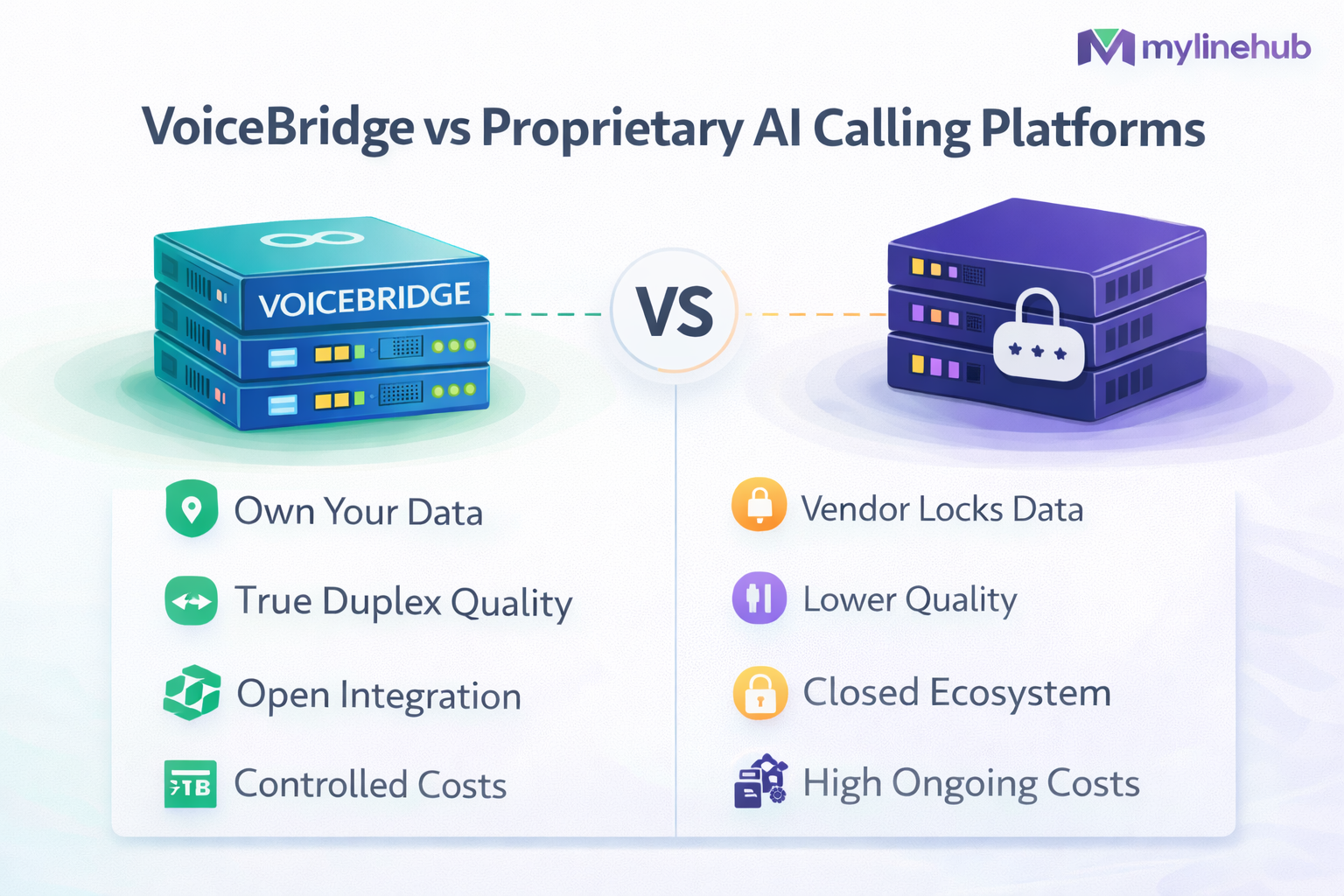
VoiceBridge vs Proprietary AI Calling Platforms
“AI calling platform” can mean very different things: some vendors are basically a cloud dialer with an LLM bolted on, others are a closed CPaaS + bot runtime, and a few are full-stack “voice agent” products that hide telephony and media details completely.
MYLINEHUB VoiceBridge takes a different path: it is an open-source, RTP-correct, production full-duplex bridge designed to sit next to your existing Asterisk/FreePBX and connect it to real-time AI (STT/TTS/LLM) without changing your PBX internals.
This is not a “features list” comparison. It’s an architecture and operations comparison: data ownership, media quality, barge-in correctness, debuggability, latency control, scale patterns, and long-term cost.
VoiceBridge repository:
https://github.com/mylinehub/omnichannel-crm/tree/main/mylinehub-voicebridge
Canonical architecture reference:
https://mylinehub.com/articles/mylinehub-voicebridge-architecture
What Proprietary AI Calling Platforms Usually Are
Most proprietary AI calling platforms bundle three layers into a single closed system:
- Telephony entry: SIP trunks, DID management, outbound dialing, caller ID, compliance templates
- Media layer: audio capture, audio injection, jitter buffering, recording, sometimes WebRTC
- AI layer: STT, LLM orchestration, tools/actions, TTS, conversation memory
The advantage: fast time-to-demo. The cost: you inherit an opaque system where the most important telecom problems (RTP timing, NAT, jitter, barge-in) are hard to verify and harder to fix when something breaks.
What VoiceBridge Is (In Concrete Engineering Terms)
VoiceBridge is a Java service that connects to Asterisk/FreePBX using ARI and builds a duplex media graph that:
- captures caller audio via RTP
- streams to AI in real-time
- injects AI speech back as RTP with correct headers, timestamps, pacing
- supports interruption (barge-in) by truncating bot output immediately
Where the key “production guarantees” live in the repository
-
ARI media graph (bridges + external media):
src/main/java/com/mylinehub/voicebridge/ari/impl/AriBridgeImpl.java,src/main/java/com/mylinehub/voicebridge/ari/impl/ExternalMediaManagerImpl.java -
RTP correctness (packetizing, NAT symmetry, port planning):
src/main/java/com/mylinehub/voicebridge/rtp/RtpPacketizer.java,src/main/java/com/mylinehub/voicebridge/rtp/RtpSymmetricEndpoint.java,src/main/java/com/mylinehub/voicebridge/rtp/RtpPortAllocator.java -
Session lifecycle (per-call state and cleanup):
src/main/java/com/mylinehub/voicebridge/session/CallSession.java,src/main/java/com/mylinehub/voicebridge/session/CallSessionManager.java -
Realtime AI + barge-in truncation:
src/main/java/com/mylinehub/voicebridge/ai/RealtimeAiClient.java,src/main/java/com/mylinehub/voicebridge/ai/impl/RealtimeAiClientImpl.java,src/main/java/com/mylinehub/voicebridge/ai/impl/OpenAiRealtimeTruncateManager.java -
Deployment/container baseline:
docker/Dockerfile,docker-compose.yml,.env.example,src/main/resources/application.properties
The Most Important Question: Who Owns the Media Plane?
In voice AI, the “media plane” is where production issues live: not in the prompt, not in the LLM — in the audio pipeline.
Proprietary platforms
- You do not control RTP pacing rules
- You cannot easily confirm whether audio is truly duplex on-wire
- You often cannot debug with Wireshark at the correct boundary
- You rely on vendor support for “why does it stutter at peak hours?”
VoiceBridge
- You control the RTP pipeline (packetization, timestamps, sequencing)
- You can inspect call health deterministically and reproduce issues
- You can enforce strict NAT-safe behavior (symmetric RTP learning)
- You can tune and scale your media workers without changing the PBX
In VoiceBridge, RTP is not a side effect — it is a first-class engineered subsystem, mainly inside:
rtp/RtpPacketizer.java and rtp/RtpSymmetricEndpoint.java.
Latency Reality: Average Latency Is Not the Problem, Tail Latency Is
A call feels “human” when the system avoids long spikes. Vendors often report average latency; real users experience tail latency: the occasional 500–1200ms stalls that break turn-taking and make barge-in fail.
Where proprietary platforms usually lose
- shared multitenant media clusters under unpredictable load
- hidden buffering policies (great in a demo, laggy under stress)
- fixed STT/TTS pipelines with limited ability to tune packet pacing
How VoiceBridge is designed to win
- RTP clock isolation: AI may be bursty, RTP must stay steady. That discipline is implemented where packets are emitted (packetizer + scheduling).
-
Immediate truncation: when caller interrupts, bot output is stopped fast, not “when buffer drains”.
Truncation logic is a real component:
ai/impl/OpenAiRealtimeTruncateManager.java. - Local adjacency: you can deploy VoiceBridge close to Asterisk to remove WAN jitter from PBX-to-bridge. Proprietary platforms typically force PBX-to-cloud over the internet (or force you to move trunks).
Full Duplex and Barge-In: The Feature That Separates “IVR AI” from “Conversational AI”
Most “AI calling” systems are still turn-based in practice. They may capture audio continuously, but they cannot stop speaking naturally when the customer interrupts.
What happens in many proprietary systems
- caller talks over bot
- bot keeps playing because audio is already buffered
- conversation becomes unnatural and frustrating
What VoiceBridge does differently
- caller audio is continuously streamed in
- bot audio is continuously streamed out
- interruption triggers a “cut-through” policy that stops bot output immediately
This is a session-level, media-level decision, not a prompt trick:
that is why VoiceBridge models calls explicitly via
session/CallSession.java and session/CallSessionManager.java,
and why truncation exists as a real component.
Integration Depth: PBX Control vs PBX Replacement
Many proprietary platforms succeed by replacing your PBX workflow: “bring your numbers here, use our dialer UI, use our recording.”
That can be fine for greenfield startups. It is painful for companies with: FreePBX dialplans, queues, time conditions, ring groups, call routing policies, compliance rules, and support operations.
VoiceBridge integration strategy
- Keep Asterisk/FreePBX as the system of record for telephony
- Use ARI to control and bridge media without rewriting PBX internals
- Inject AI where it belongs: as a media participant, not as the PBX owner
ARI integration is implemented in the ARI layer:
ari/impl/AriBridgeImpl.java and
ari/impl/ExternalMediaManagerImpl.java.
Debuggability: The Hidden Cost of “Managed” Platforms
Debugging voice issues is a different discipline than debugging web apps. You need to answer questions like:
- Did Asterisk send RTP to the correct IP:port?
- Did SSRC change mid-call?
- Are timestamps monotonic and paced correctly?
- Is NAT rewriting happening on the path?
- Is the bot sending bursts instead of 20ms frames?
Proprietary platform debugging (common reality)
- support ticket + “we’ll check logs”
- partial metrics without packet-level truth
- limited ability to reproduce the exact conditions
VoiceBridge debugging (what you can do)
- Packet-level verification with Wireshark on your own infrastructure
- Correlate sessions with your own logs and call IDs
- Inspect the RTP engine behavior and tune it if needed
Practical RTP handling and correctness is concentrated in:
rtp/RtpPacketizer.java,
rtp/RtpSymmetricEndpoint.java,
and call lifecycle code ensures cleanup and traceability.
Security and Compliance: “Where Does My Audio Go?”
The highest-risk asset in AI calling is not the prompt — it’s: call audio, transcripts, and the customer’s PII.
Proprietary platforms (typical tradeoffs)
- audio leaves your network by default
- recordings and transcripts often live in vendor storage
- compliance and retention are vendor-specific, sometimes inflexible
- your incident response depends on vendor policies and timelines
VoiceBridge (what changes)
- you control where VoiceBridge runs (cloud, on-prem, hybrid)
- you control firewall boundaries between Asterisk, VoiceBridge, and AI endpoints
- you choose how/where to store recordings and transcripts
VoiceBridge’s deployment patterns and environment controls are meant to be explicit and auditable:
src/main/resources/application.properties,
.env.example,
docker-compose.yml.
Scaling and Cost: Vendor “Per Minute” vs Infrastructure Economics
Proprietary platforms frequently price by: per minute + per call + STT/TTS + “agent” fees + storage + compliance add-ons. That can be reasonable at low volume, and painful at scale.
VoiceBridge scaling model
VoiceBridge scales like a normal service: more calls → more media workers. The PBX remains your PBX; VoiceBridge is the duplex media bridge layer.
- Run multiple VoiceBridge instances behind a load balancer
- Pin RTP sessions (do not “spray” UDP packets across nodes)
- Use deterministic port ranges and firewall rules per node
- Use containerization for repeatable deployments
Deterministic media port planning is why a dedicated allocator exists:
rtp/RtpPortAllocator.java.
Important honesty
Open-source does not magically remove costs. It changes the cost profile from “vendor margin + lock-in” to “your infra + your ops”. For many serious telecom teams, that is a win because it is controllable and optimizable.
Lock-In: The Strategic Risk Most Teams Underestimate
Vendor lock-in in AI calling is not only API lock-in. It is:
- media lock-in: you cannot migrate your conversation logic without rebuilding the audio layer
- data lock-in: transcripts, recordings, evaluation metrics live in vendor formats
- workflow lock-in: routing, compliance, reporting become vendor-specific
VoiceBridge reduces lock-in because:
- it keeps the PBX as your telephony core
- it keeps the media integration open and inspectable
- it lets you swap AI providers (or run on-prem AI) without changing telephony
Side-by-Side Summary
| Dimension | Proprietary AI Calling Platform | MYLINEHUB VoiceBridge |
|---|---|---|
| Deployment | Vendor cloud (sometimes hybrid) | Your servers (on-prem/cloud/hybrid), container-friendly |
| PBX Integration | Often PBX replacement or trunk migration | Works with Asterisk/FreePBX via ARI without rewriting PBX logic |
| Duplex + Barge-in | Often limited by buffering / platform policy | Engineered duplex with explicit truncation control |
| RTP Debuggability | Opaque | Inspectable; RTP correctness is in code you control |
| Data Ownership | Often vendor storage by default | You decide where audio/transcripts live |
| Cost Model | Per-minute + add-ons | Infra economics + chosen AI provider costs |
| Lock-in | High (media + data + workflow) | Lower (open bridge layer, PBX retained) |
How to Decide (A Practical Rule)
Choose a proprietary platform if:
- you need a demo immediately and you can accept vendor dependency
- your telephony workflows are simple or you’re willing to migrate them
- you don’t need deep control over duplex, timing, and packet-level debugging
Choose VoiceBridge if:
- you need real conversational duplex with reliable barge-in
- you run serious call volume and need predictable scaling economics
- you must keep data and recordings under your policy control
- you already rely on FreePBX/Asterisk logic and do not want PBX replacement
Reference: “Where to Look in the VoiceBridge Codebase”
If you want to validate that VoiceBridge is a real engineered media bridge (not a demo script), these are the most relevant areas:
-
ARI bridge/media graph:
src/main/java/com/mylinehub/voicebridge/ari/impl/AriBridgeImpl.java,src/main/java/com/mylinehub/voicebridge/ari/impl/ExternalMediaManagerImpl.java -
RTP engine:
src/main/java/com/mylinehub/voicebridge/rtp/RtpPacketizer.java,src/main/java/com/mylinehub/voicebridge/rtp/RtpSymmetricEndpoint.java,src/main/java/com/mylinehub/voicebridge/rtp/RtpPortAllocator.java -
Per-call lifecycle:
src/main/java/com/mylinehub/voicebridge/session/CallSession.java,src/main/java/com/mylinehub/voicebridge/session/CallSessionManager.java -
Streaming AI + truncation:
src/main/java/com/mylinehub/voicebridge/ai/impl/RealtimeAiClientImpl.java,src/main/java/com/mylinehub/voicebridge/ai/impl/OpenAiRealtimeTruncateManager.java -
Deployment baseline:
docker/Dockerfile,docker-compose.yml,src/main/resources/application.properties
Repo: https://github.com/mylinehub/omnichannel-crm/tree/main/mylinehub-voicebridge
Want to see API-driven CRM + Telecom workflows in action? Try the WhatsApp bot or explore the demos.
Comments (0)
Be the first to comment.