Why MYLO Limits a Campaign to 5,000 Leads
MYLO limits one campaign to 5,000 leads so each outbound operation remains reviewable, measurable, recoverable, and bounded. The limit is an explicit product rule, not a hidden spreadsheet failure and not a claim that an organisation may contact 5,000 people lawfully.
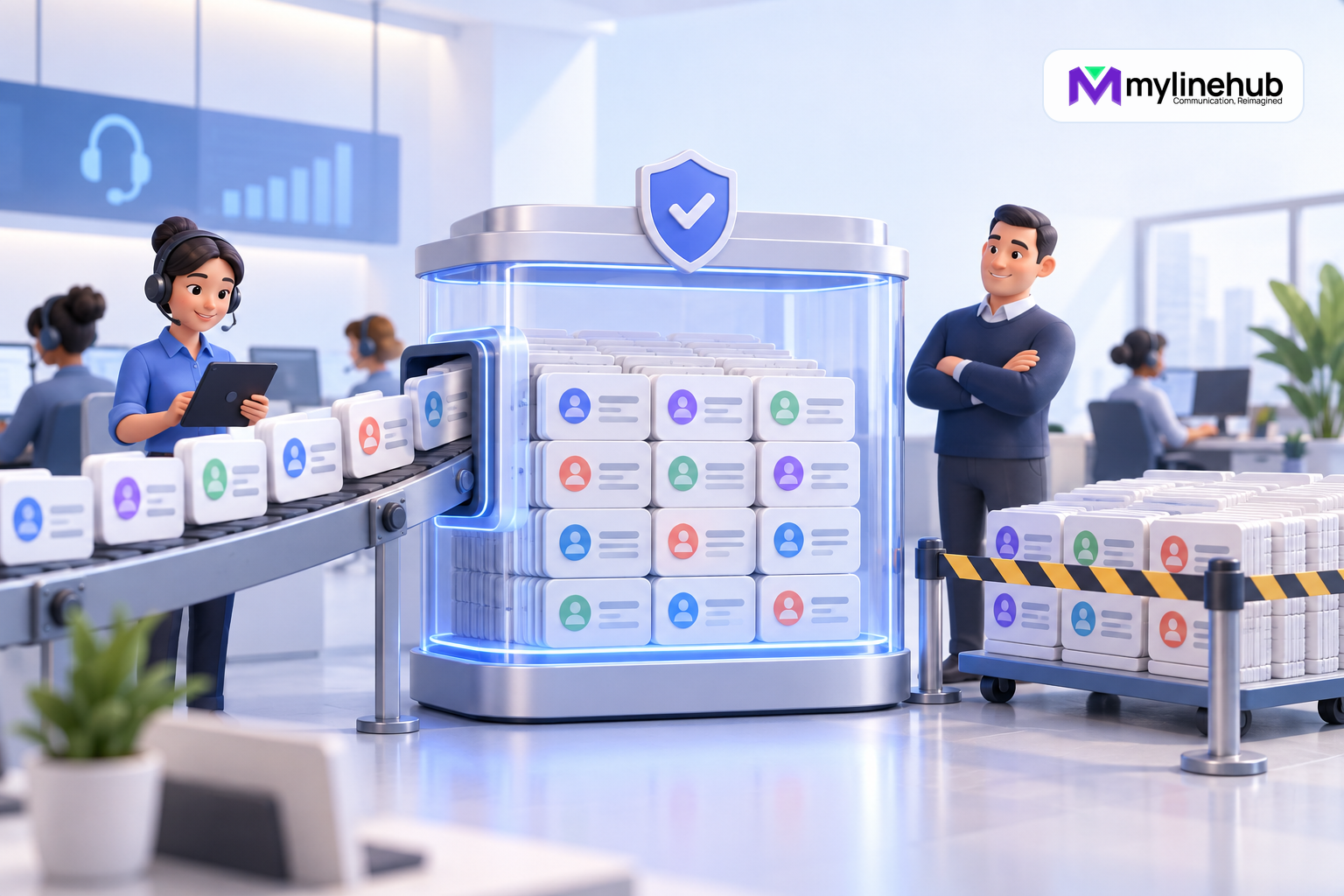
MYLO limits one campaign to 5,000 leads so each outbound operation remains reviewable, measurable, recoverable, and bounded. The limit is an explicit product rule, not a hidden spreadsheet failure and not a claim that an organisation may contact 5,000 people lawfully. A business with a larger authorised audience can divide it into separate campaigns with clear names, schedules, owners, and acceptance checks. Smaller campaign units make it easier to inspect preparation results, pause work, understand progress, correct an input problem, and protect personal data. The customer remains responsible for consent, lawful purpose, suppression, permitted timing, provider terms, and list accuracy. MYLO manages supported campaign execution within these boundaries; it does not turn list size into permission to call.
A Product Boundary That Users Can Plan Around
A clear numerical limit is better than a system that accepts any file and fails later under load. The user can see during preparation that a list exceeds the campaign boundary and can decide how to segment it. The system should report the rule before approval rather than silently truncating rows or creating an incomplete campaign.
The 5,000-lead boundary applies to the number of leads in one MYLO campaign. It does not describe calls per second, simultaneous channels, daily legal limits, data-retention periods, or the maximum size of a customer database. Those are different operational, provider, product, and compliance questions.
Operational Control
An outbound campaign creates many state transitions: eligible, claimed, attempted, connected, failed, retry eligible, completed, paused, or otherwise final. Keeping the campaign bounded makes these transitions easier to reconcile after interruptions and easier for an operator to understand. A campaign can expose meaningful progress without requiring the user to navigate an unlimited task.
Bounded campaigns also support safer issue response. If a prompt, caller ID, destination, or schedule is wrong, an operator can pause the affected campaign, preserve evidence, and correct the next operation without confusing it with unrelated audiences. The limit does not eliminate the need for deterministic claiming, idempotency, pacing, capacity control, and restart recovery.
Reviewability Before Calling
Every campaign should be understandable before it starts. The operator needs to review the source, eligible and invalid counts, duplicate treatment, connection flow, caller IDs, agent or IVR resources, schedule, pacing, retries, recording choice, and test result. Review becomes less credible when one operation spans a huge, mixed audience assembled from several purposes.
Segmenting can make review more meaningful. For example, separate campaigns may represent different regions, languages, customer stages, appointment dates, or business owners. Segmentation should follow a legitimate operating reason, not be used to evade suppression, provider, or legal restrictions.
Privacy and Data Minimisation
A smaller campaign scope reduces the number of people whose data is exposed to one operational task and its authorised users. It supports purpose limitation: the team can include only fields needed for that campaign instead of loading a master customer export. Separate retention decisions can follow separate purposes.
The limit is not a privacy guarantee. The customer must still control file access, collect only necessary data, honour consent and objections, protect exports, and delete or retain records under an approved policy. Five thousand unauthorised contacts are not safer because they fit within a product limit.
Progress and Reporting
A bounded campaign can present counts that operators can reconcile: total prepared, eligible, pending, active, completed, failed, and retry eligible. These categories must have precise definitions. A connected call is not automatically a successful business result, while an unanswered call is not necessarily eligible for unlimited retry.
Separate campaigns also make comparisons more useful. A business can compare two appointment dates or regions without mixing their schedules and operating conditions. Reporting should retain event history and current status without rewriting the past when a later retry changes the final outcome.
How to Divide a Larger Authorised List
First remove ineligible, invalid, duplicate, and suppressed destinations. Then choose a business-relevant segmentation key. Good examples include service date, region, language, branch, customer owner, or an approved test-versus-production cohort. Give each campaign a descriptive name and retain the relationship to the original authorised source.
Avoid arbitrary slicing that causes the same person to appear in several campaigns. Deduplicate across the full intended outreach, not only within each 5,000-row piece. Apply suppression changes to every not-yet-called segment. If consent expires or the purpose changes, do not assume that creating another campaign renews permission.
Practical Example: 12,400 Service Notices
A utility contractor has an authorised list of 12,400 customers who need a planned-service notice. After cleaning and suppression, 11,850 records remain. Rather than attempting one oversized campaign, the business creates three campaigns based on service region and work date. Each has fewer than 5,000 leads, its own schedule, named owner, region-specific message, and functional test.
The team checks duplicates across all three sets before approval. When a work date changes in one region, it pauses only that campaign and corrects its message and schedule. The other regions remain unaffected. This is the value of bounded operational units: control and evidence, not merely smaller files.
Capacity Is a Separate Calculation
A 5,000-lead campaign does not mean MYLO calls 5,000 people at once. Live capacity depends on the selected campaign flow, available human agents or IVR resources, provider channels, caller-ID eligibility, appliance limits, pacing, active calls, and reserved headroom for other services. Human campaigns generally need an available person for each active conversation.
Deterministic services should admit work only when the required resources are available. They should not reserve imaginary capacity simply because leads remain in the campaign. Inbound calling and other approved workloads must follow the deployment’s capacity policy.
What Happens at the Limit
During preparation, a file that would create more than 5,000 leads should produce a clear explanation and offer a controlled route to segment the data. It should not accept the first 5,000 and discard the rest without approval. The original file and resulting campaign sets should remain traceable under the customer’s data policy.
Creating another campaign is a new operational decision. It needs its own preview, configuration, approval, and functional test. A previous campaign’s successful test can inform the work but should not automatically prove that a new audience, prompt, schedule, or caller-ID set works.
Campaign-Sizing Checklist
- Confirm the full list has an authorised purpose and accountable owner.
- Clean, suppress, and deduplicate before dividing the audience.
- Keep every MYLO campaign at or below 5,000 leads.
- Choose business-relevant segments with no unintended overlap.
- Name each campaign so its audience and schedule are clear.
- Review data fields and access separately for each purpose.
- Configure flow, capacity, pacing, retries, caller IDs, and recording.
- Run a functional test for every distinct campaign configuration.
- Apply new suppressions to all pending segments.
- Review progress and final outcomes without confusing them with permission.
The practical rule is simple: use campaigns as controlled units of work. If an authorised audience exceeds 5,000 leads, divide it transparently and preserve the operational and privacy discipline for every part.
Operate a Series of Campaigns as One Programme
When a legitimate outreach programme needs several campaigns, maintain a programme-level register outside the live dialling state. Record the authorised source, segmentation rule, campaign identifiers, owners, planned order, shared suppression process, and completion status. This provides oversight without merging the campaigns into one unbounded runtime object.
Decide whether segments may run in parallel. Parallel execution can compete for agents, caller IDs, provider channels, storage, and inbound headroom. The deterministic capacity system should consider all active campaigns, while the business decides priority. Completing one campaign does not automatically authorise the next if timing, purpose, audience, or consent conditions have changed.
Reconciliation between segments
Before starting the next segment, apply newly received objections, wrong-number reports, and suppression updates across every pending campaign. Check whether a destination was already completed in an earlier segment due to source overlap. Reconcile counts back to the authorised source so skipped, rejected, and completed records remain explainable.
Closing the programme
At the end, preserve campaign-level outcomes and an aggregate summary with clear definitions. Retain personal data only for the approved period and purpose. Archive or delete exports consistently, including local working copies. A programme is complete when operational state, customer follow-up, suppression updates, and data handling are all closed—not simply when the final lead has an attempt record.
Acceptance Checks for Every Segment
Before each campaign begins, confirm that it contains no more than 5,000 leads, its counts reconcile to the programme register, and no destination already completed in another segment without an approved reason. Verify the exact prompt or script, schedule, flow, caller IDs, recording decision, capacity, pacing, retry rule, and current suppressions.
Run a functional test using controlled destinations and record the observed customer and agent or IVR experience. Reusing a template can save preparation effort, but each campaign still needs evidence that its current audience and configuration form a coherent, authorised operation.
Continue planning
Continue with Five Ways MYLO Connects Agents and Customers; How MYLO Prepares a Lead File for Calling; How Indian Phone Numbers Should Be Cleaned Before a Campaign. For deeper implementation context, use MyLineHub technical architecture guidance.
For a requirement outside the prepared MYLO scope, discuss the exact outcome with MyLineHub.
Want to see API-driven CRM + Telecom workflows in action? Try the WhatsApp bot or explore the demos.
Comments (0)
Be the first to comment.