Five MYLO Campaign Connection Flows for Agents, Customers and IVR
MYLO supports five authoritative outbound connection flows: customer phone to agent mobile, customer phone to agent extension, agent extension to customer phone, agent mobile to customer phone, and customer phone to an IVR.
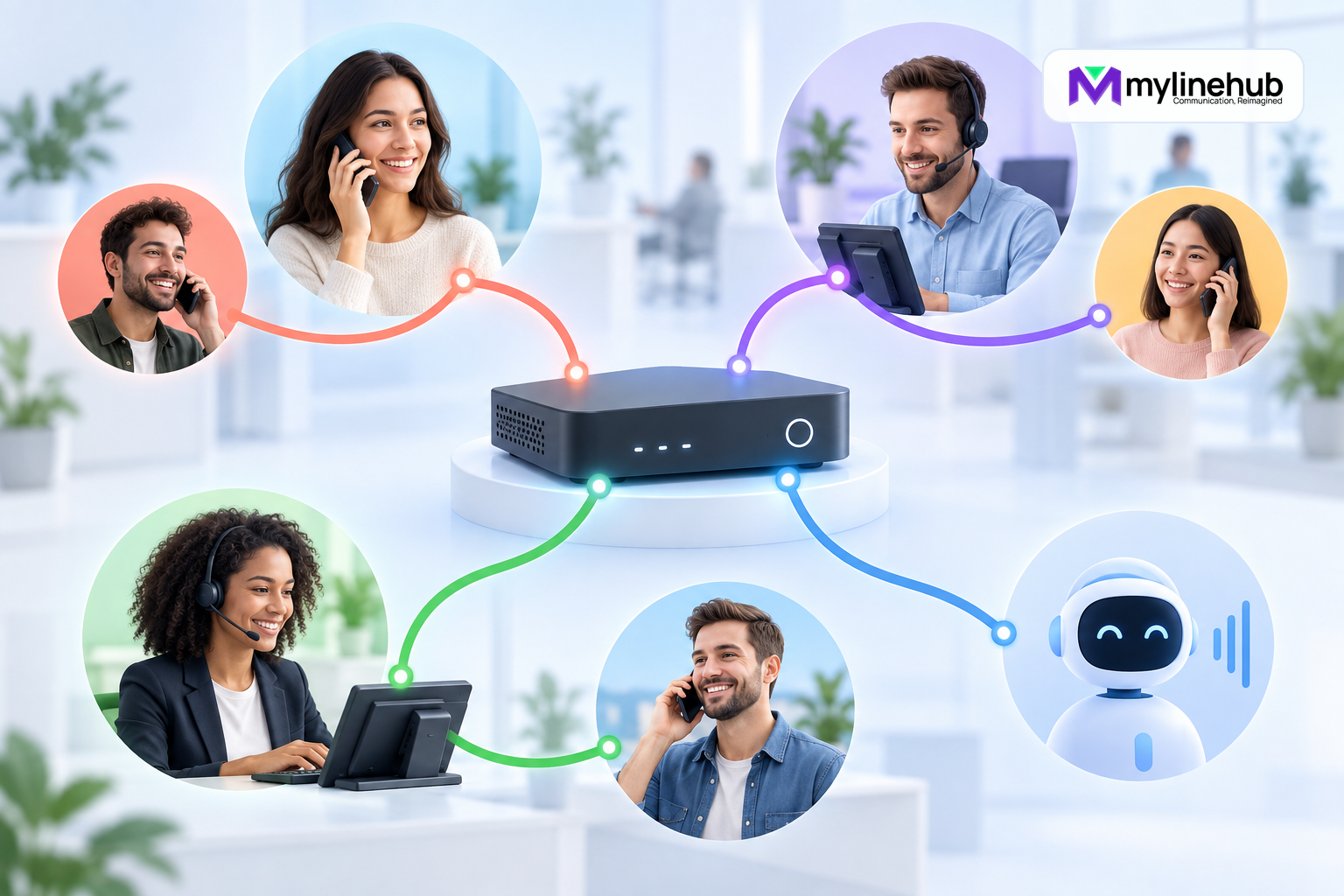
MYLO supports five authoritative outbound connection flows: customer phone to agent mobile, customer phone to agent extension, agent extension to customer phone, agent mobile to customer phone, and customer phone to an IVR. The flow determines which destination is called first, what is called second, and whether a human agent participates. It does not describe a dialer algorithm or promise capacity. After a person approves a prepared campaign, deterministic services control scheduling, eligibility, capacity, retry, caller-ID selection, and the two call legs; an AI model does not decide each live call. The telecom provider must authorise the trunk, numbers, channels, and presented identity. A business should choose a flow according to customer waiting risk, agent location, purpose, and available resources, then verify it with real calls.
The Five MYLO Connection Flows
Customer phone to agent mobile
MYLO calls the customer first. After the customer answers, it calls an approved mobile agent and connects the legs. This can serve remote teams, but the customer may wait while the agent leg is established. The agent's private number should not be exposed as the business identity.
Customer phone to agent extension
The customer is called first, followed by an internal extension. It suits office agents registered to the business phone system. Endpoint availability and the time needed to establish the second leg affect customer experience.
Agent extension to customer phone
MYLO calls the office extension first. When the agent is ready, the customer leg begins. This reduces the risk that an answered customer waits for an unavailable agent, while using agent time for customer attempts that may not answer.
Agent mobile to customer phone
The remote agent's approved mobile is called first, then the customer. The connected conversation uses the configured business telephony path and authorised caller identity rather than requiring manual personal-number dialling.
Customer phone to IVR
The customer is called and, on answer, enters an approved automated prompt and keypad flow. No human operator is required. It suits narrow reminders, confirmations, and surveys when notice, timing, consent, and response handling are appropriate.
Who Is Called First?
Customer-first flows begin customer contact before confirming that the second human destination is ready. They may use agent time efficiently, but require a carefully bounded wait, suitable audio, second-leg failure handling, and enough available capacity. Agent-first flows establish the person before dialling the customer. They protect customer experience from waiting for an agent but can leave an agent waiting through ringing, no answer, or failure.
The IVR flow is customer-first but has no agent leg. Capacity and outcome rules therefore differ from human flows. The comparison in Customer-First vs Agent-First Calling should be part of campaign approval.
How Runtime Execution Works
- The business supplies an approved lead set and chooses one supported flow.
- MYLO validates required destinations, caller-ID eligibility, schedule, recording choice, and available configuration.
- An authorised user reviews and approves the consequential operation.
- Deterministic scheduling selects eligible work within configured pacing and capacity.
- Asterisk originates and bridges the actual call legs or runs the IVR.
- Live telephony evidence records progress and final outcomes for recovery and reporting.
AI can help interpret requirements and prepare a proposal. It does not remain in the control loop making unpredictable decisions for every dial attempt.
A Practical Selection Example
A distributor has three office agents, two remote representatives, and an appointment-confirmation list. Office representatives use agent-extension-to-customer because the business wants the employee ready before contact. Remote representatives use agent-mobile-to-customer with approved mobile destinations. Appointment confirmations use customer-to-IVR because each caller hears the same narrow prompt and presses a key.
The company does not label these as five dialer strategies. It separately chooses conservative pacing, retry windows, eligible caller IDs, and capacity based on staff and provider channels. It tests successful answer, no answer, busy, agent failure, IVR input, and hang-up paths.
Limits and Responsibilities
- The provider controls trunk service, channels, number authorisation, and external network behaviour.
- The customer owns lawful contact, lead quality, consent, schedules, agent destinations, recording choice, and outcomes.
- One configured agent does not guarantee availability; one DID does not guarantee one channel.
- MYLO's five flows do not imply arbitrary predictive dialling or unlimited concurrency.
- Custom CRM, provider, multi-site, or large-capacity designs require separate scope.
Flow Selection Checklist
- Is a human required?
- Should the customer or agent be called first?
- Does the agent use a mobile or registered extension?
- What happens if the second leg fails?
- How long may an answered customer wait?
- Are caller ID, schedule, recording, and retries approved?
- Do provider channels and agent capacity support the plan?
- Have all outcomes been tested with real calls?
Continue with Customer-First vs Agent-First Calling, or ask MyLineHub to scope requirements outside the prepared MYLO boundary.
Continue planning
Continue with Customer-First vs Agent-First Calling. For deeper implementation context, use MyLineHub technical architecture guidance.
For a requirement outside the prepared MYLO scope, discuss the exact outcome with MyLineHub.
Want to see API-driven CRM + Telecom workflows in action? Try the WhatsApp bot or explore the demos.
Comments (0)
Be the first to comment.