Customer Phone to Agent Extension: How the Flow Works
In the customer-phone-to-agent-extension flow, MYLO calls the customer first, then calls an approved internal agent extension and bridges the two answered legs.
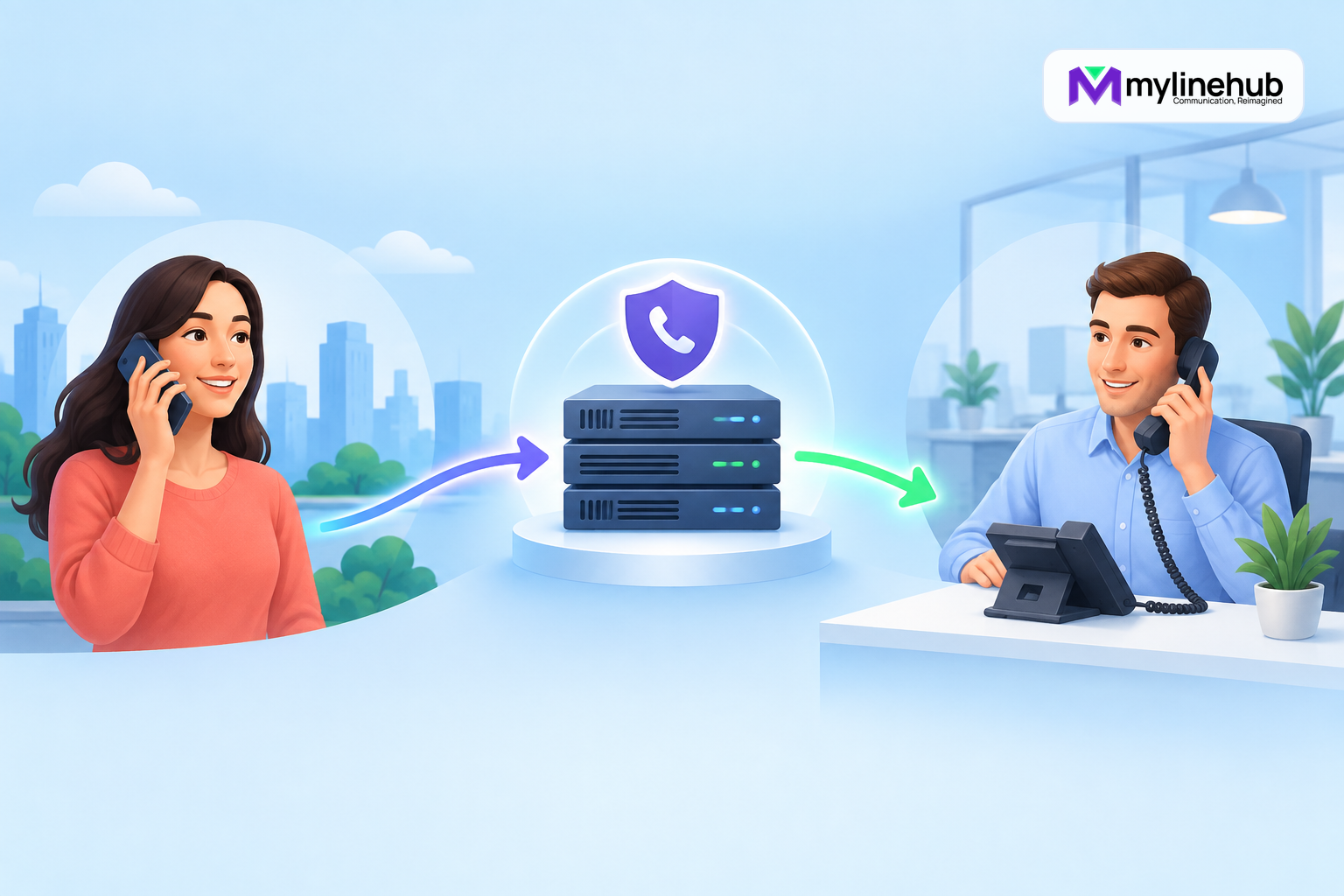
In the customer-phone-to-agent-extension flow, MYLO calls the customer first, then calls an approved internal agent extension and bridges the two answered legs. It is intended for office-based agents registered to the business telephony system. Customer-first ordering can avoid occupying an agent for unanswered customer attempts, but an answered customer may wait while the extension rings or fail to connect if the endpoint is unavailable. MYLO therefore needs explicit capacity, eligibility, connection timeout, and failure handling. The provider supplies the external trunk, channels, and authorised caller identity; Asterisk executes the customer call, extension call, and bridge. The business owns the campaign purpose, lead approval, schedules, agent staffing, recording, and customer experience. A registered extension helps establish availability but does not guarantee that a person will answer.
Start the Customer Leg
Deterministic scheduling chooses an eligible lead within the approved rules. The external customer call uses a permitted DID and records live states. No answer, busy, rejected, invalid destination, provider failure, and answer should not collapse into one generic result.
When the call is answered, use a short, accurate connection experience. Do not expose account details before the intended participant is verified. Decide what happens if the customer hangs up during the extension attempt.
Call the Internal Extension
The extension must belong to an eligible agent and be configured in the live PBX. MYLO should not infer readiness solely from a database row. Asterisk registration and call evidence matter, alongside campaign assignment rules that prevent one human receiving overlapping conversations.
Ring timeout, busy, unavailable, rejection, and forwarding require explicit treatment. Forwarding an extension to a mobile may change privacy, cost, voicemail, and answer behaviour and should be tested as a separate operating choice.
Bridge and Complete
Once both legs are in the required state, Asterisk connects media. The final record should preserve which customer, agent, extension, caller ID, attempts, timestamps, and outcomes were involved. If recording is approved, recording evidence and failures belong with the call outcome.
A completed bridge is not necessarily a successful business result. Agents still record disposition through the approved workflow, and supervisors should distinguish technical connection from resolution or sale.
A Practical Office Example
A three-agent renewals desk uses registered extensions 201–203. During staffed hours, MYLO selects one eligible agent lane and calls the next approved customer. After answer, it rings the assigned extension for a bounded period. If the agent responds, the call bridges. If the extension is unavailable, the customer receives a concise message and the attempt becomes an agent-leg failure, not a customer no-answer.
The supervisor investigates repeated extension failures, removes unavailable agents from eligibility, and prevents automatic retries from creating repeated customer inconvenience. Real tests cover busy endpoints, logout, restart, provider failure, and customer hang-up.
Boundaries
- Extension registration does not prove a person is ready.
- Customer-first ordering creates a bounded customer wait.
- External capacity depends on provider channels and local resources.
- The business controls agent schedules, lead authority, consent, recording, and outcomes.
- Custom presence, CRM assignment, and contact-centre logic may require separate work.
Checklist
- Are the extensions live and mapped to named eligible agents?
- Is each human limited to one active flow?
- What timeout and failure message apply?
- How are customer and agent failures distinguished?
- Are authorised DIDs and provider channels confirmed?
- What happens after restart or agent logout?
- Are recordings and dispositions controlled?
- Has the full external-to-extension path been tested?
Compare Customer Phone to Agent Mobile and the agent-first alternative in Agent Extension to Customer Phone.
Prove Extension Readiness Before Customer Contact
A registered extension is not automatically an available person. Campaign eligibility should also reflect the assigned user, working state and one-active-flow boundary. If an extension is logged out, already engaged or no longer owned by the expected employee, the campaign must treat that as an internal readiness problem.
Acceptance testing should cover a successful bridge, busy extension, unregistered endpoint, agent rejection and customer hang-up while the second leg rings. Confirm the displayed caller information, two-way audio and cleanup of both channels. Repeated extension failures should pause or remove that agent lane without consuming a customer retry.
Continue planning
Continue with Five Ways MYLO Connects Agents and Customers; Customer Phone to Agent Mobile: How the Flow Works; Agent Extension to Customer Phone: How the Flow Works. For deeper implementation context, use MyLineHub technical architecture guidance.
For a requirement outside the prepared MYLO scope, discuss the exact outcome with MyLineHub.
Want to see API-driven CRM + Telecom workflows in action? Try the WhatsApp bot or explore the demos.
Comments (0)
Be the first to comment.