MYLO Connection Flow vs Dialer Strategy: What Is the Difference?
A connection flow defines the order and destinations of call legs: who MYLO calls first, what it calls second, and whether the destination is a mobile, extension, customer, or IVR.
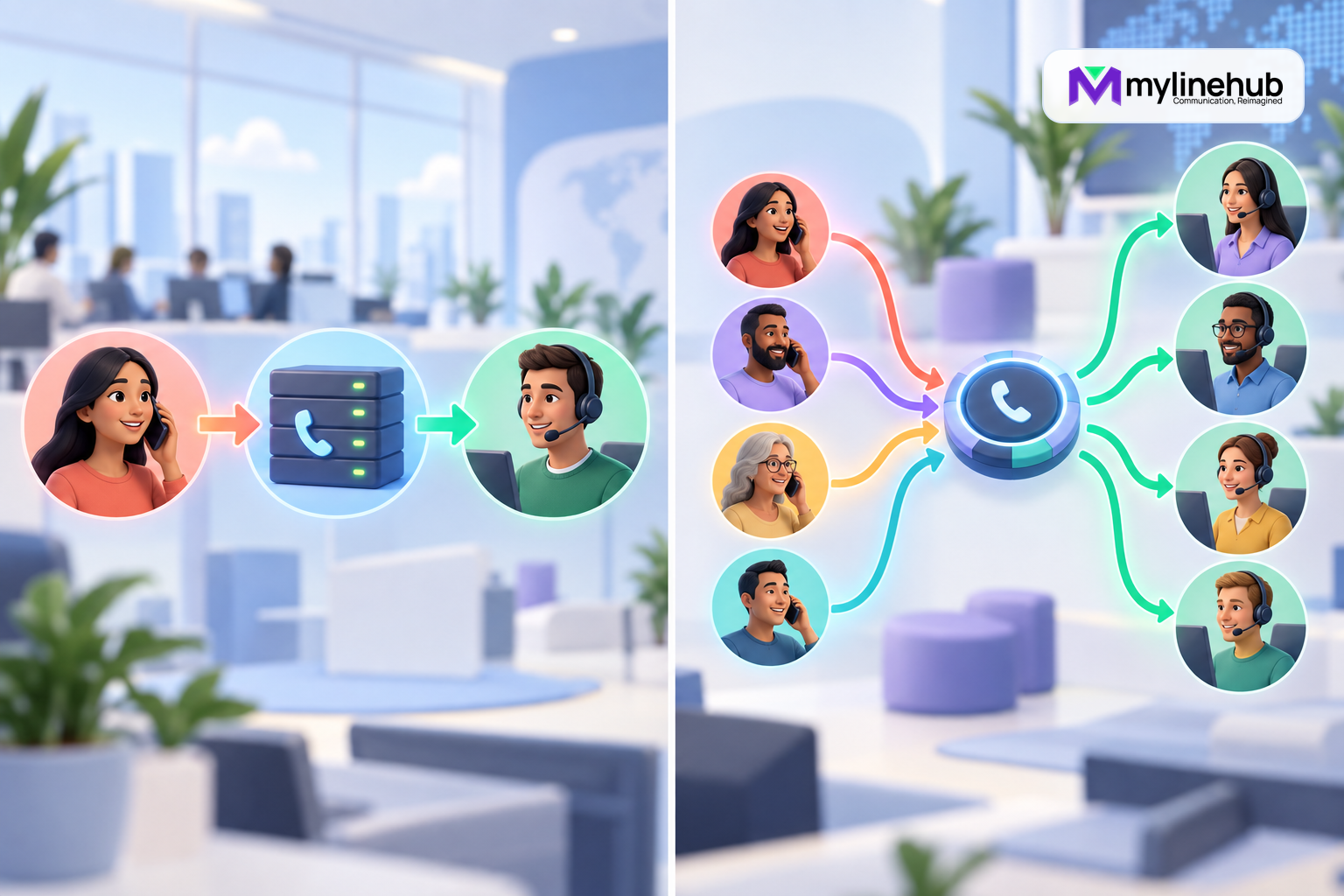
A connection flow defines the order and destinations of call legs: who MYLO calls first, what it calls second, and whether the destination is a mobile, extension, customer, or IVR. A dialer strategy describes how work is paced and selected across available resources. These are separate dimensions. “Customer phone to agent mobile” is a MYLO connection flow; “progressive” or “predictive” describes a broader dialling approach and should not be used as a casual substitute. MYLO's authoritative five flows do not amount to five conventional dialer algorithms. After approval, deterministic software handles eligible leads, capacity, pacing, caller IDs, attempts, and retry. An AI assistant may help prepare and explain the campaign but does not decide live runtime actions. Clear terminology prevents buyers from assuming capabilities or risks that the selected flow does not provide.
What Connection Order Defines
Connection order answers three practical questions: who receives the first call, which second destination follows, and when the legs bridge. MYLO supports customer-to-agent-mobile, customer-to-agent-extension, agent-extension-to-customer, agent-mobile-to-customer, and customer-to-IVR.
The first four are two-leg human flows. The fifth is a one-customer-leg automated IVR journey. These names describe topology and order, not the rate at which a list is dialled.
What Dialer Strategy Defines
A dialer strategy concerns when another attempt may start, how resources are reserved, whether an agent must already be ready, and how expected outcomes affect pacing. Industry terms vary by vendor and implementation. A business should ask for observable behaviour rather than relying on a label.
MYLO should not be described as predictive merely because it can run more than one independent call lane. Human-flow capacity remains bounded by available agents and telephony resources, with one active flow per available human. IVR capacity is different because it has no agent leg, but remains bounded.
Keep Retry Separate Too
Retry policy decides whether and when a record can be attempted again after busy, no-answer, temporary provider failure, invalid number, rejection, or another result. It is not determined solely by leg order. Each leg can fail independently, and classification must say whether the customer was contacted.
Deterministic rules should cap attempts, enforce time windows, stop terminal records, and survive restart without duplicate uncontrolled calls.
A Two-Dimension Example
A team selects agent-extension-to-customer as its connection flow. It could still use conservative progressive pacing: each available agent lane starts one attempt after the prior flow ends. Another configuration with the same connection flow might use different bounded pacing. The topology remains agent extension first, customer second.
An appointment programme selects customer-to-IVR. It has no agent capacity constraint, but the business still caps concurrent calls by provider channels and local resources, applies contact windows, and handles DTMF results. Calling it “predictive” would add confusion without describing the actual journey.
Why the Distinction Matters
- Customers can understand who waits and when.
- Operations can size agents separately from provider channels.
- Developers can test leg outcomes separately from scheduler behaviour.
- Compliance reviewers can see timing, identity, and retry rules.
- Buyers avoid assuming conventional dialer capabilities from a flow name.
Product Boundaries
MYLO provides the five named connection flows within its supported appliance design. It does not imply every algorithm or feature available in the broader MyLineHub open-source platform or custom contact-centre deployments. The provider remains authority for trunk capacity and number presentation; Asterisk is authority for live telephony evidence; the MYLO application owns approved campaign state.
Decision Checklist
- Which endpoint is called first and why?
- Is a second human leg required?
- Who may wait and for how long?
- How many human and IVR lanes are permitted?
- What starts the next attempt?
- How are each leg's failures classified?
- What retry and schedule bounds apply?
- Can restart recovery reconcile state safely?
- Has the complete flow been tested rather than inferred from terminology?
Begin with Five Ways MYLO Connects Agents and Customers and compare leg order in Customer-First vs Agent-First Calling. Scope any advanced dialer requirement explicitly with MyLineHub.
Continue planning
Continue with Five Ways MYLO Connects Agents and Customers; Customer to IVR: How an Automated Outbound Flow Works; How MYLO Prepares a Lead File for Calling. For deeper implementation context, use MyLineHub technical architecture guidance.
For a requirement outside the prepared MYLO scope, discuss the exact outcome with MyLineHub.
Want to see API-driven CRM + Telecom workflows in action? Try the WhatsApp bot or explore the demos.
Comments (0)
Be the first to comment.