Customer-First vs Agent-First Calling
Customer-first calling dials the customer before establishing the human agent leg; agent-first calling prepares the agent before dialling the customer.
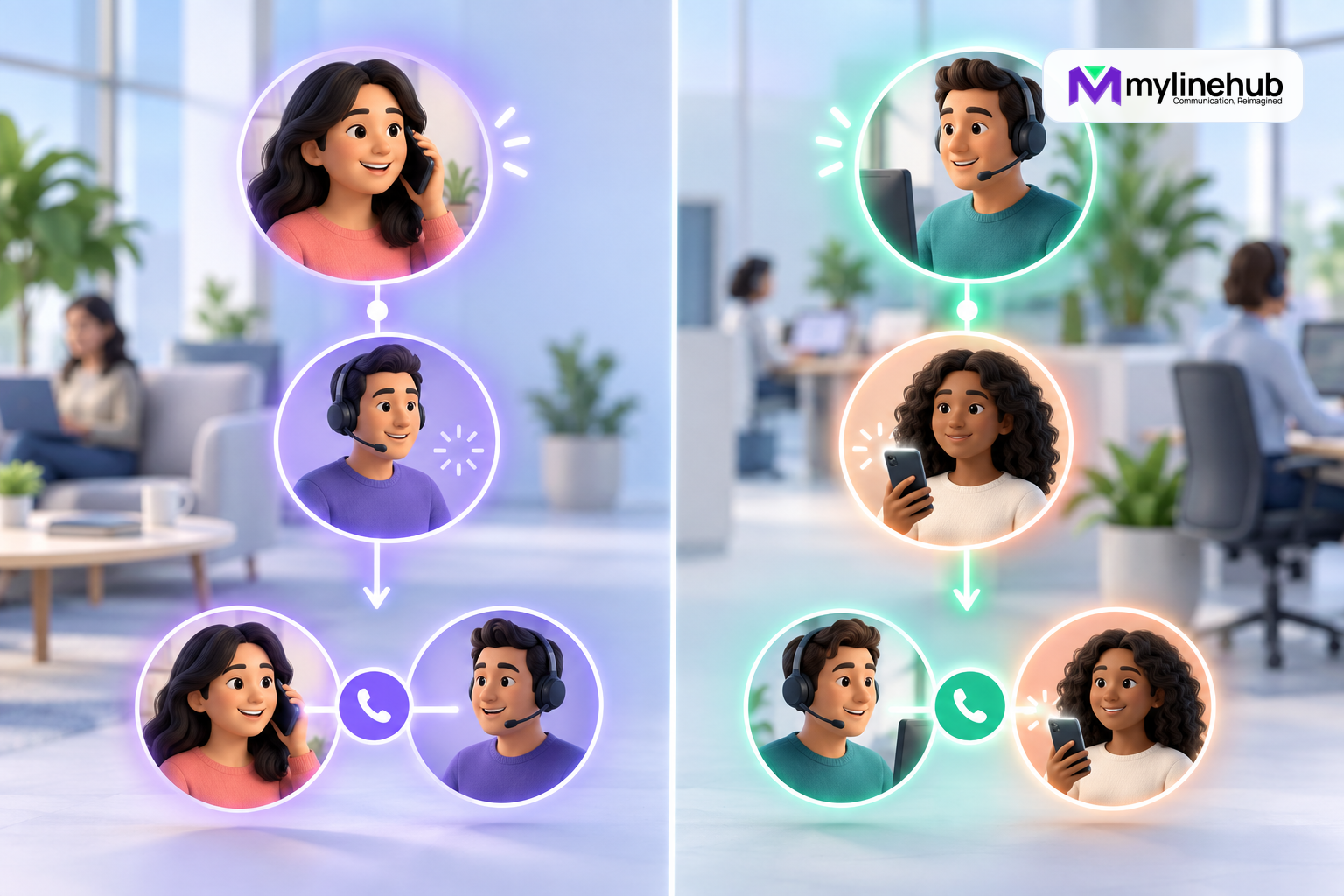
Customer-first calling dials the customer before establishing the human agent leg; agent-first calling prepares the agent before dialling the customer. The choice changes who waits, which resource is occupied, and how failures feel. Customer-first can avoid holding agents through unanswered calls, but an answered customer may wait or be disconnected if the agent leg fails. Agent-first makes a person ready before customer contact, but consumes agent time during ringing and unsuccessful attempts. Neither is universally better, and neither is a substitute for pacing, capacity, retry, or provider rules. MYLO treats leg order as an explicit campaign type and executes approved calls deterministically. The business must select the experience, staff it, define failure handling, and validate the complete path with real calls.
The Customer-First Experience
MYLO originates the customer leg. Only after the required answer state does it originate the approved mobile or extension leg. The customer may hear a short, accurate connection message while the second call is established. Set a strict maximum and safe failure destination; do not trap a customer in indefinite music.
This model can suit teams where customer answer rates are low and the business wants to use human time after an answer. It requires confidence that an eligible agent destination is actually available. Presence assumptions and stale registrations are not enough.
The Agent-First Experience
MYLO calls an approved extension or mobile destination and waits for the agent-ready condition. It then originates the customer leg. The agent understands the campaign context before the customer answers and can greet immediately after connection.
This model reduces customer waiting for a human but occupies an agent during ringing, busy, no-answer, and provider failure. Pacing must not assign the same person to overlapping work. Mobile voicemail and extension forwarding require testing so a non-agent answer does not trigger an unintended customer call.
Compare the Risks
- Customer wait: higher risk in customer-first when the second leg is slow.
- Agent idle time: higher in agent-first during unsuccessful customer attempts.
- Second-leg failure: customer-first needs a customer-facing fallback; agent-first can stop before customer contact.
- Readiness: both require current evidence, not a guessed status.
- Capacity: both consume provider and local resources across legs; limits must be deterministic.
Leg order is only one decision. Connection Flow vs Dialer Strategy explains why pacing terminology should remain separate.
A Practical Example
A debt-free service-renewal team calls existing customers who requested follow-up. For office agents it selects agent-extension-to-customer so each customer reaches a ready employee. A remote field team uses customer-to-agent-mobile only during scheduled on-call periods, with a short connection window and fallback that records the unconnected outcome rather than repeatedly dialling.
The company measures answer, second-leg success, bridge time, customer waiting, agent occupancy, and terminal outcomes. It does not choose customer-first merely to maximise attempt counts. It chooses the flow that supports the agreed experience and available people.
Deterministic Control
After approval, software applies configured schedules, capacity, agent eligibility, caller-ID rotation, attempt limits, and retry classification. Asterisk supplies live call events. Recovery after restart reconciles persisted campaign state with telephony evidence rather than asking a language model what should happen next.
The AI assistant may explain trade-offs and prepare the proposed campaign. It cannot expand the authorised lead set, invent numbers, override a closed schedule, or silently change the chosen flow.
Responsibilities and Limits
The provider controls channels, external reachability, signalling, and authorised identities. The customer controls lawful purpose, consent, contact windows, lists, agents, recording, and escalation. MYLO does not guarantee answer rates or human availability. Calls to mobiles can encounter personal voicemail, forwarding, or network announcements; extensions can be offline or unregistered.
Selection Checklist
- Whose waiting experience matters most for this use case?
- How is agent readiness proven?
- What is the maximum customer connection wait?
- What happens when either leg fails?
- How are retries classified and limited?
- Are agent and provider capacity known?
- Will caller identity remain authorised?
- Have mobile voicemail, extension failure, and restart recovery been tested?
See the complete set in Five Ways MYLO Connects Agents and Customers. Custom dialling policies should be separately scoped with MyLineHub.
Continue planning
Continue with Five Ways MYLO Connects Agents and Customers; Five Ways MYLO Connects Agents and Customers; Customer Phone to Agent Mobile: How the Flow Works. For deeper implementation context, use MyLineHub technical architecture guidance.
For a requirement outside the prepared MYLO scope, discuss the exact outcome with MyLineHub.
Want to see API-driven CRM + Telecom workflows in action? Try the WhatsApp bot or explore the demos.
Comments (0)
Be the first to comment.