Asterisk, FreeSWITCH or Custom Architecture: How to Decide
Choosing between Asterisk, FreeSWITCH, and a custom communications architecture is not a contest between product names. It is a decision about operating model, call behavior, media requirements, integrations, failure tolerance, team capability, and lifecycle ownership.
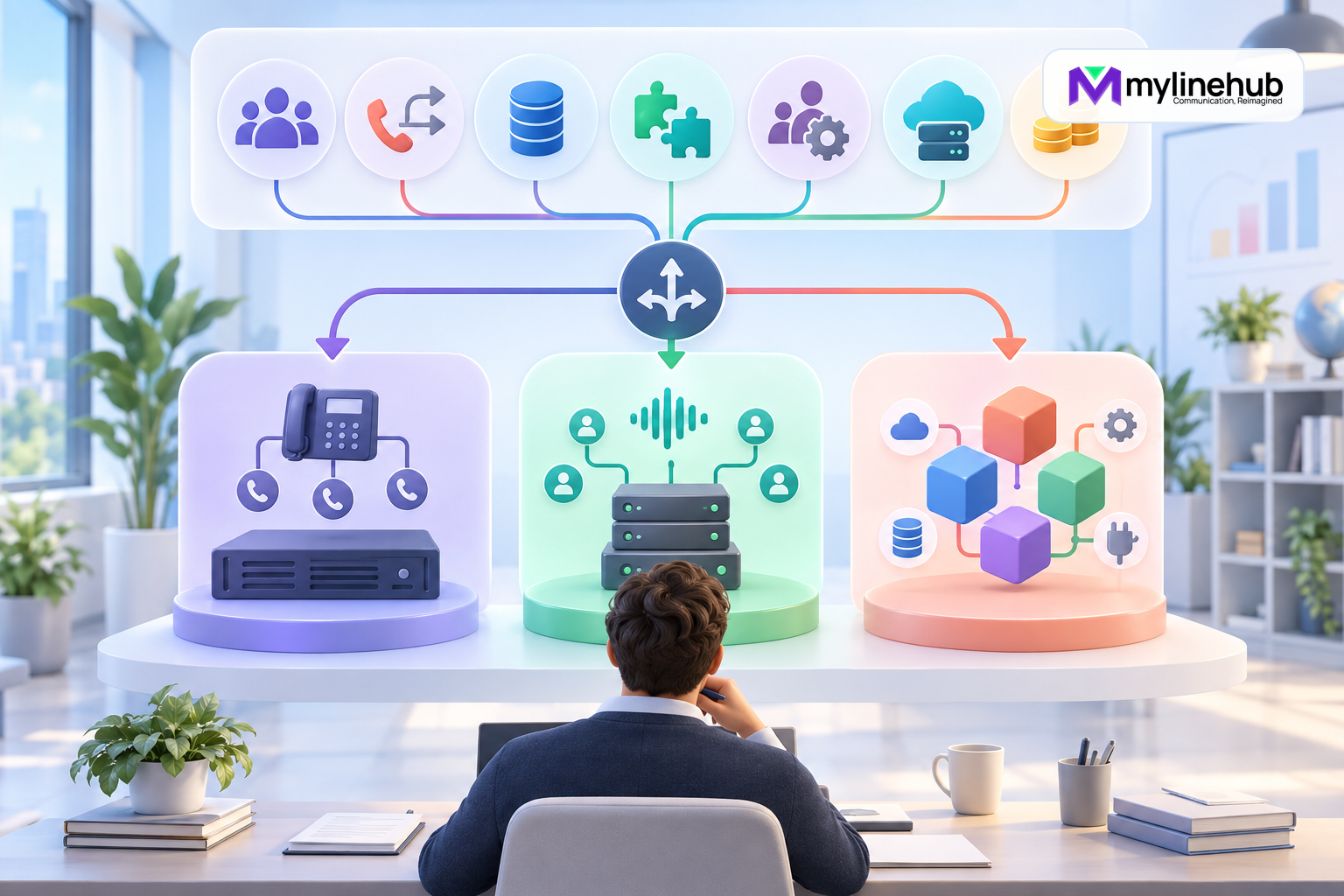
Choosing between Asterisk, FreeSWITCH, and a custom communications architecture is not a contest between product names. It is a decision about operating model, call behavior, media requirements, integrations, failure tolerance, team capability, and lifecycle ownership. A platform can be technically capable yet wrong for a business that cannot securely operate it. Custom development can create an important advantage, or merely recreate solved telephony problems with more risk.
Begin with the service, not the engine
Describe the communications service in business terms. List inbound numbers, users, offices, hours, languages, IVRs, queues, recordings, outbound calling, campaigns, APIs, reports, integrations, and recovery objectives. State which journeys are customer-critical and which are experimental.
Quantify expected concurrent calls, attempts per second, average duration, media features, geographic distribution, and growth. Identify legal and contractual boundaries for consent, recording, retention, caller identity, emergency calling, and data residency. Architecture cannot compensate for an undefined service.
Separate commodity requirements from differentiators
Registration, SIP trunking, routing, codec negotiation, DTMF, bridging, queues, IVRs, recordings, and call detail records are mature telephony capabilities. Reimplementing them in a general-purpose application requires protocol expertise, interoperability testing, media handling, security controls, and years of edge-case learning.
A custom layer is justified when the business differentiator lies in workflow, policy, data, or user experience: a specialized dispatch algorithm, a regulated approval journey, a unique marketplace connection model, or real-time application behavior not handled cleanly by configuration. Even then, the custom layer can usually control an established telephony engine rather than replace its signaling and media core.
What Asterisk brings
Asterisk is a mature open-source communications framework and PBX engine. Its architecture centers on channels created by channel drivers, dialplan applications and functions, and bridges connecting channels. Its PJSIP stack represents remote parties through modular endpoint, AoR, authentication, identification, registration, and transport objects.
Asterisk's traditional dialplan expresses behavior through contexts, extensions, and ordered priorities. AMI supports management actions and events. ARI provides resource-oriented application control for channels, bridges, playback, recording, and other objects handed into a Stasis application. This combination can serve conventional office telephony and application-controlled communications.
Asterisk may fit teams that value its procedural dialplan model, existing ecosystem, PBX-oriented patterns, and AMI or ARI integrations. Fit depends on the exact modules, release, packaging, operational knowledge, and scale model—not on the project name alone.
What FreeSWITCH brings
FreeSWITCH is an open-source communications platform with an event-driven core and modular endpoints, media, dialplan, and integration components. Its common XML dialplan evaluates contexts, extensions, conditions, and actions. Sofia SIP profiles create signaling domains around which directory users and gateways operate.
The Event Socket exposes commands and events to external applications in inbound mode and can hand a call leg to an external controller in outbound mode. FreeSWITCH also supports scripting and dynamic configuration patterns. It is frequently considered for media-intensive or application-integrated systems, but every proposed workload still needs realistic validation.
FreeSWITCH may fit teams comfortable with its profile, directory, XML, event, and media models. As with Asterisk, production quality depends on design, observability, capacity testing, secure configuration, and named operational ownership.
What “custom architecture” should mean
Custom architecture should not automatically mean a new SIP stack or media server. More often it means an application layer that owns business state and instructs one or more telephony engines through supported interfaces. The engine handles protocol and media mechanics; the application handles customer workflow, scheduling, policy, integration, and product-specific state.
A custom design may include an API service, event consumers, workflow engine, databases, message queues, reporting pipeline, identity controls, and an operator interface. Each component adds deployment, monitoring, security, backup, and failure-recovery obligations. Draw these explicitly before estimating delivery.
Use a three-layer model
The first layer is deterministic telephony: listeners, endpoint identity, trunks, codecs, routing boundaries, media, and safe fallbacks. The second is application control: customer workflow, campaign state, agent assignment, consent, and integrations. The third is operations: approvals, observability, backups, incident response, reporting, and change evidence.
Asterisk and FreeSWITCH can participate in all three, but the boundary should remain clear. Keep safety-critical behavior available when the application is unavailable. Do not make an AI service, CRM request, or analytics pipeline a hidden prerequisite for basic inbound calling unless the business consciously accepts that dependency.
Compare representative call journeys
Build a proof around real journeys, not isolated features. Include an inbound call through the carrier, business-hours decision, IVR, queue or ring strategy, agent connection, transfer, recording policy, reporting event, and failure fallback. Include outbound agent calling and any automated campaign or API-controlled flow.
Implement the same acceptance criteria on each serious option. Measure call setup time, audio quality, DTMF, transfer behavior, event completeness, recovery, operator effort, and clarity of diagnosis. A platform that completes a demonstration but produces opaque failure evidence may be expensive to own.
Evaluate integration boundaries
List every external dependency: carrier, CRM, help desk, identity provider, storage, AI provider, payment system, analytics service, and notification channel. For each, document authentication, data shared, timeout, retry policy, idempotency, rate limit, and behavior when unavailable.
Asterisk AMI and ARI and the FreeSWITCH Event Socket expose different control models. Compare them using the application's state machine. Decide who owns a live channel, how events are correlated, how duplicate commands are prevented, and what happens after either side restarts.
Assess media and scale honestly
Concurrent calls alone do not describe workload. Transcoding, recording, conferencing, speech processing, packetization, encryption, prompt playback, and network topology affect capacity. Call attempts per second can matter more than steady concurrency during campaign bursts.
Run load tests using the actual codecs, call durations, recordings, event consumers, storage, and application behavior. Respect carrier limits and never direct synthetic load at customer numbers. Measure resource headroom and failure behavior, not only the maximum successful number.
Security and privacy are architecture criteria
Map public signaling, RTP, management interfaces, application APIs, databases, and operator access. Apply least privilege and network separation. Keep SIP credentials, API keys, recordings, and customer identifiers out of articles, chats, public repositories, and AI prompts.
Decide which component is authoritative for identity, consent, recording policy, and audit. Caller ID is not authentication. An event stream can contain personal data. A custom analytics service should receive only the fields it needs and retain them only as long as policy permits.
Design for failure before choosing
Ask what happens when the carrier, office internet, database, controller, event consumer, AI service, storage system, or telephony node is unavailable. Define which calls continue locally, which receive a controlled message, and which operations pause. Set recovery time and recovery point objectives for configuration and business state.
Test restart and reconciliation. An outbound system must not call a customer again merely because an agent connection or acknowledgement failed. An inbound system must not loop callers when a destination is unavailable. High availability without state ownership can create duplicate or conflicting actions.
Evaluate the team, not only technology
List the roles required to operate each option: telephony engineer, Linux and network operator, application developer, database owner, security reviewer, quality tester, and incident lead. One person may cover several roles, but the responsibilities still exist.
Consider on-call coverage, documentation, hiring, vendor support, upgrade testing, and succession. A custom system maintained by one original developer is a continuity risk. A standard engine with no trained operator is also a risk. Prefer the design the organization can explain and recover under pressure.
Compare total lifecycle cost
Include hardware or hosting, carrier service, support, engineering, monitoring, backups, security review, compliance work, testing, training, upgrades, and incident time. Open-source licensing does not make operations free. A prepared appliance may cost more initially but reduce integration and deployment work. Custom development may be justified when differentiated value exceeds its continuing ownership cost.
Estimate a multi-year lifecycle with realistic change demand. The cheapest proof of concept can become the most expensive platform when every business change requires scarce engineering time.
Use evidence-based decision gates
- The business journeys and service levels are documented.
- Commodity and differentiating capabilities are separated.
- A representative proof passes functional and failure tests.
- Capacity is measured with realistic media and integrations.
- Security, privacy, recording, and consent boundaries are approved.
- Deployment, backup, rollback, and incident procedures are rehearsed.
- Named people own telephony, applications, data, network, and support.
- Total lifecycle cost and exit strategy are accepted.
Common decision mistakes
Do not choose from a feature checklist without testing the complete journey. Do not equate popularity with fit. Do not assume FreeSWITCH is always for scale or Asterisk is only for small PBXs; architecture and workload matter. Do not call ordinary configuration “custom development” merely because it is unfamiliar.
Avoid a hybrid design with no boundary. Running both engines can be valid when each has a clear role, but it doubles skills and operational surfaces. Do not add a second platform to solve a training or process problem. Do not build a proprietary core without an exit plan and test harness.
A practical selection pattern
Choose a prepared Asterisk- or FreeSWITCH-based solution when requirements are mostly established telephony patterns and the business wants bounded deployment. Choose an open platform when the organization has engineering ownership and needs deeper configuration or integration. Add a custom application layer when business logic is genuinely distinctive and can be tested independently.
Replace the underlying telephony engine only when evidence shows that supported engines cannot meet a critical requirement. Even then, consider contributing a module or using a specialized media component rather than rebuilding SIP and RTP wholesale.
Version and documentation caveat
Features, modules, defaults, supported releases, and integration behavior change. Validate against the exact versions and distribution you will operate. Primary references reviewed in September 2026 include the official Asterisk channel architecture, Asterisk dialplan documentation, the official FreeSWITCH Users Manual, its XML dialplan, and Event Socket documentation.
Bottom line
Asterisk and FreeSWITCH are proven engines with different configuration and integration models. Custom architecture is valuable when it adds distinctive business control around those engines, not when it unnecessarily recreates their foundations. Choose through representative calls, failure tests, security review, team capability, and lifecycle cost. The strongest architecture is the one the business can operate, verify, recover, and evolve.
Require a Proof of Concept That Tests the Decision
A final platform choice should follow a bounded proof of concept, not precede it. Select two or three representative call journeys and define measurable acceptance criteria: signalling success, two-way media, DTMF, routing accuracy, recovery behaviour, event correlation, reporting completeness, deployment repeatability and operator diagnosis. Use the intended carrier, network pattern, codecs and application interface. A laboratory call between two local endpoints does not validate the production requirement.
The proof should also exercise failure. Disconnect an integration safely, reject a credential, make a destination unavailable, restart an approved component and demonstrate how an operator identifies the affected layer. Record the platform version, modules, configuration assumptions, evidence and unresolved risks. If a custom architecture is proposed, test the boundaries between components as carefully as the components themselves.
Review current primary documentation during evaluation: the official Asterisk architecture guide and the official FreeSWITCH core-concepts chapter. This comparison was reviewed in September 2026; installed releases, supported modules and operational defaults must be verified again at implementation time.
Begin With the Business Problem
Choose architecture only after defining the business problem, expected users and concurrent calls, integrations, internal skills, security and evidence needs, and who will maintain the result. A prepared MYLO appliance suits a bounded supported requirement; MyLineHub open source suits a capable self-managing team; genuinely new workflows or systems require a scoped custom engagement.
Continue planning
Continue with MYLO Appliance vs MyLineHub Open Source: Which Path Fits?; FreeSWITCH Troubleshooting: Registration, Routing and Audio. For deeper implementation context, use MyLineHub technical architecture guidance.
For a requirement outside the prepared MYLO scope, discuss the exact outcome with MyLineHub.
Want to see API-driven CRM + Telecom workflows in action? Try the WhatsApp bot or explore the demos.
Comments (0)
Be the first to comment.