MYLO Users, Extensions, DIDs, Channels and Concurrent Calls Explained
Users, extensions, channels, and concurrent calls describe different parts of an office phone system. A user is a person with an authorised role.
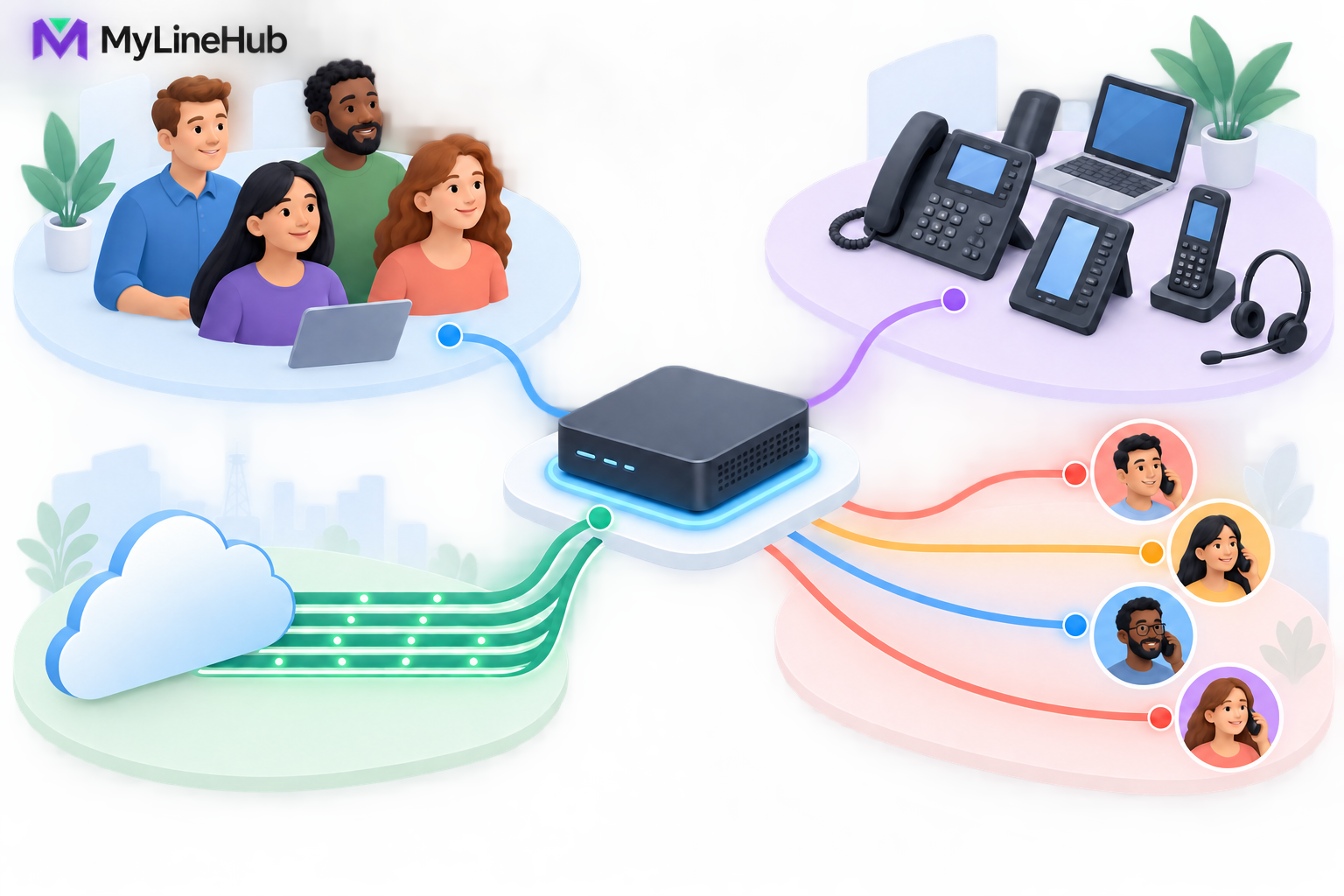
Users, extensions, channels, and concurrent calls describe different parts of an office phone system. A user is a person with an authorised role. An extension is an internal dialable identity or destination. A channel is provider or telephony capacity used by a call leg. Concurrency is the number of call legs active at the same time. These numbers sometimes look similar, but they are not interchangeable. A package supporting twenty users does not automatically include twenty external channels or guarantee twenty simultaneous customer conversations. Correct planning begins by counting people, internal destinations, carrier capacity, and workflow call legs separately. That distinction helps a business buy an appropriate MYLO package, order the right SIP trunk capacity, and avoid discovering during a busy period that one external conversation consumes more than one carrier leg.
What a User Means
A user is a person who participates in the supported system with an account, role, extension relationship, or operational responsibility. Examples include the administrator who approves changes, the receptionist who receives calls, a sales employee who makes calls, a support employee who answers a queue, or an authorised campaign operator.
User count is primarily about people and accountability. Ten employees should not be hidden behind two shared logins simply to fit a smaller package. Individual identities make it possible to grant only the permissions required, understand who performed an action, and remove access when someone changes role or leaves.
Not every user needs the same capabilities. An administrator may manage approvals, while an employee may only use an assigned calling function. A role difference does not make the person disappear from capacity planning. Count everyone who requires supported use, then map each person to the least authority needed.
What an Extension Means
An extension is an internal number or dialable destination in the phone system. It may identify an employee’s phone, a shared desk, a reception point, or another internal target. Extensions make internal routing manageable: a caller or route can reach a short known identity without using a public number for every desk.
An extension is not necessarily a separate human. Shared functions, conference destinations, queues, IVRs, or service routes can use internal numbering. One user might also interact with more than one destination depending on the supported design. Therefore, “we need fifteen extensions” is not enough information to conclude that the business has fifteen users.
Extensions are also not public DIDs. A DID is a number supplied by the telecom provider and reachable from the public network. An inbound route can map one DID to an IVR, queue, ring group, or extension. Several internal destinations can be served through one published number, and several DIDs can reach the same system when the provider contract allows it.
What a Channel Means
In a buying discussion, a channel commonly refers to the carrier capacity required for one external call leg. The exact terminology and accounting come from the provider, so the customer should confirm how its chosen trunk is sold and limited. Channels do not arrive merely because an appliance supports a certain number of users.
A typical outside customer speaking with an office extension uses one external provider leg. An internal call between two local extensions may not use the external trunk. A workflow connecting a customer phone to an agent’s mobile can require one external leg to the customer and another to the mobile agent. One connected conversation can therefore consume two provider channels.
Some people use “channel” more broadly within Asterisk or another telephony engine, where internal call legs and technologies have their own channel representation. For purchasing, ask the carrier for its definition and capacity. For technical troubleshooting, describe the complete call topology. Mixing the commercial and technical meanings without context leads to bad estimates.
What Concurrent Calls Means
Concurrency describes activity at the same moment, not the total calls made in a day. An office may complete hundreds of short calls across business hours while having only a few live at once. Another office may receive a sharp peak in which many customers call during the same ten minutes.
The phrase “concurrent calls” is sometimes ambiguous. It may mean connected customer conversations, active external call legs, or every live telephony leg including calls that are ringing. A responsible capacity discussion defines which quantity is being counted. For trunk purchasing, simultaneous external legs are especially important.
Concurrency changes second by second. Calls begin, ring, connect, transfer, and end. Capacity rules must handle those transitions deterministically so the system does not launch work based on a stale count. The business also needs a planned experience when capacity is occupied, such as controlled queueing, overflow, callback ownership, or a clear failure outcome.
Why the Four Numbers Differ
Consider an office with ten users and twelve extensions. Ten extensions belong to people, one reaches reception, and one is an internal service destination. The business has a provider contract for four external channels. During an ordinary period, one customer speaks with support while another employee makes an outbound call, using two external legs. There are ten users, twelve extensions, four purchased channels, and two currently active external legs.
Now suppose the office starts a supported flow that connects a customer phone to an agent mobile. The connected conversation may use two external legs. If another identical conversation starts, all four provider channels may be occupied even though only two agents and two customers are talking. The remaining eight users still exist, but they do not create additional carrier capacity.
This example is not a promise about a particular provider or package. It shows why the topology must be drawn. Count every external leg in each intended flow and confirm the result with the provider and supported product design.
Inbound Calling Example
A business publishes one DID. The carrier delivers an inbound call through the trunk, and MYLO’s approved configuration routes it to a sales-and-support menu. The caller chooses support and reaches an internal queue. When an employee answers on a local extension, the customer conversation normally continues over one external provider leg.
If four customers call simultaneously, the provider service needs enough inbound capacity for those external legs. The system also needs a defined destination and enough available people to answer. Four carrier channels do not create four available support employees; four logged-in employees do not create carrier channels. Human capacity and telecom capacity are separate constraints.
When every employee is busy, the business must decide what callers experience. Waiting, overflow, voicemail, and callback are operational choices. A larger user package by itself does not make that decision.
Outbound Calling Example
An office employee using a local extension calls a customer. That common topology may use one external provider leg to the customer. If the same business supports remote agents on mobile phones, an application-controlled connection between the mobile agent and customer may use two external legs. Five simultaneous connected mobile-agent conversations could therefore require ten external legs, subject to the actual provider and design.
Campaign operation adds other limits. Human-assisted work depends on an available operator. Pacing and retries must respect the selected flow and business rules. Caller IDs must be authorised by the provider. Recording, consent, and data handling remain customer responsibilities. Channel capacity is necessary, but it is not permission to place unlimited calls.
For this reason, MYLO package selection and SIP trunk selection are related but separate purchases. The appliance package defines a supported product boundary; the provider contract defines external telecom service. Both must match the intended workload.
How to Estimate Capacity Without Guessing
- Count named users: include every person who needs supported access or a system role.
- List internal destinations: document employee extensions, shared functions, IVRs, queues, and other dialable targets.
- List public numbers: record each DID and the inbound destination it should reach.
- Draw each call flow: show customer, office extension, mobile agent, IVR, and provider boundaries.
- Count external legs: calculate the carrier capacity used by one instance of each flow.
- Measure the busy period: estimate or observe simultaneous inbound and outbound demand, not only daily totals.
- Include human availability: identify how many trained people can actually handle calls at that time.
- Define full-capacity behaviour: decide what happens when the provider, system, or team has no available capacity.
- Verify: confirm the model with current provider terms and representative real-call testing.
Common Planning Mistakes
- “Twenty users means twenty calls.” User capacity does not state the carrier channel count or topology.
- “Every extension needs its own public number.” Internal destinations can share inbound DIDs through routing.
- “One conversation always uses one channel.” A customer-to-mobile-agent connection can use two external legs.
- “Fast Internet guarantees good voice.” Stability, latency, jitter, packet loss, routing, and congestion also matter.
- “Unused channels mean agents are available.” Telecom capacity cannot answer a call without the required human or automated destination.
- “Internal extension calls consume the trunk.” Local calls may remain internal, depending on the design.
- “The appliance decides carrier limits.” Purchased provider service remains an external authority.
Questions to Take to MYLO and the Provider
- How many named users need supported access now and during near-term growth?
- Which extensions and shared internal destinations are required?
- How does the provider define and price a channel?
- Are inbound and outbound calls drawn from the same capacity pool?
- How many external legs does each intended flow use?
- What is the expected peak, and what should happen when capacity is full?
- Which DIDs and outbound identities are authorised?
- Does the requirement remain within the selected MYLO package boundary?
Use these answers when reading the MYLO 10 versus MYLO 20 comparison. The key takeaway is simple: count people, internal identities, external legs, and simultaneous activity as four separate dimensions. When the intended call flow is clear, package and provider decisions become much easier to verify.
Continue planning
Continue with What Is a Telephony Appliance for a Small Business?; MYLO 10 vs MYLO 20: Which Package Fits Your Business?; Complete Cost of Starting a 10-User Office Calling System. For deeper implementation context, use MyLineHub technical architecture guidance.
Review current MYLO pricing, or discuss this requirement on WhatsApp.
Want to see API-driven CRM + Telecom workflows in action? Try the WhatsApp bot or explore the demos.
Comments (0)
Be the first to comment.