Complete Cost of Starting a 10-User Office Calling System With MYLO
The complete cost of starting a ten-user office calling system is larger than the appliance price.
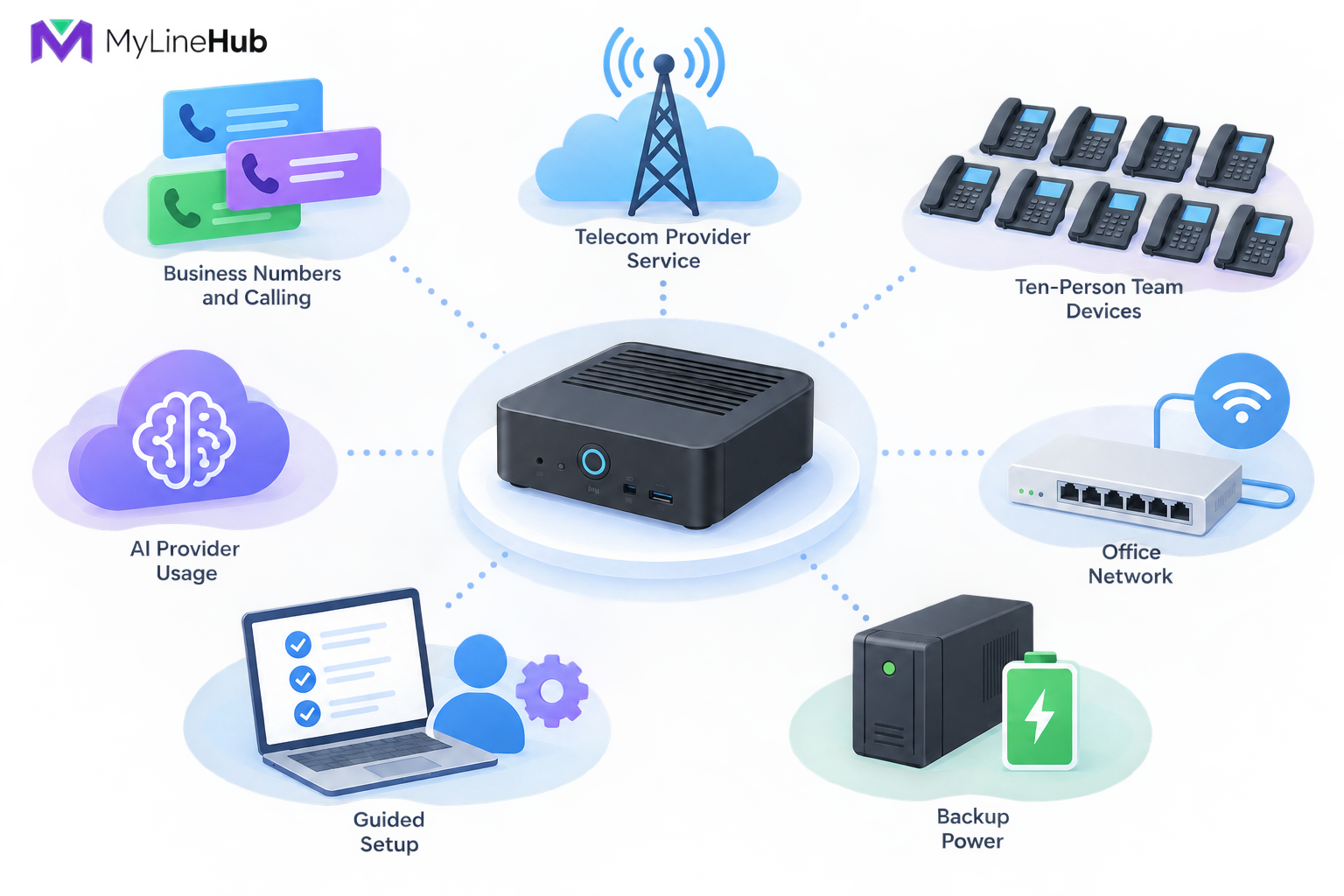
The complete cost of starting a ten-user office calling system is larger than the appliance price. A realistic budget includes the MYLO 10 package, a SIP trunk or other supported telecom service, business phone numbers, provider channels, calling charges, user devices, office networking, power backup, setup or implementation work, and any external AI-provider usage. Some businesses already own suitable computers, headsets, routers, switches, and UPS capacity; others must purchase them. The safest way to estimate cost is to separate one-time purchases from monthly and usage-based charges, then confirm every time-sensitive figure with the current supplier or provider. Do not treat ten supported users as ten simultaneous external calls: provider capacity and call topology determine concurrency separately.
Begin With the Appliance Cost
MYLO 10 is the prepared on-premise centre of the system for a supported team of up to ten users. The applicable product offer should state the current appliance price, taxes, hardware condition, warranty, included setup or support, and delivery terms. Those commercial details can change, so this article does not freeze an old figure as a permanent fact.
The appliance cost covers the prepared product boundary, not every service required to make an external call. It should be evaluated alongside the cost of the carrier, office infrastructure, user endpoints, and the work needed to turn the business requirement into a verified call path.
Provider Setup, Numbers and Channels
A telecom provider normally supplies the SIP trunk, public business numbers, agreed channel capacity, external routing, and calling plan. Depending on the provider and contract, the business may pay an activation fee, recurring rental, number charges, channel charges, usage charges, or a minimum commitment.
Ask the provider to explain its commercial units. A trunk is not the same as a phone number. A DID identifies a public number. A channel represents external call-leg capacity under the provider’s model. One trunk may carry several numbers, while the number of simultaneous calls remains limited by the purchased service and live topology.
Obtain a written provider document before budgeting configuration work. Authentication type, IP requirements, number format, inbound delivery, outbound caller-ID authorisation, codecs, and escalation contacts can affect readiness even when the monthly price looks acceptable.
Calling Charges Are a Variable Operating Cost
Outbound calls are usually billed according to destination, duration, plan, and provider terms. Inbound service may also carry rental or usage charges. A team that receives mostly inbound enquiries has a different cost profile from a team running daily outbound campaigns.
Estimate volume using actual business behaviour: expected calls per day, average connected duration, retry policy, seasonality, and the share of calls going to mobiles, landlines, or other destinations. Do not multiply total leads by a guessed duration and call that a final budget. Unanswered attempts, busy outcomes, agent availability, and provider billing rules influence the result.
User Devices and Audio Equipment
Ten users do not necessarily require ten new desk phones. Some businesses use softphones on existing computers, some prefer IP phones, and others use supported mobile-agent flows for particular campaigns. Each option creates different equipment and network requirements.
- Softphones: may reuse existing computers but need suitable headsets and disciplined device management.
- IP phones: add dedicated hardware, switch ports, cabling, and possibly Power over Ethernet requirements.
- Web or browser tools: depend on supported browser, microphone permissions, and local device quality.
- Mobile-agent workflows: may consume an additional external provider leg and create separate calling charges.
Budget replacement headsets, spare devices, and hygiene where several people share equipment. Low-quality audio devices can make a technically successful call feel unreliable to customers.
Network Readiness Costs
Voice requires stable network behaviour. The office may need a better router, managed switch, additional Ethernet cabling, corrected Wi-Fi coverage, or a backup Internet connection. These are not automatically part of the appliance purchase.
Consistent latency, jitter, packet loss, and upload quality matter more than headline download speed alone. If the provider delivers a separate telecom connection, the site may also need appropriate placement and cabling between the provider equipment and MYLO.
Include installation labour when the network is not already documented. A cheap cable run that is unlabeled or poorly terminated can create recurring diagnosis costs later.
Power Backup Must Cover More Than MYLO
The appliance, router, switch, provider termination equipment, and powered phones may all be necessary for a call. A UPS connected only to the MYLO box does not preserve service when another link in that chain loses power.
Calculate backup requirements from the actual equipment load and desired runtime. Also budget for battery replacement over the life of the system. An existing office inverter may be sufficient, but that should be verified rather than assumed.
AI-Provider Usage and Account Ownership
Where a MYLO workflow uses an external AI provider, the customer may supply its own provider key and pay that provider directly for usage. Charges depend on the selected model, the amount of content processed, and provider pricing at the time of use.
AI cost should be tracked separately from telephony cost. Live call execution, pacing, capacity, retry, and recovery remain deterministic; they should not create an unnecessary model call for every runtime decision.
Setup, Guided Work and Custom Implementation
A prepared appliance reduces infrastructure assembly, but the customer’s trunk, numbers, users, routes, IVR, caller IDs, devices, and testing are site-specific. The purchase may include a defined onboarding activity, or the business may buy a separate guided session or implementation task.
Ask what outcome is included, what information the customer must provide, how acceptance is tested, and what happens when a new requirement appears. A custom CRM integration or unusual provider design should not be hidden inside a general “setup” label.
A Ten-User Planning Worksheet
| Cost area | Typical timing | Question to confirm |
|---|---|---|
| MYLO 10 appliance | One time | What current package, warranty and delivery terms apply? |
| SIP trunk activation | One time or contract start | What setup and IP requirements apply? |
| DIDs and channels | Recurring | How many numbers and simultaneous external legs are included? |
| Calling usage | Variable | How are destinations and durations billed? |
| Phones and headsets | One time plus replacement | What will each user actually use? |
| Network improvements | One time plus Internet rental | Is the current network voice-ready? |
| UPS or inverter | One time plus batteries | Which devices must remain powered? |
| AI-provider usage | Variable | Which provider and model will the customer fund? |
| Implementation and support | One time or recurring | What exact outcome and response boundary are included? |
Practical Example
A ten-person service office already owns laptops, a stable router, and an inverter. It chooses softphones and buys ten suitable headsets. The provider supplies one main number, one additional departmental DID, and enough channels for the expected busy period. The business purchases guided configuration and keeps a small budget for cabling and a replacement headset.
Its initial budget is therefore not “MYLO plus nothing.” It is the appliance, provider activation, endpoints, configuration, and any infrastructure gap. Its monthly budget is trunk rental, number or channel charges, calling usage, Internet service, and applicable AI usage or support. Existing equipment reduces cost, but only after its suitability is verified.
Final Budget Checklist
- Use the current MYLO 10 offer rather than an old price.
- Obtain a written provider quotation covering numbers, channels, rental and usage.
- List the device assigned to every user.
- Test network quality and document any required improvements.
- Protect the complete call chain with suitable power backup.
- Separate one-time, recurring and usage-based costs.
- Include setup, testing, training and support where required.
- Keep a contingency for replacements and business growth.
Review what is not included with a MYLO appliance and how users, extensions, channels and concurrent calls differ before finalising the worksheet. Contact the relevant provider and MyLineHub for current commercial figures.
Build the Budget as a Twelve-Month Operating Plan
A useful ten-user estimate separates one-time preparation from recurring service. List the current MYLO package and any selected implementation work as one-time items. Then list SIP trunk rental, public numbers, channels, calling minutes, Internet, AI-provider usage where enabled, support arrangements, and replacement allowances as recurring or variable items. Desk phones, headsets, switches, cabling, a UPS, and network improvements may be one-time purchases but still need maintenance and eventual replacement.
Model three calling months rather than one optimistic average: a quiet month, an expected month, and a peak month. User count does not equal concurrent external calls, so estimate how many people will actually be connected at the same time and whether inbound and outbound activity overlap. Confirm channel pricing, destination rates, minimum commitments, taxes, and caller-ID conditions directly with the chosen provider. MYLO does not supply public numbers or calling minutes.
Include the cost of ownership inside the office. Assign an administrator, schedule acceptance testing, maintain endpoint and number inventories, protect credentials, review recordings and retention, and rehearse outage escalation. Keep contingency for a failed headset, ageing UPS battery, carrier change, or network correction. A lower hardware price is valuable only when the complete chain remains funded.
Use Acceptance Evidence Before Calling the Project Complete
Test every representative journey through the real telecom provider: inbound number delivery, business-hours and after-hours routes, extension ringing, transfers, outbound caller ID, two-way audio, DTMF, hang-up, and the chosen recording behaviour. Record unresolved dependencies and their owners. If the business later needs a deep CRM integration, unusual multi-site architecture, or unsupported workflow, budget it separately as MyLineHub open-source or custom engineering rather than assuming it is included in the ten-user appliance cost.
Continue planning
Continue with What Is a Telephony Appliance for a Small Business?; Users, Extensions, Channels and Concurrent Calls Explained; Complete Cost of Starting a 20-User Office Calling System. For deeper implementation context, use MyLineHub technical architecture guidance.
Review current MYLO pricing, or discuss this requirement on WhatsApp.
Want to see API-driven CRM + Telecom workflows in action? Try the WhatsApp bot or explore the demos.
Comments (0)
Be the first to comment.