What Is a Telephony Appliance? How a MYLO AI Telephony Agent Helps a Small Business
A telephony appliance is a prepared local system that brings business calling hardware, phone-system software, browser-based management, and guided assistance into one deployment.
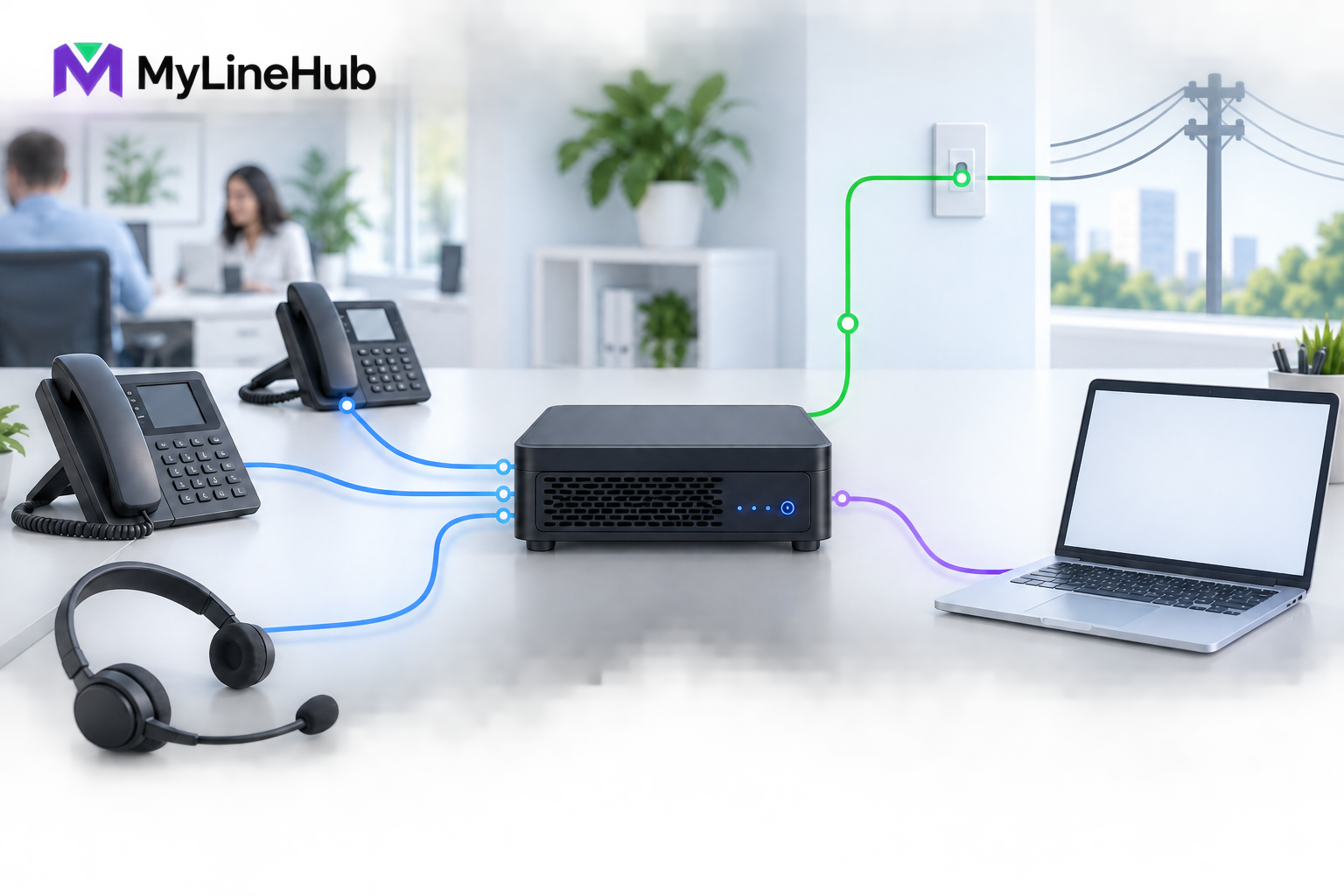
A telephony appliance is a prepared local system that brings business calling hardware, phone-system software, browser-based management, and guided assistance into one deployment. Instead of asking a small business to select a server, install a PBX, connect a telecom provider, and assemble its own management tools, the appliance provides a defined starting point for that work. MYLO is intended for organisations that want an on-premise calling system without first becoming telecom infrastructure specialists. The appliance still depends on services the customer arranges, including a suitable SIP trunk, business phone numbers, network connectivity, power protection, and user devices. Its value is not that those responsibilities disappear. Its value is that the central system arrives as a prepared product with a clearer setup and operating journey.
The Business Problem a Telephony Appliance Solves
A small business may need a professional incoming number, extensions for employees, call routing, an IVR, recordings, or controlled outbound calling. Buying these features separately can create a fragmented project. Hardware may come from one seller, phone numbers from a telecom provider, PBX software from an open-source project, and configuration from a consultant. When something fails, the business must first determine which part owns the problem.
A prepared appliance gives that project a defined centre. The local system runs the business phone environment, stores MYLO-owned operational information, and provides a browser interface through which an authorised person can understand and manage supported tasks. The telecom provider continues to deliver the number, trunk, channels, and external calling service. Office phones, softphones, headsets, networking, and backup power remain part of the customer environment.
This separation is important. An appliance can make deployment more organised, but it cannot replace a provider contract, repair an unstable Internet connection, or create unlimited calling capacity. It helps the business assemble the required parts around a prepared core.
What a Telephony Appliance Combines
Prepared business hardware
The appliance provides a computer platform dedicated to the supported calling workload. A dedicated system avoids making the office phone service depend on an employee laptop that may be switched off, removed from the office, or overloaded with unrelated work. The exact package and supported capacity should always be checked before purchase rather than inferred from the physical size of the machine.
Telephony software
MYLO uses Asterisk as its telephony engine. Asterisk handles the real phone-system work: endpoints, trunks, dialplan execution, call routing, media-related behaviour, and call-state evidence. MYLO does not replace that engine with an AI conversation. It provides a more guided way to describe, approve, apply, and verify supported business outcomes around it.
Local application services
The application keeps the structured information it owns, such as users, permissions, approved operations, campaign state, and reporting relationships. Asterisk remains the authority for live telephony configuration and evidence, while the operating system remains the authority for machine and network state. Keeping these responsibilities explicit reduces the risk that a convenient screen or an old note is mistaken for current operational truth.
Browser-based access
An authorised user opens MYLO through a browser on the office network. This means the administrator does not need to work directly at the appliance for every supported task. Browser access does not remove the need for secure accounts, appropriate roles, and careful network administration. It simply provides a practical operating surface for the people responsible for the system.
Guided AI assistance
MYLO can use AI to understand a request expressed in normal business language, identify missing information, explain evidence, and prepare a structured proposal. Consequential execution remains controlled. Deterministic services validate the proposed operation, permissions apply, and the responsible person approves changes where approval is required. Live campaign scheduling, capacity, retry, and call sequencing do not wait for an AI model to make the next runtime decision.
How MYLO Differs From Installing PBX Software Alone
PBX software is a crucial component, but software alone is not a complete office deployment. A business still needs compatible hardware, an operating system, network design, a telecom service, endpoint configuration, security controls, backup procedures, and a way to diagnose problems. It also needs someone to decide how incoming and outgoing calls should behave.
A prepared MYLO appliance packages a defined product path around those responsibilities. It is designed to reduce the amount of infrastructure assembly needed before configuration can begin. That does not mean every possible Asterisk feature or every capability in the broader MyLineHub open-source platform is automatically included. The appliance has a supported product boundary. Requirements outside that boundary may need a separate implementation task or a custom MyLineHub deployment.
This distinction protects the buyer. A prepared product should have understandable limits. An open-source platform is more flexible, but flexibility introduces design, engineering, deployment, and maintenance work that must be owned by a capable team.
How the Complete Calling Chain Works
- The telecom provider supplies external service. This normally includes one or more business numbers, trunk access, agreed channels, routing details, and calling charges.
- The office connects the required infrastructure. The appliance, router, provider termination equipment where applicable, switches, phones, and power backup must form a working chain.
- The administrator defines the business outcome. This may be a support number, department routing, an IVR, extensions, or an approved outbound workflow.
- MYLO prepares and validates supported changes. The system can gather the required information, present a proposal, and use controlled services to apply an approved operation.
- Asterisk executes calls. The PBX processes the actual telephony path and provides live evidence used for verification and troubleshooting.
- The business operates and reviews the result. Authorised users monitor outcomes, maintain users and routes, review call information, and respond when provider, network, or equipment conditions change.
A Practical Small-Business Example
Consider a service company with a receptionist, a sales team, and a support team. The company obtains a business number and suitable trunk service from a telecom provider. Employees use a mixture of desk phones and softphones. The business wants callers to hear a short menu, reach the correct department, and have an alternative when everybody is busy.
The MYLO appliance becomes the local centre of that setup. The administrator describes the departments and the desired caller experience. The proposed structure is reviewed before consequential configuration is applied. The resulting route is tested with a real external call because a configuration reload alone does not prove that the provider, number representation, dialplan, endpoint, and audio path all work together.
If the company later needs a custom CRM integration, unusually large capacity, or a specialised multi-site architecture, that requirement may sit beyond the prepared appliance. The business can then evaluate the open-source MyLineHub platform or a scoped custom engagement without pretending the original appliance purchase included unlimited engineering.
Who a Prepared Appliance Is For
A telephony appliance is a strong fit when a business:
- prefers to keep its calling system on premises;
- wants a prepared starting point instead of assembling a PBX server independently;
- has a defined small-team requirement that fits an available MYLO package;
- can arrange the required telecom provider, network, devices, and power protection;
- has a responsible administrator who can control users and approvals; and
- values guided configuration while keeping actual execution deterministic and auditable.
The appliance is not a substitute for organisational ownership. Someone must remain responsible for provider accounts, lawful use, user access, call recordings, customer data, consent, and operating procedures.
When Custom Development Is More Suitable
A prepared appliance is deliberately bounded. Custom development is more appropriate when the required outcome depends on a unique CRM workflow, a non-standard provider integration, high or unusual concurrency, several sites, bespoke analytics, a specialised customer application, or an architecture that must be designed around existing infrastructure.
The broader MyLineHub architecture and technology stack is relevant to teams evaluating a more extensible engineering path. Businesses comparing ownership models can also review the existing guide to on-premise AI calling and telecom setup costs. These resources describe a wider technical landscape and should not be read as a promise that every capability is included in a fixed MYLO appliance package.
Decision Checklist
- How many people need extensions or calling access?
- How many simultaneous external calls does the business expect?
- Has a provider confirmed the required SIP trunk, numbers, and channels?
- Is the office network stable enough for voice traffic?
- Will the appliance, router, provider equipment, switches, and phones have suitable power backup?
- Which person will own administration, approvals, access, and provider coordination?
- Does the requirement fit a prepared MYLO package, or does it need custom architecture?
A good buying decision starts with the complete operating chain, not only the appliance specification. Review the current MYLO package information for a prepared deployment, or contact MyLineHub with the required users, call flows, provider details, and expected capacity when the requirement is custom.
Where the MYLO AI Telephony Agent Fits
MYLO adds an AI telephony agent to a prepared local appliance. Human language is used to understand the requirement and prepare a structured proposal; Asterisk remains the telephony authority, Linux remains the network authority, and controlled services validate, apply and verify approved work. MYLO is a layer between the telecom provider, the PBX and business users—not the carrier, Internet provider, CRM, hardware manufacturer or the whole office IT environment.
For the exact buying boundary, compare what the MYLO appliance includes with what remains outside the MYLO appliance.
Continue planning
Continue with Can Refurbished Hardware Reliably Run a Business Phone System?. For deeper implementation context, use MyLineHub technical architecture guidance.
Review current MYLO pricing, or discuss this requirement on WhatsApp.
Want to see API-driven CRM + Telecom workflows in action? Try the WhatsApp bot or explore the demos.
Comments (0)
Be the first to comment.