Why MYLO Uses Refurbished Business-Grade Hardware for On-Premise Telephony
MYLO uses refurbished business-grade hardware to make a prepared on-premise phone system more affordable while giving capable equipment a longer useful life.
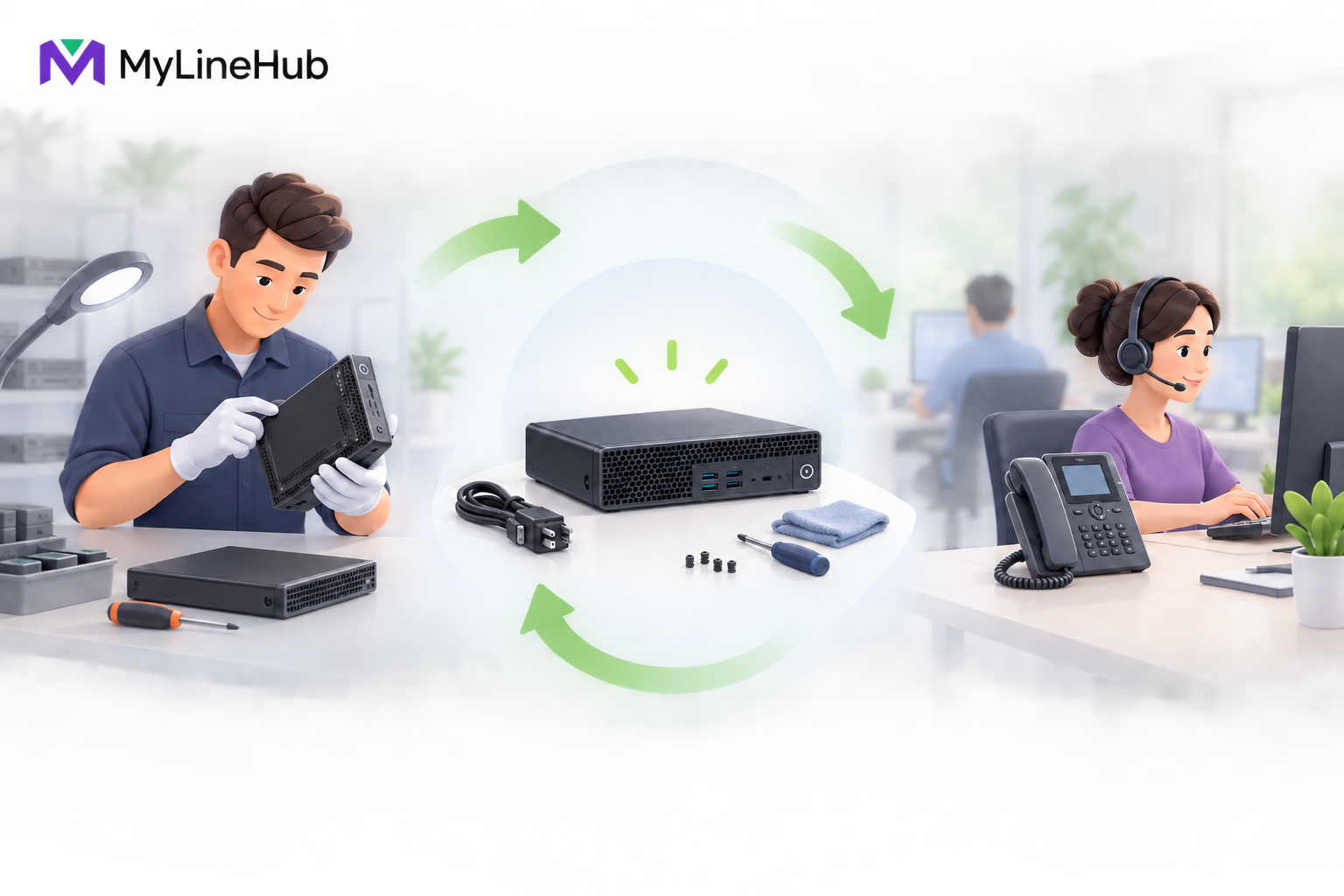
MYLO uses refurbished business-grade hardware to make a prepared on-premise phone system more affordable while giving capable equipment a longer useful life. The approach is practical only when the hardware is selected for a defined workload, inspected, tested, cleaned, and supplied with transparent condition and support information. Refurbishment is not a claim that used hardware is identical to new hardware, and it is not a promise that components cannot fail. It is a way to avoid charging a small business for unnecessary new-machine performance when a verified commercial computer can support the intended MYLO package. The product value comes from the complete preparation: suitable hardware, installed software, a supported operating boundary, and a clearer path from delivery to business calling.
Reducing the Entry Cost of On-Premise Telephony
A business phone system has several cost layers. There is the central appliance, the SIP trunk or other telecom service, business numbers, calling charges, user devices, networking, power backup, configuration, and ongoing support. If the server hardware consumes too much of the initial budget, a small business may delay the entire project or choose a service that does not fit its ownership requirements.
Refurbished business hardware can reduce the appliance portion of that starting cost. Many commercial computers still have years of useful service available when they leave their first organisation. Reusing an appropriate unit allows the prepared product to focus spending on the complete outcome rather than on the marketing value of an unopened box.
Lower hardware cost should not be confused with zero operating cost. The customer still arranges provider service, numbers, channels, call charges, network connectivity, endpoint devices, and suitable power protection. AI-provider usage, implementation work, or custom development may also sit outside the fixed appliance price. A transparent buying conversation separates these costs instead of presenting one attractive price as the entire office calling budget.
Why Business-Grade Equipment Is a Useful Starting Point
Business computers are commonly built for regular office use, fleet management, and maintainability. Their cases, cooling systems, storage access, firmware options, and network interfaces are designed around organisational deployment rather than occasional home use. That does not mean every business model is automatically suitable, but it creates a stronger pool from which a defined appliance can be selected.
Phone-system reliability depends on consistent operation, not visual novelty. A small appliance may spend most of its life in an equipment area, processing calls and storing operational data without being touched. For that role, verified memory, healthy storage, stable network ports, sound cooling, and reliable power behaviour matter more than a perfect outer case.
The workload must still be respected. User count is not the same as simultaneous external calls. Recording changes storage use. Codec choices and call flows affect resource needs. Extra applications compete with the telephony system. MYLO packages should therefore be chosen according to their supported boundary rather than by assuming that any computer can run any number of calls.
What Preparation Adds
Buying an unknown used computer and buying a prepared appliance are different transactions. The preparation process should turn a general-purpose machine into a known product starting point.
- Selection: choose a business model with the required processor, memory, storage options, cooling, and network interfaces.
- Inspection: check physical condition, ports, fans, power components, and signs of damage or poor repair.
- Testing: verify startup, memory, storage health, network stability, thermals, and representative sustained operation.
- Cleaning and servicing: remove dust, restore airflow, and correct supported replaceable components where required.
- Software preparation: install the approved operating environment and MYLO product build for the package.
- Product verification: confirm that expected local services start and that the appliance is ready for customer-specific network and telecom configuration.
- Documentation: state what is included, what the customer must arrange, and which support or warranty terms apply.
This work does not activate the customer’s SIP trunk or prove an external calling path before provider and site details are available. It prepares the central system so that those customer-specific steps can begin from a controlled baseline.
Extending Useful Hardware Life
Reusing capable hardware avoids discarding a machine solely because another organisation reached the end of a lease or standard refresh period. Extending useful life can reduce electronic waste and extract more value from materials and manufacturing already invested in the equipment.
Environmental benefit should be described carefully. Reuse does not erase the energy consumed by the appliance, the eventual need for recycling, or the impact of replacement components and shipping. It is one practical step: use a suitable existing machine for longer instead of manufacturing demand being the automatic answer to every deployment.
Responsible reuse also means planning the end of the second life. Storage devices may contain business information. When a component is replaced or the appliance is retired, the organisation should follow an appropriate data-erasure and recycling process rather than putting electronic equipment into ordinary waste.
A Practical Cost-and-Readiness Example
A local services company wants ten employees to use a professional business number. It needs an inbound route, several extensions, and a simple IVR. The company has a reasonable office network but has not yet ordered the SIP trunk or decided which employees will use desk phones versus softphones.
A prepared refurbished appliance can reduce the cost of the central system, but the buying process still starts with readiness questions. The team must obtain the correct provider service, confirm expected simultaneous calls, protect the router and provider equipment during power cuts, and assign an administrator. The hardware saving is valuable because it leaves more budget for the parts that make the complete chain dependable.
If the same company later asks for a complex multi-site design, high-capacity custom dialler, or deep CRM workflow, the prepared appliance should not be stretched silently beyond its product promise. That work belongs in a separate requirement assessment for the broader open-source MyLineHub platform or a custom implementation.
What Refurbishment Does Not Guarantee
Clear limitations are part of a trustworthy product description:
- The machine is not new merely because it has been cleaned and prepared.
- Cosmetic wear may remain and should be disclosed where relevant.
- No test can guarantee that a component will never fail later.
- Hardware condition cannot compensate for unstable power, heat, dust, or poor networking.
- The appliance does not include every external service needed for calling.
- The computer’s theoretical capacity is not permission to exceed the supported MYLO package.
- Custom integrations and engineering are not automatically part of a fixed appliance purchase.
Current warranty, replacement, shipping, and support terms should be confirmed from the applicable offer before purchase. They are time-sensitive commercial facts and should not be assumed from a general educational article.
Transparency Buyers Should Expect
A buyer should be able to obtain clear answers to these questions:
- Is the supplied hardware refurbished, and what cosmetic condition is expected?
- What hardware checks are performed before dispatch?
- Which components may have been replaced?
- What does the selected MYLO package support?
- Which cables, devices, provider services, and accessories are not included?
- What warranty or replacement process applies?
- What operating environment, backup power, and network conditions are required?
If these answers are unclear, a low price is not enough information to make a responsible business decision. The appliance will support an important communication path, so the commercial boundary deserves the same attention as the technology.
How to Decide Whether the Approach Fits
Start by reading what a telephony appliance combines and how refurbished hardware reliability should be assessed. Then compare the current MYLO package with the real office requirement: users, expected simultaneous calls, recording, provider service, network quality, endpoint devices, and power backup.
Refurbished business-grade hardware is the right choice when it has been prepared honestly, its supported workload matches the business, and the lower hardware cost helps build a stronger complete deployment. It is the wrong choice when condition is unknown, testing is superficial, support is unclear, or price is being used to hide an unsuitable system.
Acceptance Checks When the Appliance Arrives
Treat delivery as the start of site acceptance, not as proof that the complete phone service is live. Record the appliance identity and disclosed condition, inspect the case and ports for shipping damage, and confirm that supplied power items and network interfaces match the order. Place the unit where airflow is clear and where it will not be exposed to heat, moisture, heavy dust, or casual physical access. Connect it only through the documented office-network plan and suitable power protection.
The administrator should confirm local startup, browser access, system time, storage visibility, network-link stability, and supported MYLO services before adding customer credentials. Provider information should enter through the protected setup path, never ordinary chat or support notes. Once the SIP provider and endpoints are ready, run representative inbound and outbound calls through the real carrier. Check ringing, answer, two-way audio, keypad input where relevant, caller-ID behaviour, hang-up, and the chosen recording policy.
Keep the acceptance record with package scope, current warranty or replacement terms, administrator owner, provider contact, network dependencies, and test results. A refurbishment decision is sound when hardware condition is transparent, the supported workload is realistic, and the complete call journey is verified. The age of the chassis alone is neither proof of reliability nor proof of unsuitability.
Sourcing, Preparation and Warranty Ownership
MyLineHub sources suitable business-grade refurbished computers from the market; it does not manufacture the underlying machine. Make, model and vendor can vary. MyLineHub prepares the MYLO software environment and tests the unit for its intended workload, while hardware warranty and hardware replacement follow the applicable seller or vendor terms stated for that unit.
Continue planning
Continue with What Is a Telephony Appliance for a Small Business?; Can Refurbished Hardware Reliably Run a Business Phone System?; What Is Included in the MYLO Box?. For deeper implementation context, use MyLineHub technical architecture guidance.
Review current MYLO pricing, or discuss this requirement on WhatsApp.
Want to see API-driven CRM + Telecom workflows in action? Try the WhatsApp bot or explore the demos.
Comments (0)
Be the first to comment.