Complete Cost of Starting a 20-User Office Calling System
A twenty-user office calling system should be budgeted as a complete operating environment, not as one appliance purchase.
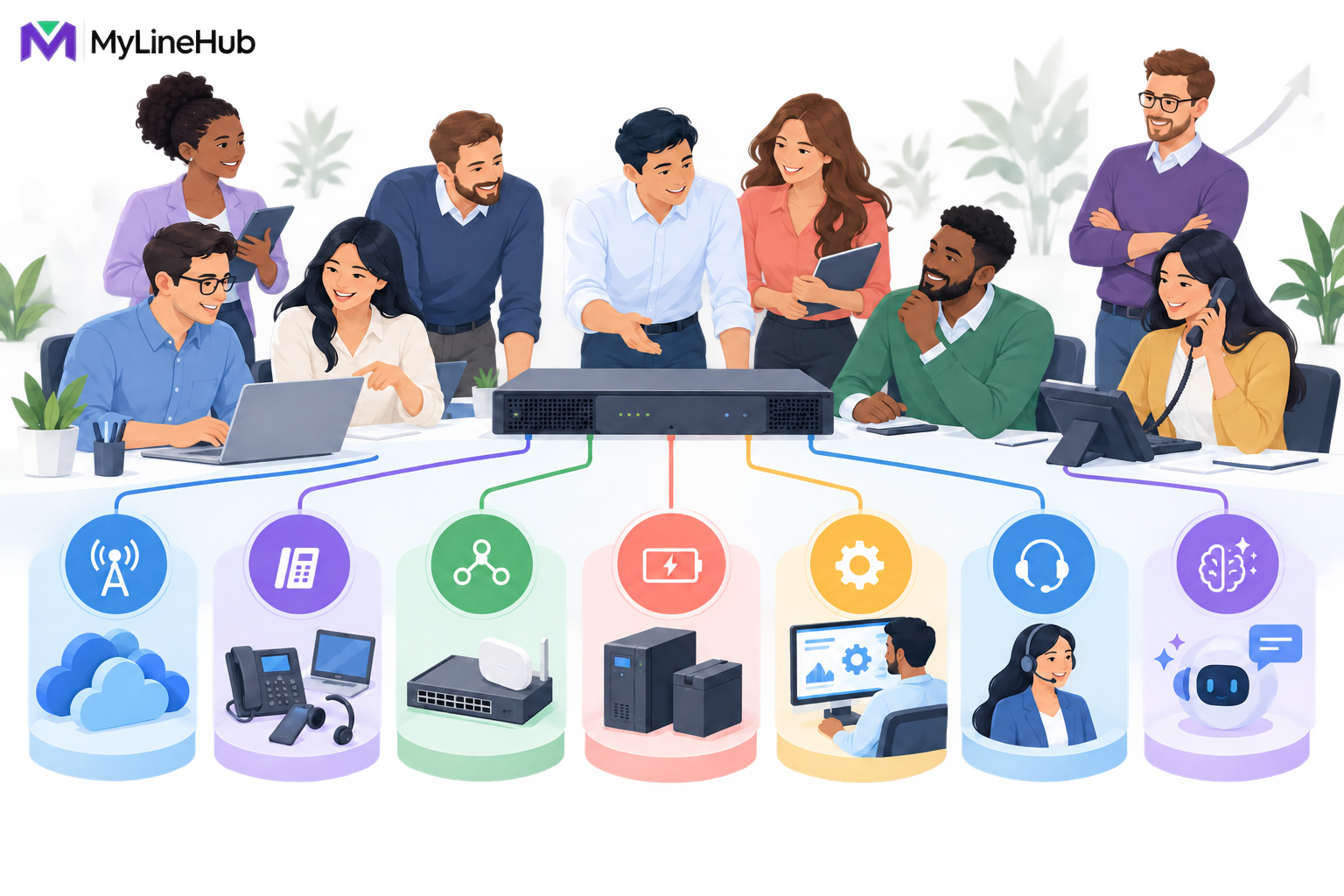
A twenty-user office calling system should be budgeted as a complete operating environment, not as one appliance purchase. The plan includes the current MYLO 20 offer, provider service, business numbers, external channel capacity, calling charges, employee phones or headsets, network improvements, power backup, recording storage, implementation, support, and any customer-funded AI-provider usage. A larger team also creates operational costs: user administration, spare devices, onboarding, supervision, and periodic capacity review. Twenty supported users do not mean twenty simultaneous external calls. Real concurrency depends on the provider contract, overlapping inbound and outbound work, available staff, and whether a workflow uses one or two external call legs. A useful budget therefore separates one-time purchases, recurring commitments, usage-based costs, and internal responsibilities.
MYLO 20 Is One Cost Layer
MYLO 20 provides a prepared local product boundary for a business that needs up to twenty supported users. The current package price belongs to the authoritative MYLO pricing page rather than this static article, because price is a time-sensitive commercial fact. Confirm the current appliance price, taxes, hardware specification, refurbished condition where applicable, warranty, delivery, included onboarding, and support terms from the quotation used for the purchase.
The appliance does not automatically include the telecom carrier, calling minutes, twenty desk phones, network upgrades, or unlimited implementation. Those elements are selected around the customer’s environment. A product photograph also does not add pictured accessories to the order; the invoice and packing list define what is physically supplied.
The broader open-source MyLineHub platform supports technical teams and custom deployments, but its wider capabilities are not automatically included in a fixed MYLO appliance. Multi-site architecture, unusual carrier integration, specialised CRM work, or requirements beyond twenty supported users should be assessed separately.
Provider Service and Calling Charges
A SIP trunk, business numbers, and calling minutes come from the selected telecom provider. Request a quotation that distinguishes activation, recurring trunk rental, DIDs, channel capacity, inbound and outbound tariffs, minimum commitments, authorised caller IDs, delivery method, and escalation arrangements.
Plan from the busiest realistic period rather than multiplying the user count by one. A twenty-person office may have only a few overlapping calls, while a smaller sales team may create concentrated outbound demand. Include normal inbound traffic, ordinary employee calls, and campaign activity in the same capacity model.
Call topology matters. A customer speaking to an office extension commonly uses one external provider leg. A flow connecting a customer phone to an agent mobile can use two. Five connected mobile-agent conversations may therefore consume ten external legs, subject to the provider’s definitions and supported design. The guide to users, extensions, channels, and concurrent calls explains why these numbers differ.
Employee Devices and Spares
Twenty employees do not necessarily need twenty identical phones. Build an endpoint inventory from actual jobs. Reception and supervisors may value dedicated IP phones. Computer-based agents may use managed USB headsets and softphones. Remote workers may use a supported mobile flow. Shared areas may need a device without requiring shared application credentials.
For each endpoint, include purchase price, compatibility checks, power needs, warranty, replacement, cleaning, and training. IP phones may require Power over Ethernet switching or individual adapters. Headsets fail and cables are damaged, so a small spare pool can reduce downtime.
Reusing existing computers can reduce starting cost, but the business still owns operating-system maintenance, security, microphone and audio quality, and network connectivity. A low-cost headset that produces fatigue or poor audio can create a larger productivity cost across a twenty-person team.
Network Readiness for a Growing Office
A twenty-user deployment benefits from documented switches, cabling, addressing, firewall policy, and Internet service. Voice quality depends on consistent delivery, not only headline bandwidth. Latency, jitter, packet loss, an overloaded upload path, or busy Wi-Fi can affect calls even when a speed test looks impressive.
Budget for a network assessment when the existing environment is unclear. Identify competing traffic such as cloud backup, video meetings, software updates, and guest Wi-Fi. Managed quality-of-service policy can help control local contention, but it cannot create missing carrier capacity or fix loss outside the office.
If the provider supplies a separate telecom-facing interface, preserve the documented topology and identify which appliance port connects to which network. A second Internet connection may improve resilience for some designs, but failover should be tested with the actual trunk rather than assumed.
Power, Placement, and Operational Resilience
Protect every powered component required for a call: the MYLO appliance, router, network switch, provider termination equipment, and powered desk phones. Calculate UPS or inverter capacity from the real equipment and desired runtime. Larger switches and a group of powered phones can materially increase the load.
Include battery replacement, surge protection, safe shutdown, and periodic testing in the operating budget. Place equipment in a ventilated and secure location with labelled cables. A twenty-user office can lose substantial productive time from one network or power failure, so resilience deserves its own cost line rather than being treated as an optional accessory.
Backup power cannot restore a failed carrier network. If continuity is important, document provider escalation and consider alternate connectivity or routing as separately scoped requirements.
Recording, Storage, and Data Responsibilities
If inbound, outbound, or campaign calls are recorded, estimate storage from actual volume, average duration, audio format, and retention period. Recording is a business decision with notice, access, retention, deletion, and security responsibilities; it is not simply a free technical checkbox.
Storage consumption accumulates. Someone must monitor available space, control authorised access, decide when recordings are no longer required, and operate any approved backup. A larger team can produce data quickly, especially during campaigns.
Legal and sector requirements vary, so the business should obtain appropriate advice rather than treating product capability as permission to record. The current MYLO package should also be checked for its supported storage and recording boundary before a long retention promise is made.
Implementation, Training, and Support
A twenty-user setup often has more departments, permissions, routes, devices, and procedures than a ten-user office. Budget time to collect provider details, define users and roles, configure the trunk, prepare inbound routes or IVRs, set up endpoints, test real calls, train the administrator, and document escalation.
Training should cover ordinary use and failure handling. Employees need to know how to identify their active device, report a call-quality problem, protect credentials, and follow the business process for missed calls or recordings. Administrators need a clear boundary between MYLO, the telecom provider, the office network, and custom support.
A guided session, product support, a defined implementation task, and custom engineering are different purchases. CRM integration, multi-site work, or specialised analytics should have separate prerequisites, outcomes, and acceptance evidence. Never assume that onboarding means unlimited configuration.
AI and Other Usage-Based Services
Where a supported workflow uses an external AI provider, the customer may supply its own provider account and pay that provider’s usage charges. Budgeting should consider expected use, provider limits, currency or tax treatment, and who will monitor the account. AI usage is separate from carrier calling charges.
The customer-controlled key should be entered only through the supported secure mechanism. AI can help understand a requirement or prepare a proposal, while deterministic services retain permission, validation, and execution responsibilities. Paying for more model usage does not increase trunk capacity or the supported user boundary.
Twenty-User Cost Worksheet
| Cost layer | One-time examples | Recurring or variable examples |
|---|---|---|
| Prepared product | MYLO 20 and delivery | Applicable support arrangement |
| Carrier | Activation and number porting | Trunk, DIDs, channels, and usage |
| User equipment | Phones, headsets, adapters, and spares | Replacement and remote connectivity |
| Network | Router, switch, cabling, and assessment | Internet and optional backup link |
| Power | UPS or inverter capacity | Battery testing and replacement |
| Data | Approved storage expansion | Backup and retention operations |
| Implementation | Setup, integration, testing, and training | Support and later change requests |
| External AI | Account preparation if applicable | Provider-billed model usage |
Add current quotations rather than guessed figures. Mark every line as required, optional, already owned, or awaiting confirmation. This makes comparisons with hosted services more honest because internal work and variable usage remain visible.
A Practical Growing-Team Example
A fifteen-person company expects to reach nineteen users. It has reception, sales, and support, and wants controlled outbound campaigns. It selects MYLO 20 for user headroom but estimates carrier capacity from busy-hour flows rather than buying twenty channels automatically.
The company reuses suitable computers, buys managed headsets and a few desk phones, adds spares, upgrades its switch, and protects the full calling chain with UPS power. A scoped implementation covers the trunk, IVR, roles, endpoint testing, campaign verification, and administrator handover. Provider charges, external AI usage, and a proposed CRM integration remain separate budget lines.
Because every cost has an owner, later changes are understandable. More call traffic affects the provider bill; longer retention affects storage; additional users affect devices and administration; custom workflow changes return to a defined engineering scope.
Final Decision Checklist
- Confirm the current MYLO 20 quotation and exact supplied items.
- Count named users and realistic near-term growth.
- Map busy-hour inbound, ordinary outbound, and campaign traffic.
- Price DIDs, channels, authorised caller IDs, and usage with the provider.
- Inventory user endpoints, adapters, licences if any, and spares.
- Assess cabling, switching, Internet quality, firewall policy, and failover.
- Size power backup for the complete call chain.
- Define recording purpose, access, retention, and storage ownership.
- Separate onboarding, continuing support, and custom development.
- Assign an internal administrator for approvals and provider coordination.
Compare this worksheet with the ten-user cost model and MYLO 10 versus MYLO 20. Current supplier, carrier, and implementation quotations remain the final authority.
Continue planning
Continue with What Is a Telephony Appliance for a Small Business?; Complete Cost of Starting a 10-User Office Calling System; What Internet Connection Does an Office Phone System Need?. For deeper implementation context, use MyLineHub technical architecture guidance.
Review current MYLO pricing, or discuss this requirement on WhatsApp.
Want to see API-driven CRM + Telecom workflows in action? Try the WhatsApp bot or explore the demos.
Comments (0)
Be the first to comment.