VoiceBridge vs AudioSocket Architectures — Latency, Quality, Complexity
A practical comparison of VoiceBridge and AudioSocket: duplex guarantees, latency behavior, codec handling, and operational complexity.
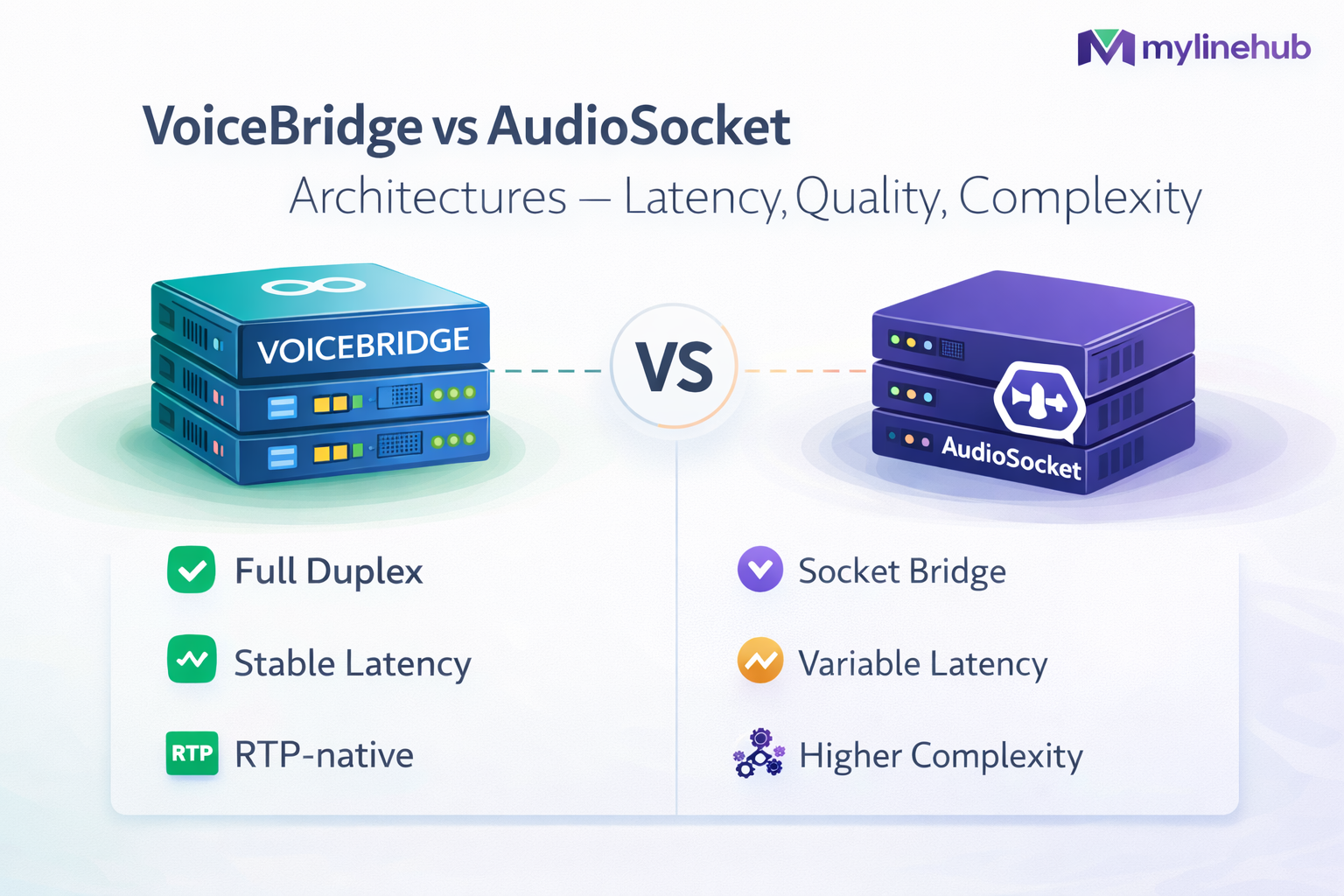
VoiceBridge vs AudioSocket Architectures — Latency, Quality, Complexity (Real Production Comparison)
Asterisk gives you multiple ways to “get audio out” for bots and automations. Two options come up often: ARI ExternalMedia (RTP) and AudioSocket. On paper, both can stream call audio to an external process. In production, they behave very differently across: latency, audio quality stability, duplex/talk-over correctness, NAT/firewall behavior, and operational complexity.
This article compares MYLINEHUB VoiceBridge (ARI + RTP done correctly) against “AudioSocket-style” designs, and explains why VoiceBridge is designed the way it is.
VoiceBridge repository:
https://github.com/mylinehub/omnichannel-crm/tree/main/mylinehub-voicebridge
Canonical architecture reference:
https://mylinehub.com/articles/mylinehub-voicebridge-architecture
Quick Definitions
What “VoiceBridge Architecture” means here
VoiceBridge is a Java service that connects to Asterisk/FreePBX using ARI, then creates a real-time media graph and runs a production-grade RTP pipeline to: (1) capture caller audio and (2) inject bot audio back with strict RTP correctness.
Key implementation areas in this project:
-
ARI & media graph:
src/main/java/com/mylinehub/voicebridge/ari/impl/AriBridgeImpl.java,src/main/java/com/mylinehub/voicebridge/ari/impl/ExternalMediaManagerImpl.java,src/main/java/com/mylinehub/voicebridge/ari/AriWsClient.java -
RTP engine:
src/main/java/com/mylinehub/voicebridge/rtp/RtpPacketizer.java,src/main/java/com/mylinehub/voicebridge/rtp/RtpSymmetricEndpoint.java,src/main/java/com/mylinehub/voicebridge/rtp/RtpPortAllocator.java -
Session lifecycle:
src/main/java/com/mylinehub/voicebridge/session/CallSession.java,src/main/java/com/mylinehub/voicebridge/session/CallSessionManager.java -
Realtime AI + truncation/barge-in control:
src/main/java/com/mylinehub/voicebridge/ai/RealtimeAiClient.java,src/main/java/com/mylinehub/voicebridge/ai/impl/RealtimeAiClientImpl.java,src/main/java/com/mylinehub/voicebridge/ai/impl/OpenAiRealtimeTruncateManager.java,src/main/java/com/mylinehub/voicebridge/ai/TruncateManager.java
What “AudioSocket” usually means architecturally
AudioSocket-style systems push audio frames over a long-lived socket (commonly TCP) to an external service. This can feel simpler because the “connection” is explicit and NAT traversal is often easier than raw UDP. But it introduces different latency failure modes (head-of-line blocking, backpressure coupling) and changes how you must design buffering, talk-over, and scaling.
The Core Architectural Difference: RTP Duplex vs Socket Duplex
VoiceBridge: two RTP legs with telecom timing discipline
VoiceBridge treats duplex as a telecom problem: RTP has strict expectations—payload types, timestamps, sequence numbers, packet pacing—and Asterisk’s media path will degrade fast when these are violated.
In VoiceBridge, RTP is not “UDP bytes”. It is a modeled, controlled stream:
-
RtpPacketizer.javabuilds RTP packets correctly (headers, sequencing, timestamps, pacing) -
RtpSymmetricEndpoint.javalearns the true remote endpoint and replies symmetrically (NAT-safe) -
RtpPortAllocator.javaallocates ports deterministically for concurrency and firewall stability
AudioSocket: a single ordered stream that couples transport to audio timing
With AudioSocket designs, your audio frames typically travel over an ordered stream. That changes the failure model:
- One delayed packet delays everything behind it (head-of-line blocking)
- Backpressure becomes audio jitter if the receiver slows down
- CPU spikes in your bot can stall audio delivery even if the network is fine
You can mitigate these, but you must design buffering and scheduling carefully. “Simpler transport” often becomes “harder real-time behavior” once you scale.
Latency: Where the Milliseconds Actually Go
For conversational voice, perceived quality depends more on tail latency than average latency. A design that has a nice average but occasional spikes will feel “robotic”, talk-over prone, and frustrating.
VoiceBridge latency profile
VoiceBridge latency is shaped by packet pacing + jitter strategy + AI response streaming. The system is intentionally built to keep the RTP timeline stable even when upstream AI has variance.
-
RTP pacing discipline lives in
rtp/RtpPacketizer.java(you must send at the codec’s expected frame rate; bursty sends create jitterbuffer pain) -
Jitter/drift concepts and interpolation notes are captured in docs like
docs/interpolation.mdanddocs/codec_sampling.md -
AI truncation for barge-in reduces “talk-over latency” (time to stop speaking after caller interrupts) via
ai/impl/OpenAiRealtimeTruncateManager.java
The key idea: VoiceBridge isolates the RTP clock from the AI clock. AI can be bursty; RTP must remain steady.
AudioSocket latency profile
AudioSocket latency is often “fine” until the external socket path experiences:
- GC pauses / CPU spikes in the bot service
- Thread scheduling stalls
- Network congestion that slows the stream
Because frames are ordered, any stall can inflate end-to-end latency. To keep it conversational you typically need:
- Strict non-blocking IO and bounded queues
- Separate threads for read/write and audio scheduling
- Drop/truncate policies (you cannot “catch up” by sending faster without creating artifacts)
Audio Quality: Why “It Plays Audio” Is Not the Same as “It Sounds Natural”
VoiceBridge: codec correctness + stable RTP timeline
In telephony, “quality” is usually lost due to timeline problems: drift, jitter, timestamp mistakes, payload mismatch, or inconsistent packet pacing. VoiceBridge’s RTP layer is explicitly designed to avoid these.
Codec conversion and framing decisions are treated as first-class technical concerns and documented:
docs/ulaw-to-pcm16-theory.mddocs/opus-to-pcm16-theory.mddocs/codec_sampling.md
If your AI prefers PCM16 while Asterisk speaks PCMU (common case), you must preserve framing consistency. VoiceBridge’s approach is: convert cleanly, then re-packetize with correct RTP pacing.
AudioSocket: “frame delivery” is easier, but real-time quality still depends on scheduling
Many AudioSocket implementations feel “clean” initially because they avoid RTP header work. But quality issues appear when:
- frames arrive late (buffer underrun → choppy speech)
- frames arrive in bursts (buffer overrun → jitter / talk-over delay)
- bot compute spikes cause output stalls
So you still need a real-time scheduler and a jitter strategy—just at the application layer instead of RTP. That work doesn’t disappear; it moves.
Duplex + Barge-In: The Hardest Part (And Where Architectures Diverge)
“Full duplex” for AI calling is not just hearing and speaking at once. It also means: interruptions must work. The caller must be able to talk while the bot is speaking, and the bot must stop quickly and respond naturally.
VoiceBridge: duplex is built into the call session model
VoiceBridge uses explicit call session state to coordinate: incoming audio, outgoing audio, AI stream state, and truncation rules.
-
Call lifecycle:
session/CallSession.java,session/CallSessionManager.java -
AI streaming:
ai/RealtimeAiClient.java,ai/impl/RealtimeAiClientImpl.java -
Fast stop/truncate:
ai/impl/OpenAiRealtimeTruncateManager.java,ai/TruncateManager.java
This is crucial: truncation is not a UI feature. It is a media control feature. If your architecture cannot stop sending bot audio immediately, callers experience “talk-over”.
AudioSocket: barge-in depends heavily on your buffering policy
In AudioSocket designs, you typically buffer audio for smoothness. That buffer creates a tradeoff:
- More buffer → smoother playback but slower barge-in (bot keeps talking after caller interrupts)
- Less buffer → faster barge-in but higher risk of choppiness under load
You can build good barge-in on AudioSocket, but it demands careful queue discipline and “drop/truncate” policies that many demo implementations skip.
Scaling: What Happens at 100–500 Concurrent Calls
Scaling is where most “working” integrations collapse. The question is not just CPU usage—it’s:
- Can you allocate media resources deterministically per call?
- Can you debug and attribute failures to specific calls?
- Can you firewall and secure the media surface area cleanly?
- Can you restart services without undefined call state?
VoiceBridge scaling characteristics
-
Deterministic RTP port management via
rtp/RtpPortAllocator.java(stable firewall rules, predictable capacity planning) -
NAT-safe “reply where you received from” behavior via
rtp/RtpSymmetricEndpoint.java(reduces one-way audio incidents across mixed networks) -
Service deployment is explicit:
docker/Dockerfile,docker-compose.yml,.env.example, and runtime knobs insrc/main/resources/application.properties -
Call state is not ephemeral:
session/CallSessionManager.javaowns lifecycle and cleanup
AudioSocket scaling characteristics
AudioSocket scaling depends on how you architect your socket servers:
- Do you keep one long-lived connection per call?
- Do you multiplex calls over fewer connections?
- How do you shard across workers without breaking “session pinning”?
If you use TCP per call, you often hit OS limits (FDs, buffers) and must tune aggressively. If you multiplex, you must implement robust framing and isolation to avoid cross-call interference.
Operational Complexity: “Simpler API” vs “Simpler System”
A common trap: AudioSocket looks simpler because you avoid RTP headers and UDP NAT pain. But production systems are judged on incident rates and diagnosability, not developer comfort on day 1.
VoiceBridge complexity (where it lives)
- RTP correctness is implemented once (packetizer, endpoint learning, allocator)
- ARI media graph is implemented intentionally (bridge manager, external media manager)
- Session lifecycle is explicit (create, run, cleanup)
That complexity is “contained” inside the VoiceBridge service and reused across all deployments.
AudioSocket complexity (where it tends to spread)
- Buffering strategy becomes application-specific
- Backpressure behavior becomes tightly coupled to AI compute performance
- Scaling often requires custom sharding, connection management, and tuning
Many teams discover they rebuilt a real-time media scheduler in the bot process—just not using RTP.
Security & Network Surfaces
Voice systems fail in production not only from bugs but from exposure: open UDP ranges, weak ARI credentials, accidental public media ports, and unclear isolation boundaries.
VoiceBridge: explicit “telecom firewall posture”
VoiceBridge is designed to run as a controlled service with known ports and explicit configuration:
-
Configuration guidance lives in:
docs/mylinehub-asterisk-config.md,docs/mylinehub-freepbx-config.md,docs/enable_ari.md -
Runtime configuration lives in
src/main/resources/application.propertiesand environment templates like.env.example
AudioSocket: fewer UDP issues, but TCP exposure and resource attacks matter
A socket-based media interface typically means:
- You expose a TCP listener (or connect outbound to one)
- You must rate-limit, authenticate, and handle slowloris/backpressure patterns
- You must ensure one call cannot starve others by forcing congestion
It is not “more secure by default”. It is “different security work”.
When AudioSocket Can Be a Good Fit
AudioSocket-style designs can be a good fit when:
- You control the network and want to avoid UDP/NAT issues entirely
- You are okay with slightly higher tail-latency risk for simpler connectivity
- You build strong buffering + drop policies and accept the complexity in the bot layer
In other words: AudioSocket can work well for controlled environments and disciplined real-time engineering. Many “samples” skip that discipline.
Why VoiceBridge Chooses RTP + ARI ExternalMedia (Even Though It’s Hard)
VoiceBridge chooses RTP because it aligns with telecom reality: Asterisk speaks RTP, carriers speak RTP, and the ecosystem of debugging tools (Wireshark, RTP stats, jitter models) is built around RTP.
The hard parts—timing discipline, NAT symmetry, port planning—are implemented inside the service so you can run it reliably:
rtp/RtpPacketizer.java— correct packetizationrtp/RtpSymmetricEndpoint.java— NAT-safe routingrtp/RtpPortAllocator.java— concurrency and firewall planningari/impl/AriBridgeImpl.java+ari/impl/ExternalMediaManagerImpl.java— correct media graphsession/CallSessionManager.java— lifecycle and cleanupai/impl/OpenAiRealtimeTruncateManager.java— barge-in and truncation control
Bottom Line
AudioSocket often feels simpler because it hides RTP, but it pushes real-time complexity into buffering, backpressure, and scaling of the socket layer.
VoiceBridge accepts RTP complexity up-front and implements it properly in a reusable Java service, keeping the media timeline stable, NAT-safe, scalable, and compatible with telecom debugging and operations.
If your goal is natural real-time duplex AI voice (with interruptions, low tail latency, and production stability), the decisive factor is not “which API is easier”, it’s “which architecture keeps the audio clock stable under stress”.
Repo: https://github.com/mylinehub/omnichannel-crm/tree/main/mylinehub-voicebridge
Want to see API-driven CRM + Telecom workflows in action? Try the WhatsApp bot or explore the demos.
Comments (0)
Be the first to comment.