Why an IVR Campaign Has Different Capacity From a Human Campaign
An IVR campaign has different capacity from a human campaign because it does not need to reserve one person for every active customer conversation.
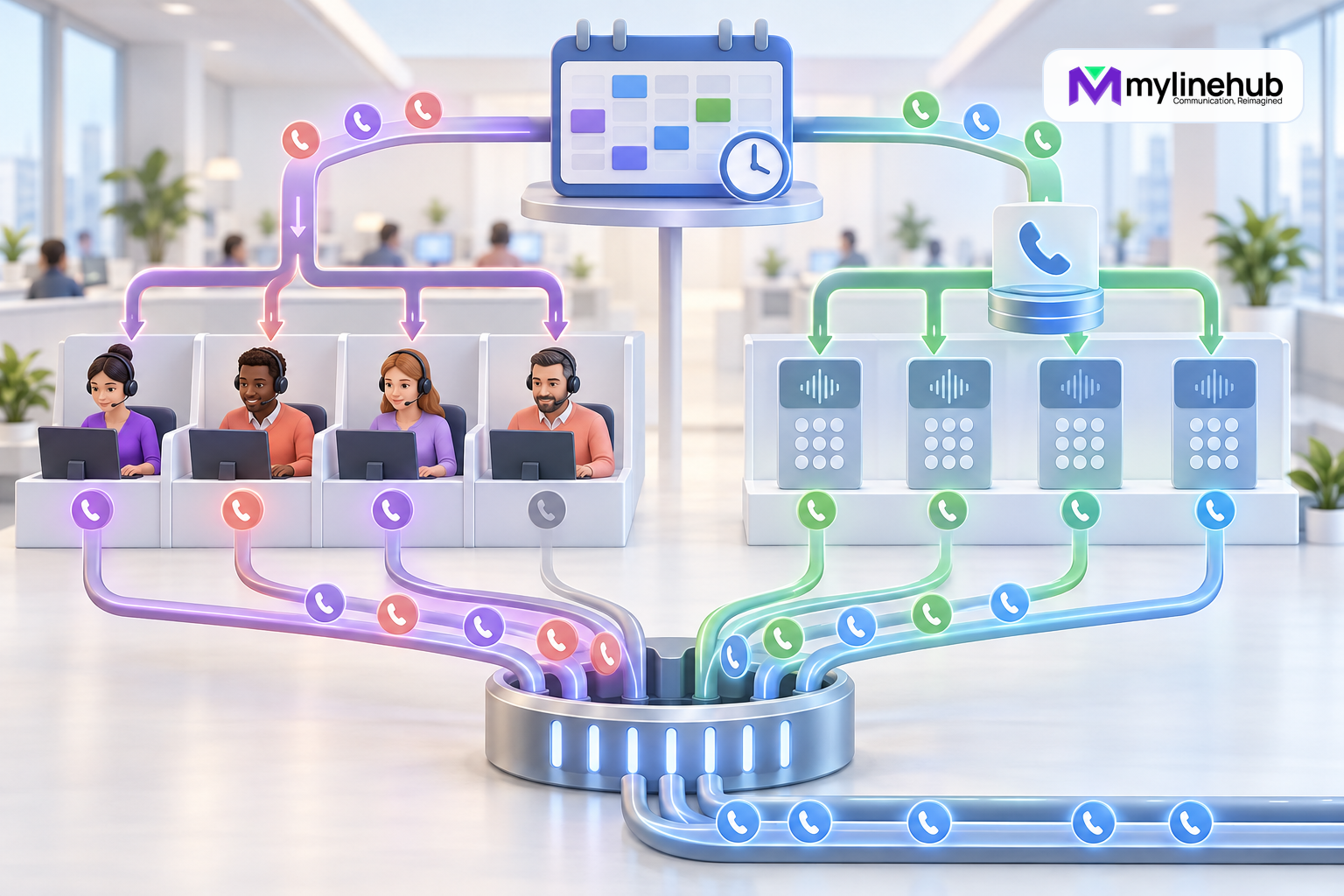
An IVR campaign has different capacity from a human campaign because it does not need to reserve one person for every active customer conversation. The same configured IVR can serve several independent calls at once when the appliance, trunk channels, media resources, caller-ID pool, and campaign policy allow it. A human agent, by contrast, normally handles one active conversation at a time, and a two-leg flow must wait for an eligible person. This does not make IVR capacity unlimited or make automated outreach automatically appropriate. MYLO’s deterministic scheduler should admit only work supported by current resources and pacing. The customer remains responsible for lawful contact, consent or preference requirements, prompt accuracy, DTMF choices, accessibility, provider capacity, privacy, and a genuine response process.
No Human Reservation for Each Call
A customer-to-IVR flow calls the customer and, after the configured answer condition, enters an automated menu or prompt. There is no second agent leg and no requirement to keep a person free for that call. Several customers can therefore interact with separate instances of the same IVR logic concurrently.
The IVR itself is a configuration, not a single person who becomes busy. Each live call still consumes call-processing, media, and provider resources. If the menu transfers to a human or external destination, additional resource and staffing rules apply at that point.
Human Campaign Capacity
Human campaigns connect a customer to an agent extension or mobile. Each active conversation requires one available person. Connection order can be customer-first or agent-first, but the scheduler must coordinate both legs and avoid leaving a customer waiting without a ready destination.
Five available agents may provide five human lanes if trunk channels and other resources permit. When agents pause, log out, become unreachable, or remain in a pacing period, safe capacity falls. A large lead list cannot replace those people.
Trunk Channels Still Bound IVR Concurrency
Each active customer call normally uses an external provider leg. If the trunk has ten usable channels and policy reserves capacity for inbound service, the campaign cannot safely consume all ten merely because the IVR can run several sessions. Other live calls and provider restrictions must be included in admission.
Provider capacity, appliance capacity, and campaign capacity are separate. The smallest current limit controls. Channel contracts also do not guarantee sufficient network quality, codec resources, storage for recordings, or successful delivery to every destination.
Media and DTMF Are Per-Call Work
Every IVR call plays audio and may receive keypad digits. Concurrent calls create concurrent media streams, file access, DTMF handling, events, and possibly recordings. CPU, memory, disk, network, and Asterisk limits matter even without agents.
Test the actual prompt formats, codecs, and provider path. A system that plays one prompt correctly may behave differently under controlled concurrency. DTMF must work independently on each call, and one caller’s state must never affect another’s branch.
Pacing Is Still Necessary
The absence of human agents does not justify releasing a large burst. Pacing protects the provider path, appliance, customer experience, and operational team. It also helps keep answer and response events within a rate the system can record and reconcile reliably.
IVR pacing is a campaign-level deterministic policy based on current capacity and recent work, rather than an agent-specific recovery clock. The exact supported controls should come from the current MYLO product. An LLM should not decide how many calls to launch in the live hot loop.
Prompt Length Changes Occupancy
A one-minute reminder occupies a channel longer than a ten-second confirmation, and a multi-question survey may remain active longer still. Capacity planning should consider average and peak call duration, not only calls per hour. Longer calls reduce how quickly channels become available for the next lead.
Keep prompts concise and give callers a clear outcome. Do not use a long automated call to collect sensitive information without suitable authentication and policy. If the IVR offers transfer to a person, define the capacity and fallback before advertising that choice.
Example: Appointment Confirmation
A clinic uses an authorised list for appointment reminders. The IVR states the approved message and offers a small set of confirmation choices. The provider supplies enough channels for a controlled number of concurrent calls, while the capacity policy preserves inbound access. No human is reserved for ordinary confirmations.
If the caller requests staff assistance, the flow follows a separately designed destination with its own hours and capacity. MYLO records the telephony result and keypad outcome according to the supported campaign model. The clinic remains responsible for patient privacy, appropriate notice, consent or lawful basis, suppression, and follow-up.
Answer Detection and Outcomes
A connected network call is not always a human listening; voicemail or another automated service may answer. The campaign should use the supported answer and IVR entry rules and report what it actually knows. It should not claim a reminder was understood merely because audio played.
Define meaningful results such as valid selection, no input, invalid input, hangup before completion, provider failure, and final attempt status. Business systems should interpret those results cautiously. A keypad choice can be useful evidence but may not prove identity or legal acceptance.
Failure Isolation and Pause
If prompts fail, DTMF stops working, error rates rise, storage approaches a limit, or the provider rejects calls, the campaign should slow or pause under deterministic policy. Existing calls should complete safely where possible, while new lead admission stops.
Operators need evidence that distinguishes list errors, provider rejections, media failures, and application issues. Restart recovery should reconcile active and incomplete attempts before new calls begin, preventing duplicate outreach after an interruption.
MYLO, Provider, and Customer Boundaries
MYLO manages supported preparation, deterministic capacity admission, pacing, attempt state, pause, recovery, and reporting. Asterisk executes the live IVR call. The provider supplies external delivery and channels. None of these roles supplies lawful permission to contact the audience.
The customer owns the list, message, choices, schedule, notices, response process, data handling, and compliance. Custom speech recognition, payment collection, CRM transactions, or specialised surveys may require separately scoped MyLineHub engineering rather than being assumed from basic IVR capability.
IVR Capacity Checklist
- Confirm the IVR campaign has an authorised purpose and audience.
- Count provider channels and preserve required inbound headroom.
- Confirm appliance, media, network, storage, and recording limits.
- Estimate occupancy from prompt length and expected interactions.
- Set deterministic campaign pacing and concurrency boundaries.
- Test prompt playback and DTMF on concurrent external calls.
- Define no input, invalid input, hangup, and provider-failure results.
- Provide capacity and fallback for any human transfer.
- Pause on defined safety or failure signals.
- Increase accepted capacity only through controlled testing.
IVR removes the one-person-per-call constraint, not every constraint. Safe capacity is the number of complete automated conversations the current end-to-end system can support and verify without harming other services.
Find a Tested IVR Operating Envelope
Establish capacity through staged tests rather than a single vendor number. Start with one authorised destination, confirm prompt, DTMF, outcome, recording choice, and hangup, then add controlled concurrent calls. Observe provider channels, Asterisk call state, CPU, memory, network, media quality, storage, event processing, and inbound availability.
Record the highest level that meets defined thresholds with reserve. The accepted campaign limit should remain below a point where audio degrades, events lag, disk fills too quickly, or inbound service is threatened. Different prompts, codecs, recordings, providers, and transfer paths may require separate acceptance.
Protect callers during overload
When capacity is unavailable, keep leads pending rather than originating calls that cannot reach a complete IVR experience. Do not answer and then play silence or terminate because a media resource was never reserved. Existing calls should retain priority over speculative new work under the approved capacity policy.
Review business throughput, not only call starts
A high origination rate can produce poor outcomes if callers abandon, digits fail, or follow-up teams cannot process responses. Compare successful completed interactions and business follow-up with the raw attempt count. The best pace is the one the entire service can absorb accurately and lawfully.
When Human Follow-Up Becomes the Bottleneck
An IVR may collect confirmations or callback requests faster than staff can process them. Capacity planning should include the downstream workload, not only concurrent calls. Limit origination so requests remain timely and accurate, and define what happens when the follow-up queue reaches its safe boundary.
If a caller selects an option requiring a person, state realistic expectations and preserve the response as operational work. Do not describe automated completion as customer resolution when a human action is still pending. Campaign reports should separate IVR interaction outcomes from completed business follow-up.
Continue planning
Continue with Five Ways MYLO Connects Agents and Customers; How Multiple Agents Increase Campaign Capacity; What Is Per-Agent Pacing in an Outbound Campaign?. For deeper implementation context, use MyLineHub technical architecture guidance.
For a requirement outside the prepared MYLO scope, discuss the exact outcome with MyLineHub.
Want to see API-driven CRM + Telecom workflows in action? Try the WhatsApp bot or explore the demos.
Comments (0)
Be the first to comment.