Can I Change My Phone Setup Later Just by Asking MYLO?
Business requirements change. Learn how a user can describe a change to MYLO in normal language while MYLO inspects the current setup, gathers missing details and uses the controlled change process.
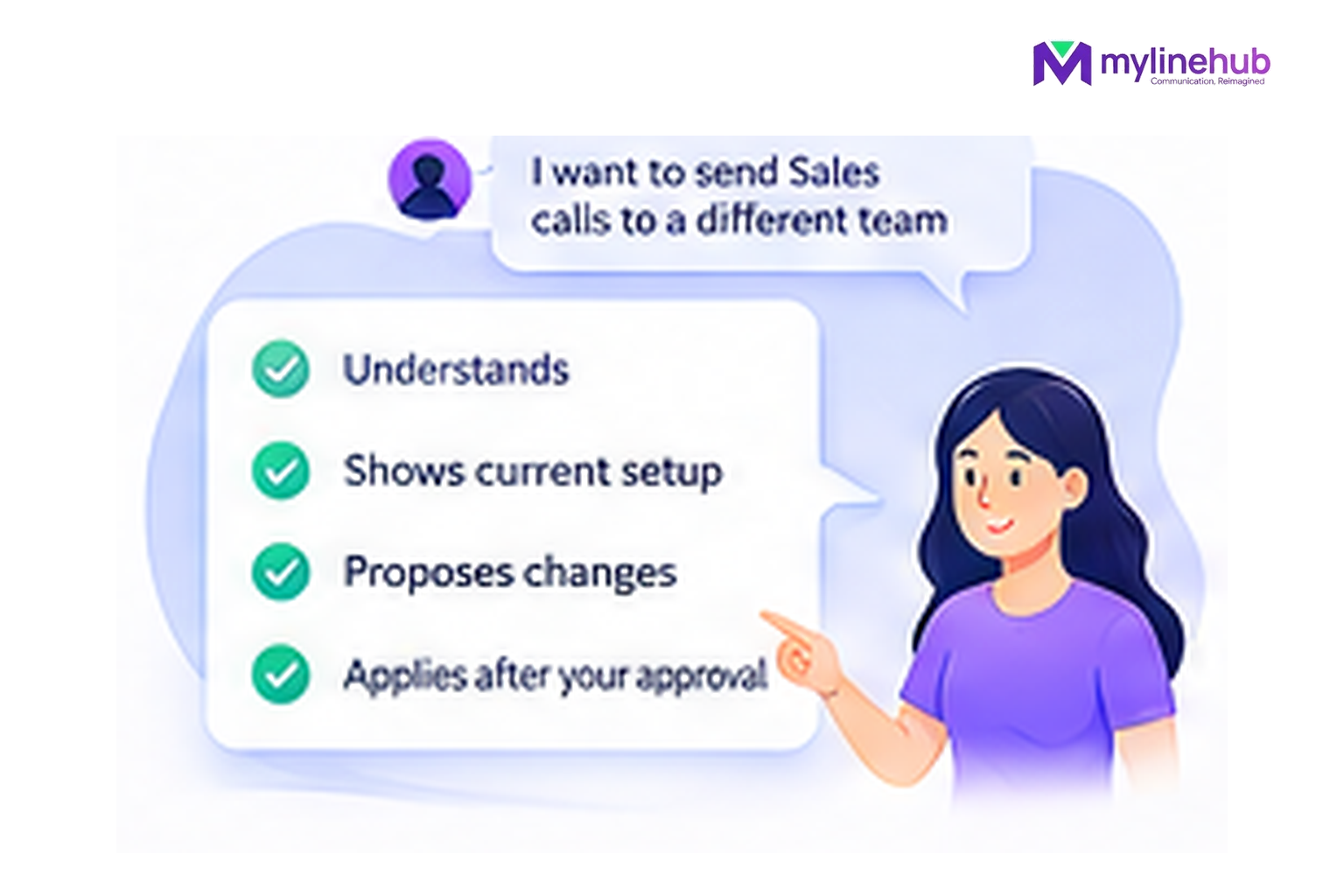
Yes. MYLO is intended to make later changes conversational as well as initial setup. A user can describe the new business requirement, while MYLO reads the current authorised state, identifies what information is missing and prepares the supported change for review rather than assuming the old configuration should simply be overwritten.
Quick answer
- Start from the business outcome; MYLO uses conversation to gather or clarify the information it needs.
- Consequential telephony work stays inside the product's permissions, validation and approval boundaries.
- The telecom provider remains responsible for public numbers, carrier service, capacity and provider-side conditions.
A safe change has more than one step
| Decision | What it means |
|---|---|
| Understand | MYLO interprets the requested business outcome |
| Inspect | Current Asterisk/application state is checked |
| Protect | Approval and backup boundaries apply where required |
| Verify | The result is tested instead of assumed |
A Change Can Begin With a Business Request
“Support calls should go to a different employee from Monday.”
The useful information is the desired outcome. MYLO can work out which specialist domain is relevant and ask which number, destination or schedule is involved. The customer does not need to start by locating an Asterisk file.
MYLO Looks at What Exists Before Proposing What Changes
The product architecture keeps Asterisk configuration as the authority for trunks, telephone profiles, routes and IVRs. That means a reconfiguration flow should be based on the current working state, not an old note or a duplicate copy in the application database. This reduces the chance that a later change unknowingly destroys a working setting.
Important Changes Still Have a Safety Boundary
The chat layer does not bypass permissions. Mutating tools are restricted to the approved operation pipeline. The v0.35 help text describes the sequence in business terms: validate and show the structured operation, approve, back up affected Asterisk files, apply atomically, reload, verify and roll back on failure.
Read why MYLO shows a proposal and how backups protect a change for the deeper safety story.
Changing the Requirement Does Not Mean Starting Over
Because conversations, operation history and the authoritative telephony state remain available, a later task can focus on the specific business change. MYLO is not “learning” by silently changing rules on its own; it can retain approved conversation context and verified privacy-safe lessons, while authority for what it may change remains bounded by the product registries and approval system.
Continue From Here
Custom Requirements and Telecom Responsibility
MYLO configures and operates the customer's local telephony layer; it is not the telecom carrier. Numbers, trunk service, calling charges and provider-side permissions remain with the customer's telecom provider. Where a requirement sits outside the standard MYLO package, MyLineHub can discuss it as a Custom Requirement.
Customisation does not override telecom-provider conditions, customer-consent obligations or applicable Indian telecom requirements. The final calling design must use services and number-routing methods that the business is permitted to use.
Want to see API-driven CRM + Telecom workflows in action? Try the WhatsApp bot or explore the demos.
Comments (0)
Be the first to comment.