How Does MYLO Know a Phone Setup Actually Works?
Saving a configuration is not the same as proving a phone system works. See how MYLO treats validation, verification and functional testing as part of completing telephony work.
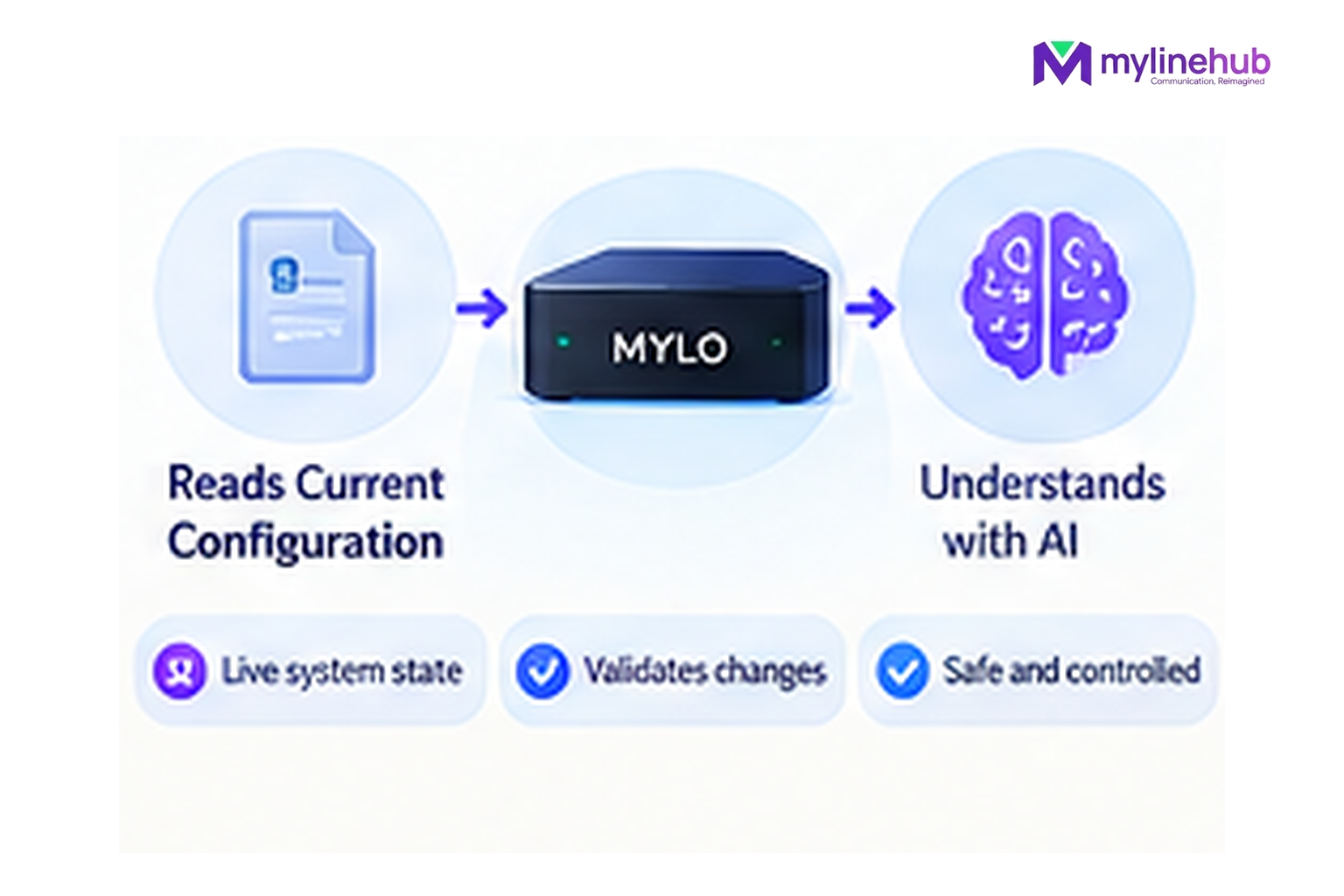
MYLO does not treat “the file saved successfully” as proof that a business call works. v0.35 separates configuration validation from runtime verification and includes a guided test-call stage so the final evidence can come from the actual call path.
Quick answer
- Start from the business outcome; MYLO uses conversation to gather or clarify the information it needs.
- Consequential telephony work stays inside the product's permissions, validation and approval boundaries.
- The telecom provider remains responsible for public numbers, carrier service, capacity and provider-side conditions.
Saved is not the same as working
| Decision | What it means |
|---|---|
| Configuration saved | The intended settings exist. |
| Service validation | Syntax/state checks pass. |
| Runtime evidence | Asterisk/provider path is observed where applicable. |
| Functional test | A representative real call proves the customer journey. |
First Check: Is the Proposed Configuration Structurally Valid?
Before an approved change is applied, deterministic validation checks the relevant configuration and policy constraints. This catches errors that can be identified locally before risking a reload.
Second Check: Did the Local Telephony Service Accept the Change?
After an approved atomic write, MYLO can reload and verify the local Asterisk state using its allowlisted local command boundary. Asterisk remains the authority for live trunks, routes, IVRs and telephone profiles; the application database does not pretend to be a second PBX configuration.
Third Check: Can a Real Call Complete?
For initial setup, MYLO includes a test-call stage. The local callback/event path records dial status and outcome; an answered test call can complete the onboarding test stage. This is much stronger evidence than a green “saved” banner.
The existing guide Why an inbound route must be tested with a real call applies the same principle to incoming calling.
Be Precise About What v0.35 Has Proved
The source package states that the architecture and local simulation are tested, while real Ubuntu/Asterisk operation, carrier calls, registration, recording and reboot persistence still require target-appliance checks. Therefore these articles describe implemented product behaviour without claiming that a simulation proves every carrier environment. Production acceptance should include the real provider and appliance.
Continue From Here
Custom Requirements and Telecom Responsibility
MYLO configures and operates the customer's local telephony layer; it is not the telecom carrier. Numbers, trunk service, calling charges and provider-side permissions remain with the customer's telecom provider. Where a requirement sits outside the standard MYLO package, MyLineHub can discuss it as a Custom Requirement.
Customisation does not override telecom-provider conditions, customer-consent obligations or applicable Indian telecom requirements. The final calling design must use services and number-routing methods that the business is permitted to use.
Want to see API-driven CRM + Telecom workflows in action? Try the WhatsApp bot or explore the demos.
Comments (0)
Be the first to comment.