FreeSWITCH Event Socket vs Asterisk AMI and ARI
FreeSWITCH's Event Socket and Asterisk's AMI and ARI let external software observe or control telephony, but they divide responsibilities differently.
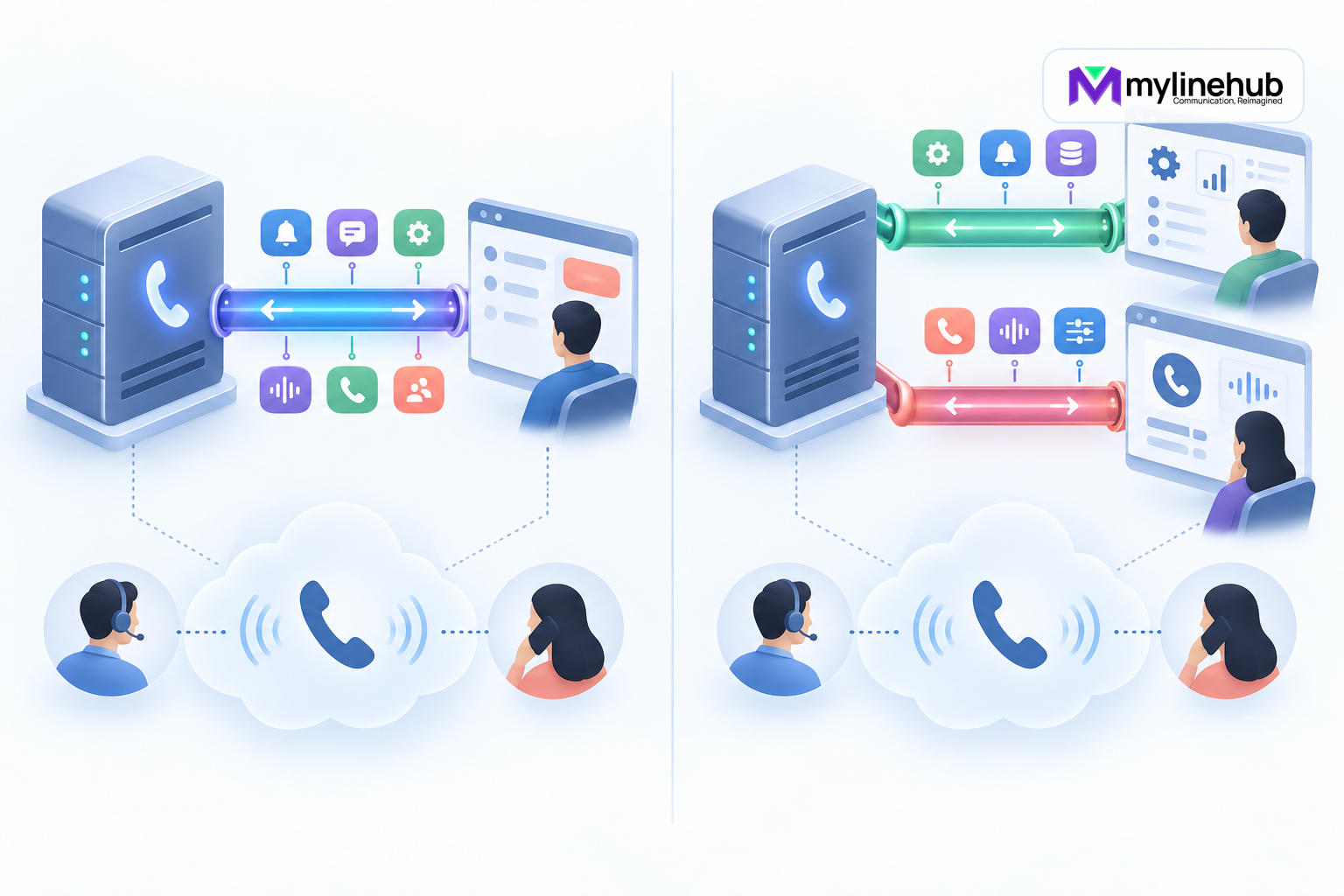
FreeSWITCH's Event Socket and Asterisk's AMI and ARI let external software observe or control telephony, but they divide responsibilities differently. The Event Socket combines commands, events, and call control through one protocol family. Asterisk offers AMI for management actions and event streams, while ARI provides application-level control over channels, bridges, media, and other resources handed to a Stasis application. Architecture should begin with the workflow and failure model, not an assumption that these interfaces are interchangeable.
What external control changes
A normal dialplan can make deterministic decisions inside the telephony engine. An external controller introduces another process, authentication boundary, network path, state store, deployment cycle, and failure mode. That can be worthwhile when calls depend on customer records, distributed workflows, or a product application. It also means the design must say what happens if the controller is slow, unreachable, restarted, or working with stale state.
Do not move logic outside the switch merely because an API exists. Stable routing, emergency restrictions, and safe fallbacks are often best kept local. External control is strongest when it owns a defined application journey and the dialplan provides a bounded handoff plus deterministic failure behavior.
FreeSWITCH Event Socket
The FreeSWITCH Event Socket is provided by mod_event_socket. It exposes API commands, real-time events, call origination, channel manipulation, DTMF, media control, and related capabilities over a TCP-based protocol. Clients use the Event Socket Library protocol directly or through a compatible library.
Inbound mode means an external application connects to FreeSWITCH. It can subscribe to selected events, execute commands, originate calls, inspect state, and control sessions for which it has identifiers and permission. The standard FreeSWITCH command-line client uses this mode, illustrating how broad the management surface can be.
Outbound mode reverses the connection for a particular call leg. The dialplan invokes the socket application, and FreeSWITCH connects to an external controller and hands that session to it. This can support application-driven IVR or call treatment. The controller must handle timing, connection loss, and hangup correctly because it participates directly in a live call.
Asterisk Manager Interface
AMI is Asterisk's management interface. A client authenticates, sends actions, and receives asynchronous events. It is commonly used for operational integration: originate a call, monitor channels, observe queue or endpoint activity, request information, and react to state changes. Events and action responses require correlation because many activities can happen concurrently.
AMI is powerful and should be treated as an administrative surface. A client should receive only the privileges it requires, connect over a protected network path, and filter the events it needs. Using one unrestricted account for every integration increases impact if a credential leaks or an application behaves incorrectly.
AMI can influence calls, but it is not automatically the best abstraction for building a complete media application. A design that reconstructs complex channel state solely from a large management event stream can become fragile. That is one reason Asterisk also offers ARI.
Asterisk REST Interface
ARI exposes resources such as channels and bridges through HTTP and delivers events through a WebSocket. A channel enters external application control when the dialplan sends it to a named Stasis application. The application can then create or manipulate bridges, play or record media, originate channels, and coordinate a live call using ARI's resource model.
ARI is therefore suited to purpose-built communications applications where software deliberately owns part of the call journey. The dialplan still determines when control is handed over and what happens before or after. ARI is not a replacement for every dialplan rule, nor should every administrative task become a Stasis application.
One interface family versus two roles
The Event Socket presents a broad command-and-event mechanism that supports general management and per-call control. The operational distinction is expressed through connection mode, permissions, subscriptions, commands, and application design. Asterisk makes a clearer interface-level distinction: AMI centers on manager actions and events, while ARI centers on resource-oriented application control.
This does not mean one platform has one capability and the other has two. It means boundaries appear in different places. A FreeSWITCH team may use separate Event Socket accounts, network paths, services, and inbound or outbound patterns. An Asterisk team may use AMI for monitoring and origination while a separate ARI application owns live media and bridges.
Choose by workflow
For a wallboard or operations monitor, event consumption with minimal command privileges is appropriate. For click-to-call, a constrained originate operation plus reliable outcome events may be enough. For an application-controlled IVR, conferencing product, or dynamic call orchestration service, direct live-call control is more appropriate. Static office routing may need no external controller.
Write the state machine before selecting the interface. Define who owns each channel, which component may answer or hang up, how two legs are correlated, when control returns to the dialplan, and what survives a process restart. If two applications can issue conflicting commands to the same call, the ownership model is incomplete.
Events are evidence, not automatically outcomes
Telephony engines emit low-level events for channel creation, progress, answer, application execution, bridge changes, DTMF, and hangup. A business result such as “customer connected to an agent” may require several correlated events across multiple legs. A single answered channel does not always prove that the intended conversation occurred.
Assign a durable application correlation identifier at the beginning of a workflow. Preserve engine identifiers for each channel and bridge. Consume events idempotently because reconnects and retries can otherwise create duplicate business actions. Store the raw technical outcome separately from the interpreted customer or campaign outcome.
Commands need acknowledgement and reconciliation
A command response may confirm acceptance without proving the requested business outcome. Origination can be accepted and later fail. A bridge command can race with hangup. A transfer can target a route that subsequently rejects the call. Track the later events that prove completion and define a timeout for uncertainty.
If acknowledgement is lost, do not blindly repeat a destructive operation. First query current engine state or reconcile from events. Originate, transfer, recording, and hangup actions need idempotency keys or business rules that prevent duplicates.
Connection loss and restart behavior
Every controller needs a documented disconnect policy. If an inbound Event Socket client disappears, FreeSWITCH continues running, but the application must reconcile after reconnecting. If an outbound socket controlling a call disappears, dialplan and socket behavior determine what follows; design this deliberately. If an AMI client reconnects, it must rebuild its view rather than assuming no events were missed. An ARI application must define what happens to channels when its WebSocket or process fails.
Persist only the business state required for recovery, and query the engine for current technical state where possible. On restart, distinguish active, completed, and uncertain work. A campaign must not call a customer twice merely because an agent-side operation or controller acknowledgement failed.
Security boundaries
- Bind control interfaces to management networks or loopback where architecture permits.
- Use unique application credentials and least privileges.
- Protect transport with suitable encryption or a secured private path.
- Restrict source addresses and rate-limit failed authentication.
- Keep SIP credentials, API secrets, and customer data out of logs, examples, chats, and AI prompts.
- Allow-list operations rather than exposing a generic command console to business applications.
- Audit who initiated sensitive actions and retain sanitized correlation evidence.
Performance and backpressure
Subscribing to every event is convenient during development but expensive and noisy in production. Select required event types and fields. Ensure consumers can handle bursts and use bounded queues. A slow consumer should not consume unlimited memory or delay live-call decisions.
Separate real-time control from analytics when their service levels differ. The component deciding the next call action needs tight latency and a small dependency chain. Reporting can often tolerate buffering and asynchronous processing. Combining both in one process can let a reporting slowdown affect callers.
High availability is more than reconnecting
Multiple controller instances require a clear ownership mechanism. Without one, two workers may act on the same event or call. Use partitioning, leases, or another explicit coordination model. Design session affinity when a live call must remain with one controller, and decide whether another instance can safely adopt it.
Monitor connection health, event lag, command latency, error rate, and the number of calls in uncertain state. A TCP connection being open does not prove that the application is processing events correctly. Synthetic functional calls provide stronger evidence.
Testing an integration
Test normal action and event flows, then test failure: invalid credentials, lost connection, delayed response, duplicate event, missing acknowledgement, controller restart, telephony restart, and a call that hangs up during an operation. Confirm that retry logic does not place a duplicate customer call or execute a transfer twice.
Use functional calls to verify audio and DTMF where the application controls media. Confirm identifiers are correlated across legs and final reports match the audible experience. Load-test realistic event volume without live customer destinations. Capture sanitized evidence and define rollback before production.
Architecture review checklist
- Does the dialplan or the external application own each stage?
- Which events prove technical and business completion?
- What happens when a response, event, or connection is lost?
- Can every operation be retried safely or reconciled first?
- Are privileges and event subscriptions limited per application?
- Can operators trace one journey without exposing sensitive data?
- Has realistic failure and recovery behavior been tested?
Version and documentation caveat
Capabilities, resource fields, event names, permissions, and defaults evolve. Validate the design against the exact deployed releases. Primary references reviewed in September 2026 include the official FreeSWITCH documentation for the Event Socket and event model, plus official Asterisk documentation for AMI and ARI.
Bottom line
FreeSWITCH's Event Socket offers a broad event-and-command protocol with inbound management and outbound per-call control patterns. Asterisk commonly separates management integration through AMI from application-owned live-call control through ARI. Choose by ownership, latency, recovery, and security requirements. A production integration is not merely able to send a command; it can prove what happened, survive disconnection, avoid duplicate actions, and fail without harming callers.
Continue planning
Continue with MYLO Appliance vs MyLineHub Open Source: Which Path Fits?; FreeSWITCH SIP Profiles vs Asterisk PJSIP Endpoints; How to Build and Test an IVR in FreeSWITCH. For deeper implementation context, use MyLineHub technical architecture guidance.
For a requirement outside the prepared MYLO scope, discuss the exact outcome with MyLineHub.
Want to see API-driven CRM + Telecom workflows in action? Try the WhatsApp bot or explore the demos.
Comments (0)
Be the first to comment.