How MYLO Selects Caller IDs for Campaign Calls
MYLO selects caller IDs for campaign calls from an eligible pool of business numbers that the provider has authorised for the relevant trunk and that the customer has assigned to the campaign context.
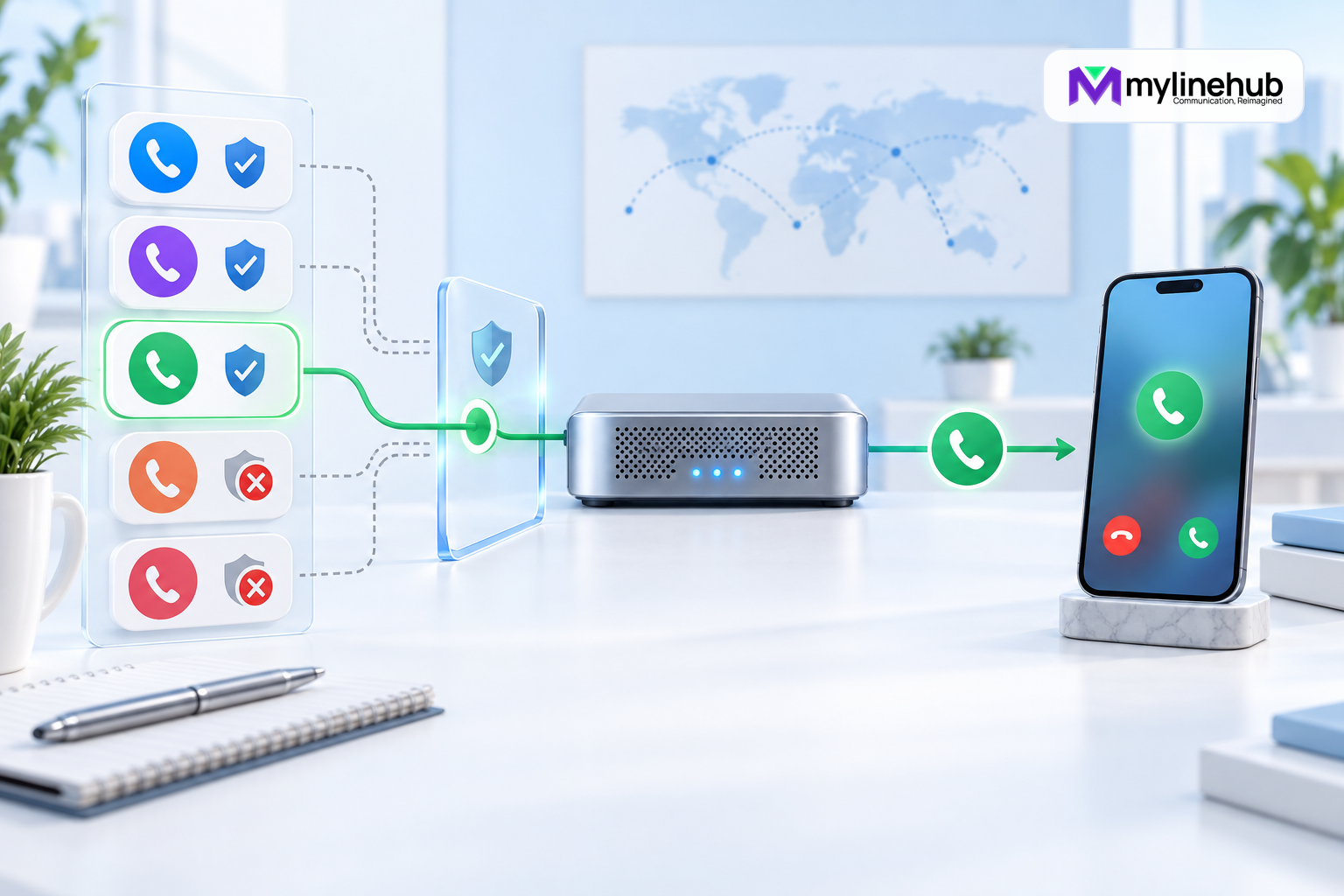
MYLO selects caller IDs for campaign calls from an eligible pool of business numbers that the provider has authorised for the relevant trunk and that the customer has assigned to the campaign context. Selection is deterministic, using a defined rotation such as round-robin rather than allowing an AI model or agent to invent a number for each call. Extension-assigned DIDs and campaign rules can narrow which numbers are eligible. If no authorised DID is available, the campaign should not present an arbitrary number or silently borrow one from another business context. It should wait, fail clearly, or follow the approved policy. The telecom provider ultimately controls which identities it accepts and presents; the customer remains responsible for number rights, lawful identity use, provider agreements, and accurate public representation.
Caller ID Is a Controlled Identity
Caller ID is the number the receiving network and phone may display, subject to provider handling. It is not simply a text label chosen by the dialer. The number should belong to or be lawfully controlled by the customer and be authorised by the outbound provider for the configured service.
Provider authentication identity and presented caller ID can be different concepts. A trunk may authenticate with one account while allowing calls from several approved business DIDs. Configuration must preserve those relationships instead of replacing the authentication username with whichever caller ID the campaign wants to show.
Build the Eligible DID Pool
Start with the provider-confirmed inventory of numbers available on the trunk. For each DID, record its business purpose, provider authorisation, active status, inbound return route, and any region, brand, language, agent, or campaign restrictions. A number should not enter the pool merely because it appears in an old configuration file.
The eligible pool for one campaign may be a subset of the complete inventory. A service reminder campaign may use the published service number, while a regional sales campaign may use approved regional numbers. The campaign owner should review that relationship before execution.
Deterministic Round-Robin Selection
In a round-robin policy, the system chooses the next eligible DID in a stable rotation and continues through the pool. This distributes use predictably and makes the decision explainable. The selection should occur in deterministic campaign services alongside lead claiming and capacity admission, not through an LLM prompt in the live dialling loop.
Rotation does not guarantee equal completed calls because attempts have different outcomes and some DIDs may temporarily be ineligible. The system should preserve evidence of which DID was selected for each attempt. Restart recovery must not create contradictory identities or duplicate calls because a rotation pointer was lost.
Extension-Assigned DIDs
A human agent extension may have one or more approved outbound DIDs. When the campaign connects through that extension, its assignments can narrow the pool so the customer sees an appropriate business identity. Shared DIDs may be valid when the provider and business rules allow them; one DID does not always belong exclusively to one extension.
The assignment should be explicit and validated. If an agent is moved between teams, the caller-ID mapping may need review. Do not infer authority from the last number an extension used or from a display name in an endpoint configuration.
Provider Authorisation Comes First
Providers may require an approved DID range, specific SIP headers, verified ownership, or other controls. They may rewrite, block, or reject a call that presents an unauthorised identity. MYLO can apply supported configuration, but it cannot grant the right to use a number or force remote networks to display it.
Test presentation on real external destinations across relevant networks. A successful SIP response is not proof that the called phone displayed the intended number. Keep provider evidence current and avoid relying on a configuration copied from another carrier.
Return Calls Need a Real Destination
Customers often return a missed campaign call. Every presented DID should have an intentional inbound route, opening-hours behaviour, and owner. Presenting a number that reaches an unrelated menu, fails, or cannot accept calls creates a poor and potentially misleading experience.
The return path may lead to the relevant team, a campaign-specific message, or another approved workflow. Its design is separate from outbound selection but should be reviewed together. If a DID is withdrawn or reassigned, remove it from eligibility before changing the inbound destination.
What Happens When No DID Is Available?
An empty eligible pool is a configuration or availability condition, not permission to improvise. The campaign should avoid claiming new work for a call it cannot lawfully present. It can expose an actionable reason: no authorised DID matches the agent, trunk, brand, or campaign.
Operators can then restore an approved assignment, select another authorised pool through the proper change process, or pause the campaign. Existing active calls should not be disrupted merely to free a caller ID; identity and channel availability are different resources.
Practical Example: Two Regional Sales Teams
A company has north and south sales teams, each with two provider-approved DIDs. The campaign owner assigns the north campaign only to north agents and north numbers. Deterministic rotation alternates between the eligible north DIDs. The south inventory is never selected even though it uses the same trunk.
Before launch, the team calls external test phones and checks displayed identity, answer, audio, recording policy, and the inbound return route for each DID. When one north DID is temporarily withdrawn by the provider, it becomes ineligible; the campaign continues only if the remaining approved number and capacity satisfy policy.
Security, Privacy, and Misrepresentation Risks
Arbitrary caller-ID presentation can enable impersonation and fraud. Access to DID inventories and assignments should be role-controlled and audited. An agent should not be able to type an unrelated number into a campaign simply to improve answer rates.
The customer must ensure that the displayed identity is accurate for the purpose and consistent with applicable rules. Caller ID is not a substitute for required disclosures, consent, or honest agent introductions. Blocking customer return calls while presenting a familiar local number may also conflict with policy or expectations.
Caller-ID Selection Checklist
- Maintain a current provider-confirmed inventory of authorised DIDs.
- Record business purpose, active status, restrictions, and inbound route.
- Assign a reviewed eligible subset to each campaign context.
- Validate extension or team relationships without assuming exclusivity.
- Use deterministic selection such as an explainable round-robin.
- Never invent or borrow an unauthorised number when the pool is empty.
- Preserve the selected DID with each attempt’s evidence.
- Test presentation and return calling through the actual provider.
- Remove withdrawn numbers before reassignment.
- Review lawful identity, access, audit, and misrepresentation controls.
Reliable caller-ID selection begins with authorised inventory and ends with a tested customer experience. Rotation is useful only inside that controlled boundary.
Validate Selection Under Concurrency and Recovery
Test more than one sequential call. With several campaign lanes active, deterministic selection must avoid race conditions, unauthorised cross-team borrowing, and inconsistent rotation after failures. Each admitted attempt should receive one eligible DID, and its evidence should remain stable even if the call is retried or another number becomes unavailable.
After a controlled pause or appliance restart, reconcile active attempts and caller-ID assignments before releasing new work. The system should not reset to a pattern that duplicates an attempt or changes the identity of an already-created call. Exact distribution may vary with availability, but every choice must remain within the approved pool.
Monitor provider rejection and reputation
A provider may reject a DID, rewrite it, or return a reason that requires investigation. Pause or remove the affected identity under controlled policy rather than cycling rapidly through other numbers to bypass a restriction. The business should also consider how honest identification, complaint handling, and consistent return-call service affect customer trust and number reputation.
Change control
Adding, removing, or reassigning a DID is a consequential change. Verify provider authority, inbound return routing, campaign scope, agent relationships, and external presentation before making it eligible. Preserve the old state for recovery and document the accepted result. A DID inventory is business configuration, not a pool of arbitrary strings.
Acceptance Test for the DID Pool
Place controlled calls using every eligible DID and each relevant agent type. Confirm provider acceptance, the identity displayed on external networks, answer and two-way audio, attempt evidence, rotation under concurrent lanes, and the inbound destination reached when the recipient calls back. Exercise the no-eligible-DID case and verify that no arbitrary fallback identity is used.
Document observed results and provider variations without assuming all receiving networks display identity identically. A DID should become campaign-eligible only after its outbound presentation and return path are both accepted for the stated business purpose.
Campaign Caller ID Is Not Extension Caller ID
A campaign rotates deterministically through eligible authoritative DIDs—for example A → B → C → D → A. It is not random and the LLM does not select the next identity. Ordinary extension calling is different: an active extension uses its fixed assigned DID unless an approved configuration changes that assignment.
Continue planning
Continue with Five Ways MYLO Connects Agents and Customers; Why Recording Is Chosen Before a Campaign Starts; How Multiple Agents Increase Campaign Capacity. For deeper implementation context, use MyLineHub technical architecture guidance.
For a requirement outside the prepared MYLO scope, discuss the exact outcome with MyLineHub.
Want to see API-driven CRM + Telecom workflows in action? Try the WhatsApp bot or explore the demos.
Comments (0)
Be the first to comment.