What Does a ₹5,000 MyLineHub Implementation Task Include?
A ₹5,000 MYLINEHUB implementation task should mean one clearly defined outcome with agreed prerequisites, implementation actions, verification evidence and acceptance—not unlimited configuration or an open-ended development engagement for a fixed fee.
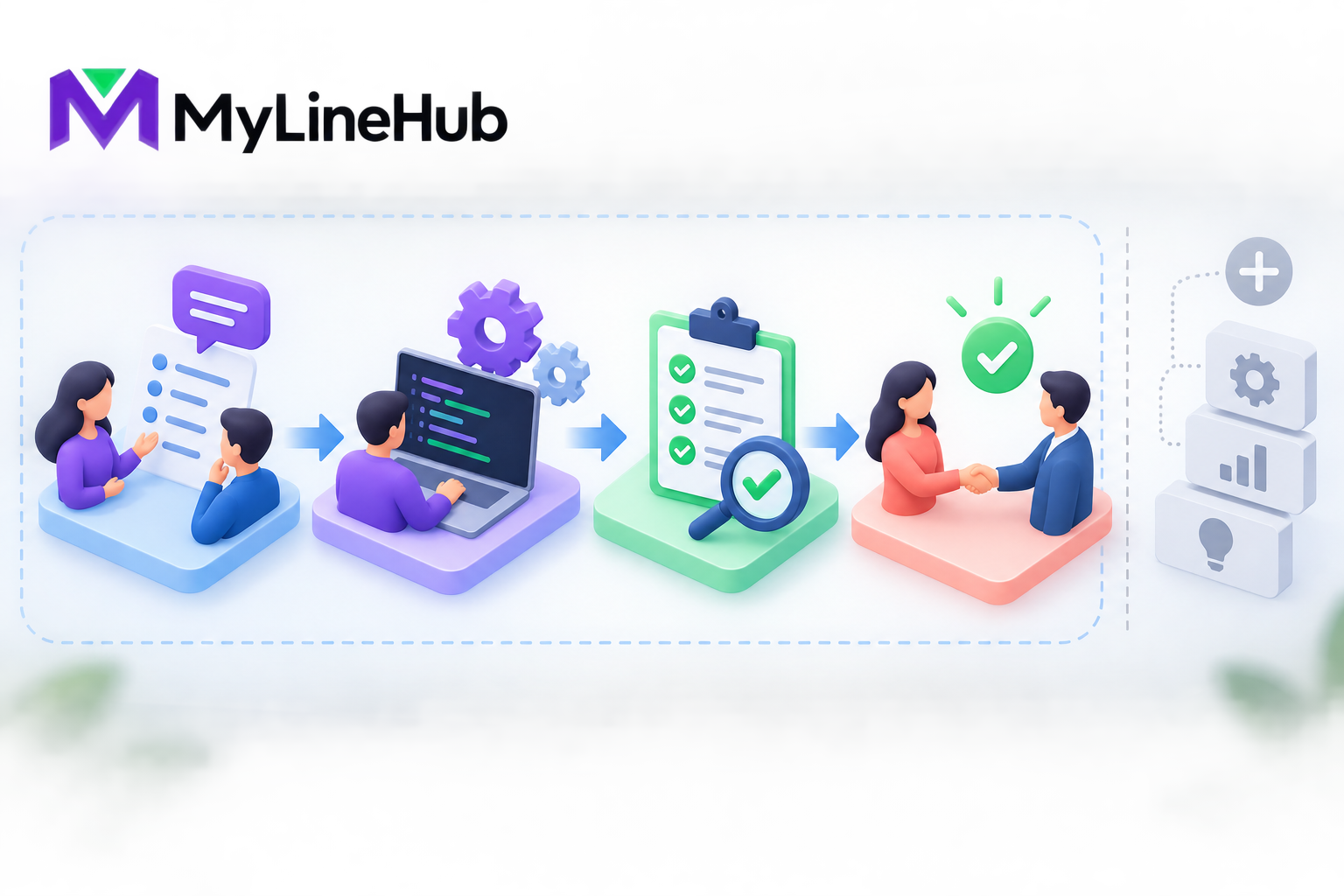
A ₹5,000 MYLINEHUB implementation task should mean one clearly defined outcome with agreed prerequisites, implementation actions, verification evidence and acceptance—not unlimited configuration or an open-ended development engagement for a fixed fee. This article is a framework for explaining that service, not a final commercial promise. Publish it only after MyLineHub confirms the current eligible task types, taxes, payment rules, delivery process, change handling, acceptance window and support boundary. Customers must rely on the current written quotation or live offer, because the topic price alone does not define scope, turnaround time, rescheduling, revisions or continuing support.
What Counts as One Implementation Task?
One task has a specific beginning and an observable end. It should describe the target environment, required inputs, work to be performed, exclusions and evidence that demonstrates completion. “Set up our telephony” is a project, not a task. “Configure and verify one agreed inbound DID route on the stated environment” is closer to a task because its boundary and test are understandable.
The exact examples eligible for the current service must appear in the live offer or quotation. An example in an educational article does not automatically make that work available at the stated price. Provider restrictions, unsupported environments, security risk or missing access can change whether a request is suitable.
Agree on the Outcome Before Work Begins
A short scope statement should answer: what will be changed, where it will be changed, who authorises it, what the customer supplies, how success will be tested, and what remains outside the task. The statement should use business language as well as technical detail so the customer can recognise the intended result.
For example, an outcome might be that calls to one already active business number reach an existing support destination during the agreed test condition. That does not silently include purchasing the number, activating a carrier trunk, creating a multi-level IVR, configuring twenty endpoints, migrating historical data and providing indefinite support. Additional outcomes require their own scope and price.
Prerequisites Belong to the Customer and Provider
Implementation can begin only when the necessary environment exists. The customer must provide authorised access, accurate requirements, a safe change window and a person able to approve decisions. A telecom provider must supply and activate contracted services. MyLineHub cannot invent missing credentials, bypass provider controls or accept third-party terms on the customer's behalf.
- The target MYLO or MyLineHub environment is identified and accessible.
- The customer has authority to request the change.
- Required provider, network or application services are active.
- Relevant documents and values are complete and current.
- Affected users and maintenance constraints are known.
- A representative verification can be performed safely.
- Backup and recovery expectations are agreed where mutation is involved.
Missing prerequisites may pause or prevent completion. The current commercial terms must explain how such a case is handled; customers should not assume unlimited waiting or repeated return visits are included.
Implementation Is More Than Giving Instructions
Unlike a guided session, an implementation task is outcome-oriented and may include authorised work within the agreed environment. A sensible flow is to inspect the relevant state, confirm the plan, validate inputs, obtain approval where required, protect affected resources, apply the bounded change and verify the result.
The exact execution model depends on the task. MYLO uses controlled, deterministic services for consequential operations rather than allowing an AI response to mutate systems directly. The broader open-source MyLineHub platform may require engineering work outside the appliance product. The service description should say which product and environment are covered.
Verification Defines Completion
A configuration saving successfully is weak evidence. Acceptance should be tied to an observable test: a real inbound call reaches the intended destination, an authorised caller ID appears correctly, an endpoint registers and completes two-way audio, or a defined API operation returns the agreed result. The test should match the outcome and be possible within the customer's available services.
Some external conditions cannot be controlled by MyLineHub. If a provider has not activated a route, verification may establish that the local configuration is ready while the end-to-end result remains blocked externally. The scope should say whether diagnosis and evidence constitute the deliverable in that situation or whether another arrangement is required.
Acceptance Should Be Explicit
The customer should review the agreed evidence and either accept the outcome or report a specific mismatch within the current acceptance period. The duration of that period, included correction policy and communication channel must be confirmed in the live terms. This article does not invent them.
Acceptance is not a promise that the environment will never change. Provider modifications, customer edits, operating-system changes, expired certificates, network failures and new requirements can alter later behaviour. Continuing maintenance or support is separate unless explicitly included.
What the Topic Price Does Not Imply
Unless a current written offer states otherwise, ₹5,000 should not be interpreted as including:
- unlimited requirements, calls, revisions or working time;
- a complete PBX, call-centre or multi-site deployment;
- carrier charges, DIDs, channels, number porting or provider activation;
- hardware, phones, headsets, network equipment or electrical work;
- open-ended custom software, CRM, API or WebRTC development;
- bulk data cleaning, campaign operation or content creation;
- 24-hour support, managed service or indefinite warranty; or
- unrelated defects discovered while performing the agreed task.
How Additional Work Is Handled
New requirements should be separated from correction of an agreed outcome. If the customer asks for a new number, another department, a different integration or a redesigned workflow, that is a scope change. The responsible approach is to describe the new outcome, identify dependencies and quote or schedule it separately.
Discovery can also reveal that a request is larger than expected. Work should not silently expand until cost and responsibility become unclear. A bounded implementation model protects both sides: the customer knows what will be delivered, and the implementer can verify that result properly.
Example Task Record
| Field | Example of the required clarity |
|---|---|
| Outcome | One named call route behaves as agreed |
| Environment | Identified customer system and provider service |
| Inputs | Access, current documentation and test destination |
| Implementation | Only the authorised resources needed for the route |
| Verification | Timestamped real-call test and expected destination |
| Exclusions | Provider activation, new IVR and unrelated repairs |
| Acceptance | Current terms to specify review and correction process |
Before Purchasing a Task
Protect production systems during delivery
Identify affected files, services, users and live call paths before approving a change. Where applicable, use the environment's established backup and recovery mechanism, apply only the authorised scope, and preserve evidence of validation. A task fee never grants permission to broaden access or modify unrelated resources. If a safe verification or recovery route is unavailable, that risk should be resolved before implementation proceeds.
Customer actions after acceptance can invalidate the result. Keep the delivered configuration record, avoid undocumented edits and report a later issue with timestamps and the changes made since acceptance. This helps distinguish correction of the agreed task from a new incident or enhancement.
Send the required result, current environment, dependencies and available test method. Ask MyLineHub to confirm that the outcome qualifies as one current implementation task and obtain a written scope containing prerequisites, deliverables, acceptance, exclusions and commercial terms. Do not book on the assumption that the price buys unlimited engineering.
If you need live participation and explanation rather than an implemented outcome, review the framework for a guided telephony session. For planning context, use the MYLO office-readiness checklist and the technical overview of MyLineHub architecture. The ₹5,000 figure remains topic framing until confirmed in the current offer for the exact requested task.
How to Prepare So the Task Produces a Useful Outcome
Before scheduled implementation work, name one authorised business contact and one technical contact. Provide the agreed requirement, current provider details through a protected channel, public-number information, expected users and simultaneous calls, office hours, routing destinations, network ownership, and the exact acceptance scenario. Ensure the SIP service, numbers, Internet, LAN, power, endpoints, and required third-party access are available. Time spent waiting for missing provider activation or undecided call flows reduces what can be completed within a bounded task.
Separate configuration from development. A supported trunk, route, extension, IVR, or deployment activity may fit when its inputs and environment are ready. New product behaviour, deep CRM work, unsupported carrier mechanisms, large data migration, multi-site architecture, or continuing managed support requires separate discovery and scope. The fee is not an unlimited promise to solve every adjacent telecom issue.
Close the task with evidence, not only a screen demonstration. Record what was changed, protected values, external dependencies, unresolved items, and the agreed owner for each follow-up. Run the defined end-to-end test through the real provider and confirm signalling, destination, answer, two-way audio, DTMF where relevant, hang-up, and records. If a third party blocks completion, preserve the evidence and state the next action rather than declaring the entire service production-ready.
Continue planning
Continue with What Is a Telephony Appliance for a Small Business?; What Does a ₹2,000 Guided Telephony Session Include?; Before You Buy MYLO: Office Readiness Checklist. For deeper implementation context, use MyLineHub technical architecture guidance.
Review current MYLO pricing, or discuss this requirement on WhatsApp.
Want to see API-driven CRM + Telecom workflows in action? Try the WhatsApp bot or explore the demos.
Comments (0)
Be the first to comment.