What Does a SIP Trunk Provider Supply?
A SIP trunk provider supplies the external telecom service that connects a business phone system to public calling.
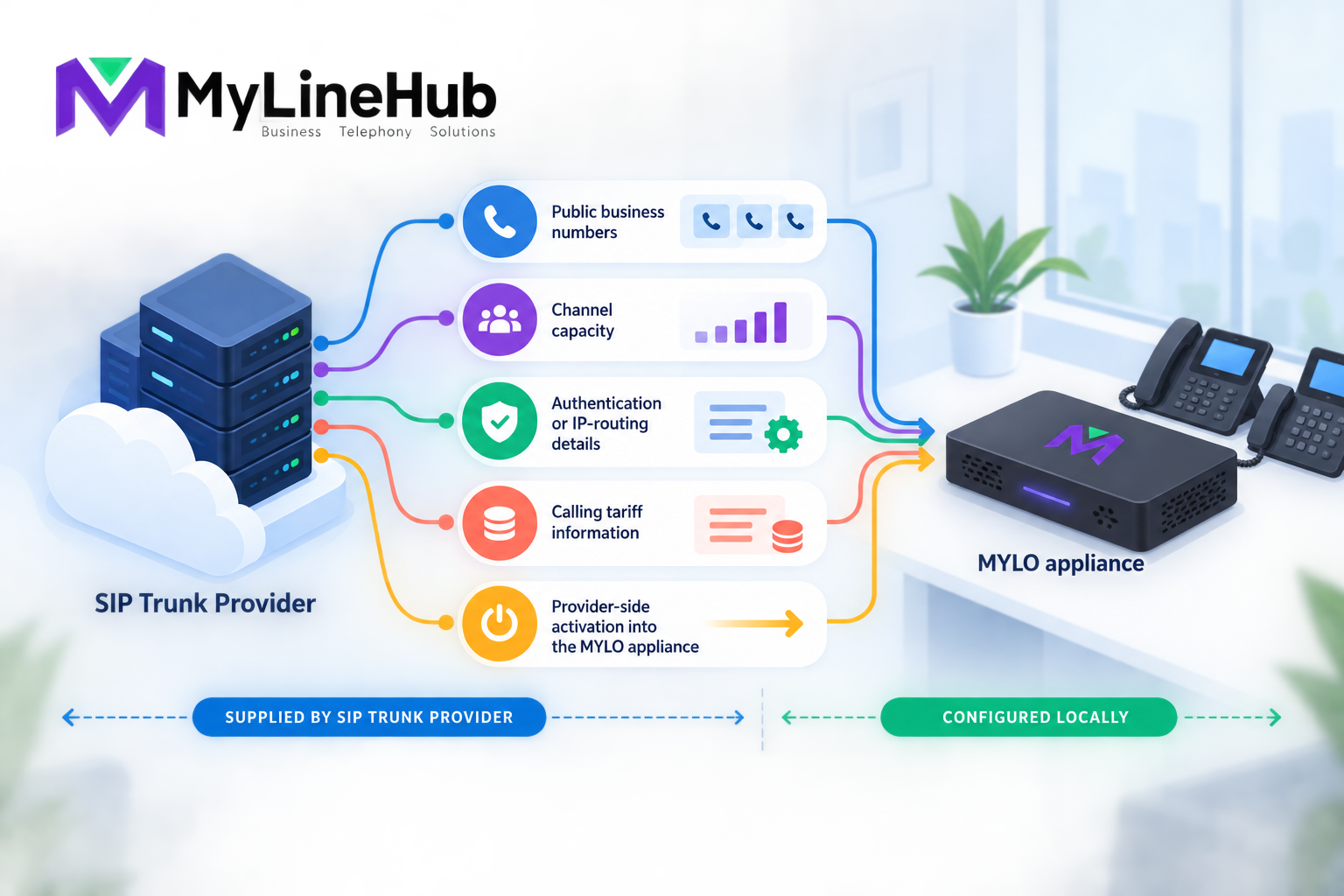
A SIP trunk provider supplies the external telecom service that connects a business phone system to public calling. Depending on the contract, that service can include one or more DIDs, a defined number of channels or call legs, authentication credentials or IP authorisation, signalling and media destinations, number-routing information, authorised outbound caller IDs, calling tariffs, and provider-side activation. MYLO uses those confirmed details to configure supported local telephony behaviour; it does not create carrier numbers, minutes, or public-network capacity by itself. Providers differ, so the customer should obtain a current commercial quotation and technical handover document. Successful provider activation must still be followed by representative inbound, outbound, caller-ID, DTMF, and two-way-audio tests.
DIDs: The Public Numbers Customers Dial
A DID is a public telephone number assigned or made available through the provider. It can represent the business, a department, location, brand, or another approved purpose. One trunk may carry several DIDs, subject to the provider’s service and contract.
The provider should supply the complete authorised number list and explain how each number appears when delivered to the PBX. The format seen by MYLO may differ from the way the number is printed on a website. Accurate representation is important because inbound routing needs to match the number actually received.
If an existing number is being ported, the old and new providers control the porting process under their current rules. MYLO can route a number after the service delivers it, but it cannot declare a port complete on the carrier’s behalf.
Channels: External Calling Capacity
Providers describe capacity using channels, sessions, concurrent calls, or call legs. The exact commercial definition must be confirmed. A channel is not a user, an extension, or a phone number. Twenty employees can share fewer external channels if their calls do not overlap, while a smaller team can require more legs when workflows connect two external parties.
Ask whether inbound and outbound calls share capacity, how transfers are counted, and what happens at the limit. The provider may reject or busy an additional attempt. MYLO cannot create capacity beyond the contracted provider service, even if the appliance itself is otherwise available.
Authentication and Service Access
The provider supplies or defines the method by which it recognises the customer’s trunk. A registration-based service may use an account identifier and protected secret. An IP-authenticated service may authorise one or more source addresses. A private service may arrive through carrier equipment and a dedicated route.
The handover should state registrar, proxy, realm, gateway, transport, registration timing, or other required fields where applicable. Credentials must be entered through MYLO’s protected workflow and should never be pasted into general chat, articles, screenshots, or unsecured worksheets.
Authentication proves that the provider recognises the service. It does not alone prove correct DIDs, outbound caller ID, routing, or audio.
IP, Routing and Media Details
A provider should document the destinations and network conditions needed for SIP signalling and call media. This may include server or gateway addresses, DNS names, source-IP restrictions, media networks, port ranges, supported codecs, and NAT expectations.
Some providers deliver service over the public Internet. Others use a private circuit or equipment installed at the office. In the second design, MYLO’s telecom-side network port may connect to the provider path while the office-side port supports browser management. This is a deployment option, not a topology shared by every carrier.
The office network administrator remains responsible for safe router, firewall, VLAN, and addressing changes. Provider guidance and current live network evidence should be reconciled before applying routes.
Calling Tariffs and Commercial Service
The provider defines rental, number or channel charges, destination tariffs, billing increments, minimum commitments, and any activation or equipment fees. Inbound and outbound charging can differ. International, mobile, landline, or special destinations may have separate rules.
Request a current written tariff and ask how unanswered, busy, short, transferred, or two-leg calls are billed. MYLO displays or records operational outcomes according to its supported behaviour, but the provider’s billing system is authoritative for the carrier invoice.
Carrier charges are distinct from the appliance price, office Internet, user equipment, implementation work, and external AI-provider usage.
Provider-Side Activation
Before calls can work, the provider must activate the ordered trunk, DIDs, capacity, authorised caller IDs, and network access on its systems. A configuration entered into MYLO cannot activate an unprovisioned carrier account.
Agree a test window and an escalation contact. The provider may request timestamps, calling and called numbers, observed responses, source addresses, or call identifiers when investigating a fault. Keep a controlled test record without exposing secrets or unnecessary customer data.
Provider activation should be proven by outcomes, not by a sales confirmation alone. Test a representative inbound number and an authorised outbound identity through the actual path.
What MYLO Configures Locally
Using approved provider facts, MYLO can support local configuration of the trunk relationship, DID inventory, extensions, routes, IVRs, caller-ID use, and other bounded telephony outcomes. Guided assistance can collect missing information and prepare a proposal, while deterministic services validate and apply approved changes.
Asterisk remains the telephony engine and source of live call evidence. MYLO does not replace a provider’s network or rewrite its contract. If the carrier changes an address, credential, number representation, codec, or authorisation, the customer must obtain the updated facts and apply an approved local change.
A Practical Service Handover
A school orders a main number and a separate admissions DID with enough capacity for its expected busy period. The provider supplies registration details, supported codecs, number formats, authorised caller IDs, tariffs, activation status, and a fault contact. Both DIDs arrive over the same trunk.
The MYLO administrator configures the trunk from the protected information, routes the main number to a short menu, and routes Admissions to the responsible team. A real call to each number verifies the delivered DID, route, ringing, and two-way audio. An outbound call verifies that the provider accepts and presents the authorised identity. These tests separate provider delivery from local routing while proving the full customer journey.
Common Boundary Mistakes
- Trunk versus number: a trunk transports calls; a DID identifies a callable public number.
- User versus channel: an employee account does not reserve one external provider channel.
- Caller ID versus capacity: a DID is an identity, not an exclusive busy/free channel lock.
- Registration versus working call: successful authentication does not prove routing and audio.
- MYLO versus carrier: MYLO configures the local system but does not sell or activate every provider’s telecom service.
- AI provider versus SIP provider: these are separate accounts, credentials, services, and invoices.
Provider Handover Checklist
- Complete DID inventory and exact inbound number representation
- Authorised outbound caller IDs and presentation format
- Contracted channel or call-leg capacity and counting rules
- Authentication type and protected credentials where applicable
- Signalling servers, proxies, gateways, transport, and DNS needs
- Media networks, port ranges, codecs, and NAT expectations
- Public or private network delivery and any provider equipment
- Activation state, test numbers, and technical escalation process
- Current rental, activation, calling, number, channel, and support charges
- Porting or change-management process where relevant
Start with the information to collect before ordering a SIP trunk. Continue with who supplies the phone number and calling minutes. For technical background, see the introduction to SIP providers. Contact the carrier for service facts and MyLineHub for MYLO configuration or custom requirements.
Ask for a Complete Provider Handover
A usable trunk handover should identify the commercial account owner, active public numbers, authorised outbound caller IDs, channel capacity, permitted destinations, number presentation, support contacts, and the technical delivery model. Depending on the service, technical information may include registrar or proxy addresses, signalling ports, transport, authentication method, fixed source addresses, codecs, DTMF method, RTP expectations, and failover targets. Exact values must come from the selected provider’s current documentation and protected customer record.
Registration credentials are not the whole trunk. A provider may accept registration while outbound caller ID is not authorised, an inbound number is not routed, or channel capacity is lower than expected. Conversely, IP-authenticated service may not register at all. MYLO should be configured for the service actually ordered rather than for a generic example.
What Remains Outside the Provider’s Scope
The provider normally does not design the customer’s IVR, create office extensions, maintain the MYLO appliance, power desk phones, repair the LAN, decide recording policy, or train agents. The customer owns those decisions and surrounding infrastructure, with MYLO guiding supported product operations. A provider-side success does not prove that the PBX route, endpoint, firewall, or user workflow works.
Name owners for the carrier account, office network, telephony configuration, endpoints, lawful-use policy, and incident response. Keep credentials out of chat and ordinary tickets. When a fault crosses boundaries, collect a precise time, direction, source and destination, provider response, PBX evidence, and media symptom without exposing unnecessary customer data.
Accept the Service With Real Calls
Before business go-live, test every supplied number inbound and each authorised caller ID outbound. Confirm the provider’s number formats, ringing, answer, two-way audio, DTMF, hang-up, busy and no-answer behaviour, simultaneous-channel use, and charging records. Test representative destinations and failure cases. Record the result and unresolved dependencies.
Maintain a provider inventory with account, numbers, capacity, caller IDs, billing owner, escalation route, and last successful test. MYLO can manage supported configuration and evidence, but it cannot activate a carrier account, mint a public number, create calling balance, or override the provider’s public-network policy.
A Sanitized Provider-Handover Example
Pilot number: [PROVIDER_PILOT_NUMBER]
DID range: [BUSINESS_DID_RANGE]
SIP domain: [PROVIDER_DOMAIN]
Gateway IP: [PROVIDER_GATEWAY_IP]
Customer IP: [CUSTOMER_TELEPHONY_IP]
SBC/Proxy: [PROVIDER_SBC_IP]
Media network: [PROVIDER_MEDIA_RANGE]
Codec: [PROVIDER_CODEC]
Channels: [CHANNEL_COUNT]
Provider formats differ, but these field meanings let MYLO identify what is present and what is missing without exposing a real customer name, password, account, telephone number or IP address. A completed handover should also identify VLAN or routing requirements, provider support contacts, and connectivity-test evidence where supplied.
Continue planning
Continue with What Is a Telephony Appliance for a Small Business?; What Information Should You Collect Before Ordering a SIP Trunk?; Who Supplies Your Phone Number and Calling Minutes?. For deeper implementation context, use MyLineHub technical architecture guidance.
Review current MYLO pricing, or discuss this requirement on WhatsApp.
Want to see API-driven CRM + Telecom workflows in action? Try the WhatsApp bot or explore the demos.
Comments (0)
Be the first to comment.